
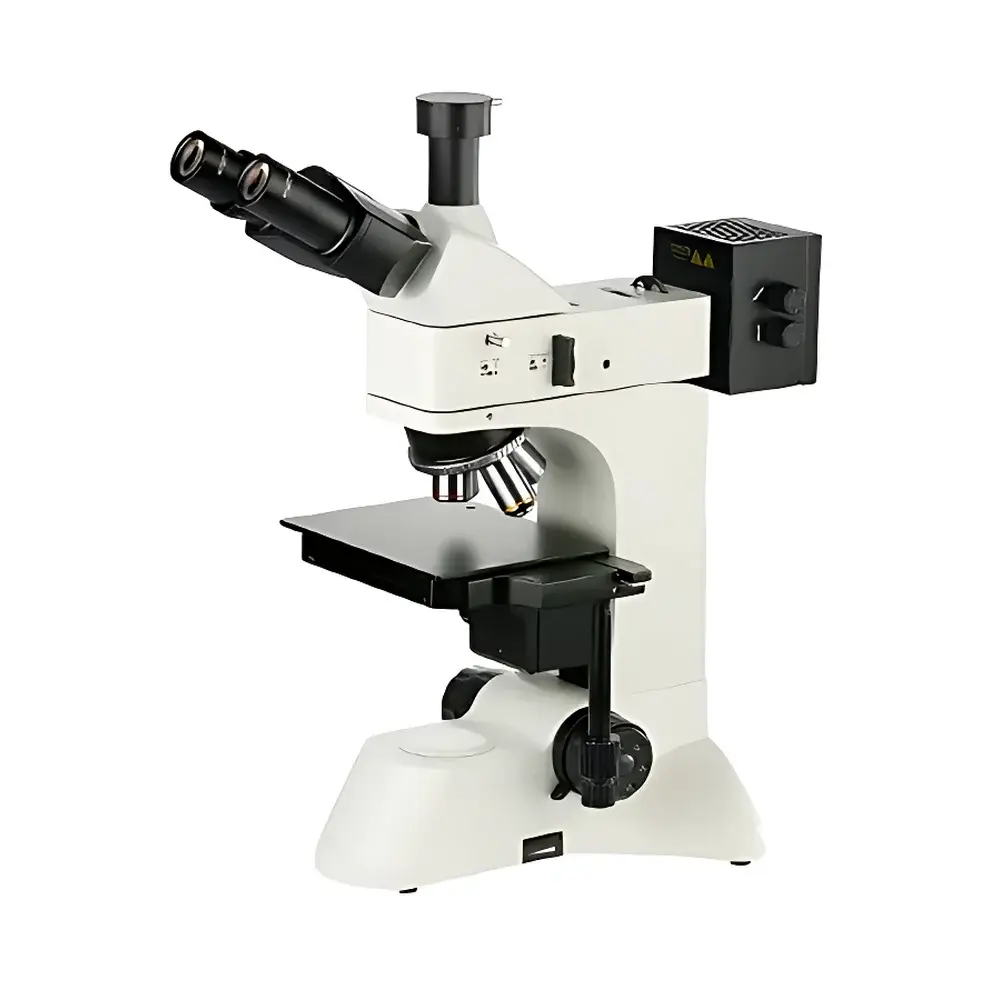
MST Upright Metallurgical Microscope
| Origin | Guangdong, China |
|---|---|
| Manufacturer Type | Distributor |
| Origin Category | Domestic (China) |
| Model | MST |
| Price | USD 2,100 (FOB) |
Overview
The MST Upright Metallurgical Microscope is an engineered optical instrument designed for high-fidelity reflected-light observation of opaque, polished, or etched specimens—primarily metals, alloys, ceramics, composites, and electronic materials. Unlike transmitted-light microscopes, it employs episcopic illumination (Köhler illumination geometry) to deliver uniform, glare-free incident light across the specimen surface. Its infinity-corrected optical pathway ensures chromatic and spherical aberration correction across the full field of view, supporting modular expansion and long-term calibration stability. The system conforms to ISO 8578:2020 (Metallographic Microscopy — Terminology and Performance Criteria) and supports routine compliance with ASTM E3, ASTM E407, and ISO 643 standards for microstructural evaluation in metallurgical laboratories and quality control environments.
Key Features
- Infinity-corrected optical design with modular functional architecture—enabling seamless integration of polarization, differential interference contrast (DIC), and digital imaging modules.
- Long-working-distance plan achromat objectives (PL L5X–60X) optimized for thick samples and cover-slip-free observation; working distances range from 3.18 mm (60X) to 26.1 mm (5X), minimizing risk of objective–specimen contact during focusing.
- Wide-field eyepieces (WF10X, 22 mm field number) providing ergonomic viewing at 30° inclined trinocular head; built-in analyzer permits rapid switching between brightfield, polarized light, and conoscopic observation modes.
- Coaxial coarse/fine focusing mechanism with adjustable tension control, mechanical stop limit, and 2 µm fine-focus graduation—ensuring repeatable Z-axis positioning essential for serial sectioning and focus-stacking workflows.
- Episcopic illumination system featuring a 6 V / 30 W halogen lamp housed in a flip-top lamphouse for safe, tool-free bulb replacement; integrated field and aperture diaphragms plus four-position filter turret (yellow, blue, green, ground glass) for contrast optimization and spectral filtering.
- Reversible polarizer (0–360° rotation) with calibrated scale, enabling quantitative birefringence assessment in anisotropic materials such as titanium alloys, quartz, or polymer laminates.
Sample Compatibility & Compliance
The MST microscope accommodates standard metallographic specimens up to 30 mm in height and 75 × 50 mm in XY travel range on its dual-layer mechanical stage. It supports both polished bulk samples and mounted cross-sections (e.g., epoxy-embedded, hot-pressed, or vacuum-infiltrated). All optical components comply with RoHS Directive 2011/65/EU and CE marking requirements for laboratory equipment. When equipped with optional DIC or polarization accessories, the system meets GLP-aligned documentation needs per ISO/IEC 17025:2017 for accredited testing laboratories. Routine maintenance intervals and calibration protocols align with manufacturer-recommended service cycles for sustained metrological traceability.
Software & Data Management
While the base configuration operates independently of proprietary software, the trinocular port (100% light path allocation in photo mode) enables compatibility with third-party imaging platforms—including open-source tools (e.g., ImageJ/Fiji with Micro-Manager plugin) and commercial packages (Olympus cellSens, Zeiss ZEN, or Media Cybernetics Image-Pro Premier). Optional USB/Video CCD cameras (DV-1 to DV-3 series) provide real-time preview, time-lapse capture, and measurement annotation with pixel calibration support. All digital outputs retain EXIF metadata (magnification, objective ID, exposure settings), facilitating audit-ready image archives compliant with FDA 21 CFR Part 11 when paired with validated software environments.
Applications
- Quantitative grain size analysis (ASTM E112, ISO 643) and phase fraction determination in ferrous/non-ferrous alloys.
- Failure analysis of fracture surfaces, inclusion mapping, and heat-affected zone (HAZ) characterization in welded joints.
- Quality assurance of sintered powders, additive-manufactured parts, and semiconductor packaging substrates.
- Teaching core microscopy principles—including polarization optics, depth-of-field limitations, and resolution constraints governed by Abbe’s diffraction limit—in university materials science curricula.
- Process validation for electroplating, thermal spray coating, and diffusion bonding where interfacial integrity must be verified at ≤1 µm feature resolution.
FAQ
Is the MST microscope compatible with digital camera systems from major OEMs?
Yes—standard C-mount adapters (0.4X, 0.5X, 1X magnification options) enable direct coupling with industrial CMOS/CCD sensors. Canon EOS and Nikon F-mount DSLR adapters are available as optional accessories.
Does the system support Köhler illumination alignment?
Yes—the built-in field and aperture diaphragms, combined with the infinity-corrected tube lens, permit precise Köhler setup per ISO 9345-2:2019 guidelines.
Can the microscope be upgraded for differential interference contrast (DIC)?
Yes—via optional Nomarski-style prism sets and strain-free objectives (PL L20X/0.40 and above), subject to objective thread compatibility (RMS standard).




