
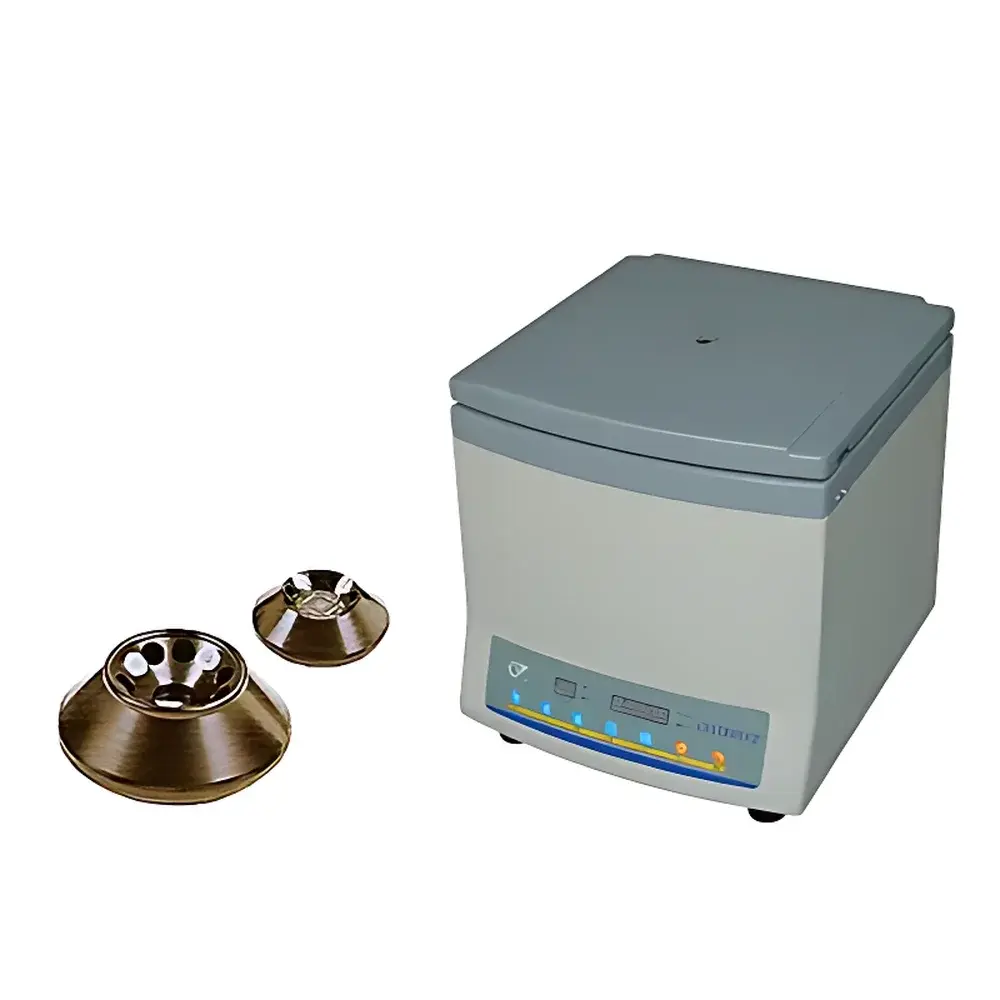
TGL-16G High-Speed Benchtop Centrifuge
| Origin | Beijing, China |
|---|---|
| Manufacturer Type | Authorized Distributor |
| Regional Origin | Domestic (China) |
| Model | TGL-16G |
| Price | USD 495 (FOB Beijing) |
Overview
The TGL-16G High-Speed Benchtop Centrifuge is an engineered solution for routine and demanding laboratory separation tasks requiring precise control of rotational speed, temperature stability, and reproducible g-force delivery. Based on the principle of sedimentation under centrifugal acceleration, this instrument separates heterogeneous mixtures—such as cell suspensions, plasma/serum fractions, nucleic acid precipitates, or particulate contaminants—by exploiting differences in particle density, size, and shape. Designed for benchtop operation in QC labs, clinical diagnostics, molecular biology workflows, and academic research environments, the TGL-16G delivers a maximum rotational speed of 16,000 rpm and generates up to 17,000 × g, enabling rapid pelleting of subcellular components including mitochondria, microsomes, and viral particles. Its compact footprint, robust aluminum-alloy rotor chamber, and integrated safety interlocks comply with IEC 61010-2-020 (Safety Requirements for Laboratory Centrifuges), ensuring operational integrity during extended runs.
Key Features
- Brushless DC motor with variable-frequency drive for smooth acceleration/deceleration and extended service life
- Digital microprocessor control with real-time RPM/RFC display and programmable run time (1 sec–99 min 59 sec)
- Automatic rotor recognition and imbalance detection with immediate deceleration and audible alarm
- Reinforced angular rotors compatible with standard microcentrifuge tubes (0.2–15 mL), including adapters for 0.5 mL and 1.5 mL formats
- Temperature-controlled variants available (TGL-16G-A) featuring imported compressor-based cooling system (–20°C to +40°C operating range)
- Double-door safety lock mechanism with mechanical and electronic interlocks meeting EN 61010-1 compliance
- Low-noise design (<65 dB(A) at 16,000 rpm) suitable for shared lab spaces without dedicated acoustic enclosures
Sample Compatibility & Compliance
The TGL-16G supports a broad range of sample containers through interchangeable angular rotors: 12 × 1.5 mL tubes (max. 16,000 rpm / 15,455 × g), 24 × 1.5 mL tubes (12,000 rpm / 9,820 × g), 12 × 10 mL tubes (10,000 rpm / 8,944 × g), and 80-well microplate carriers (6,000 rpm / 4,025 × g). All rotors are certified to ISO 15189-relevant mechanical stress standards and undergo full dynamic balancing per ISO 21500. The system meets essential requirements for GLP-compliant laboratories, supporting audit-ready documentation when paired with optional RS-232/USB data export modules. While not FDA 21 CFR Part 11–certified out-of-the-box, its firmware architecture permits integration into validated workflows via third-party electronic lab notebook (ELN) systems.
Software & Data Management
The TGL-16G operates via embedded firmware with no external PC dependency. All protocols—including speed, time, acceleration profile, and braking mode (soft/hard)—are stored in non-volatile memory (up to 10 user-defined programs). Optional USB interface enables export of run logs (timestamp, setpoint, actual RPM, final g-force, rotor ID, error codes) in CSV format for traceability. When deployed in regulated environments, laboratories may configure the device within broader quality management systems (QMS) using configurable audit trail templates aligned with ISO/IEC 17025 clause 7.7. Firmware updates are delivered via secure manufacturer-signed binaries; version history is retained in device memory for regulatory review.
Applications
- Routine preparation of clarified lysates and supernatants in protein biochemistry
- Isolation of genomic DNA, plasmid DNA, and RNA from bacterial, mammalian, and plant tissues
- Separation of PBMCs (peripheral blood mononuclear cells) using density gradient media (e.g., Ficoll-Paque)
- Concentration of viruses, exosomes, and extracellular vesicles from cell culture supernatants
- Pre-analytical processing in clinical microbiology labs (e.g., serum separation prior to ELISA or PCR)
- Quality control testing of colloidal suspensions, nanoparticle dispersions, and emulsions
- Supporting ASTM D4052 (density of liquids) and USP (dissolution testing) sample prep protocols
FAQ
What is the maximum relative centrifugal force (RCF) achievable with the TGL-16G?
The TGL-16G achieves up to 17,000 × g using the standard 12-position angular rotor with 1.5 mL tubes at 16,000 rpm.
Does the TGL-16G include refrigeration?
The base model (TGL-16G) is air-cooled and non-refrigerated. The TGL-16G-A variant incorporates a compressor-based cooling system with setpoint control from –20°C to +40°C.
Can this centrifuge be used for clinical diagnostic sample preparation under CLIA or CAP guidelines?
Yes—when operated with documented maintenance records, calibrated tachometer verification, and validated rotor usage logs, the TGL-16G supports CLIA-waived and CAP-accredited preanalytical workflows.
Are rotor certifications and material test reports available upon request?
Yes. Each rotor carries a unique serial number and is supplied with a Certificate of Conformance (CoC) detailing tensile strength, fatigue cycle validation, and ISO 15189-aligned mechanical certification.
What safety standards does the TGL-16G meet?
It complies with IEC 61010-2-020, EN 61010-1, and GB/T 13810–2017 (Chinese national standard for centrifuge safety), including lid-lock integrity testing and emergency stop response validation.



