
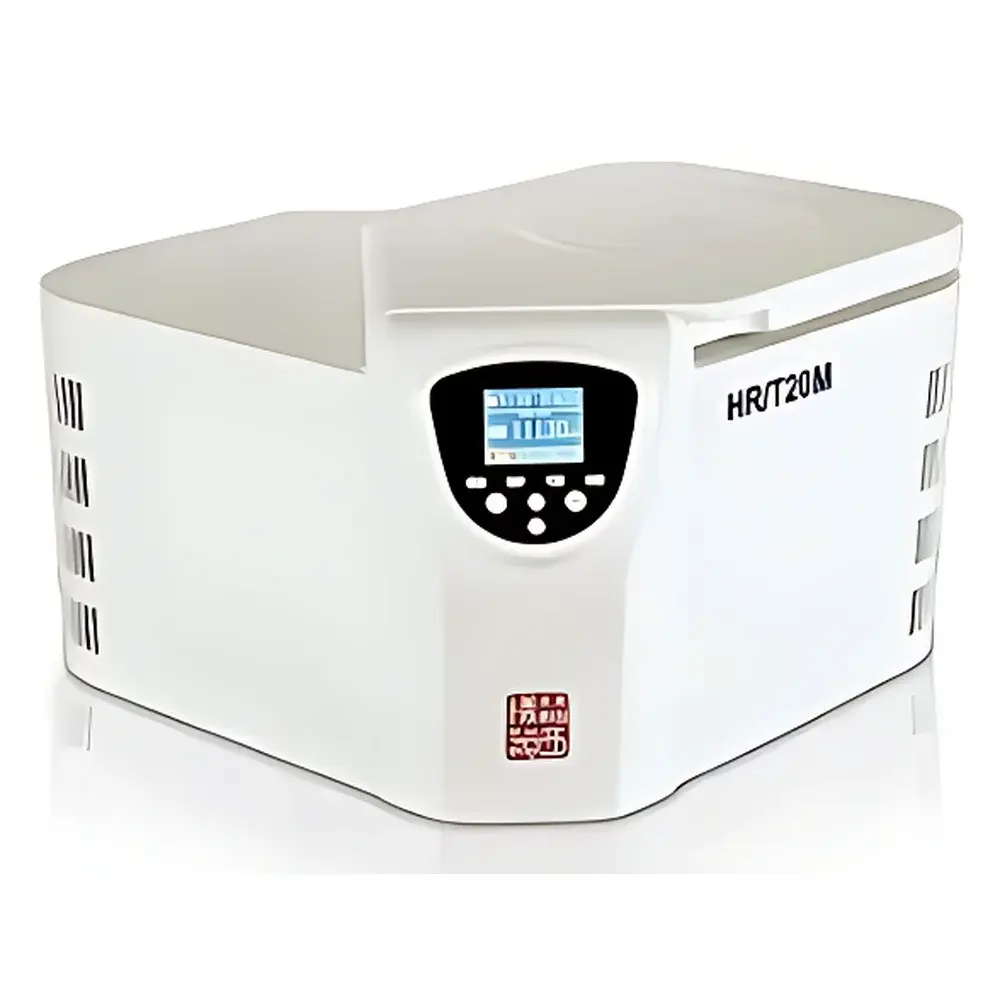
3H12RI High-Speed Refrigerated Centrifuge
| Origin | Hunan, China |
|---|---|
| Manufacturer Type | Authorized Distributor |
| Model | 3H12RI |
| Max. Speed | 12,000 rpm |
| Max. RCF | 12,300 × g |
| Max. Capacity | 4 × 100 mL |
| Dimensions (L×W×H) | 710 × 630 × 350 mm |
| Temperature Range | −20 °C to +40 °C |
| Temp. Accuracy | ±1 °C |
| Acceleration/Deceleration | 10 selectable rates |
| Noise Level | ≤65 dB(A) |
| Power Supply | 220 V, 50 Hz |
| Total Power | 1.5 kW |
| Weight | 75 kg |
| Refrigerant | R404a (non-CFC) |
| Rotor Options | Titanium 4×1.5/2.0 mL, 12×1.5/2.0 mL, 4×100 mL horizontal, and others |
Overview
The 3H12RI High-Speed Refrigerated Centrifuge is an engineered solution for precise, reproducible separation of biological and biochemical samples under controlled thermal conditions. Designed around the principles of sedimentation velocity centrifugation, it applies high gravitational forces—up to 12,300 × g—to accelerate phase separation based on particle density, size, and shape. Its refrigerated operation maintains sample integrity during prolonged or heat-sensitive protocols, making it suitable for applications requiring strict temperature control, such as nucleic acid isolation, organelle purification, viral pellet recovery, and plasma fractionation. The system complies with core mechanical safety standards relevant to laboratory centrifuges (IEC 61010-2-020) and incorporates design elements aligned with Good Laboratory Practice (GLP) workflows—including audit-ready parameter logging, programmable run profiles, and hardware-level safety interlocks.
Key Features
- High-torque brushless frequency-controlled motor ensures stable rotational performance across speed ranges, with minimal thermal drift and extended service life.
- Microchip dsPIC30F-series microcontroller provides real-time closed-loop speed regulation and fault diagnostics; FAIRCHILD FSBB30CH motor driver modules guarantee robust power delivery and electromagnetic compatibility.
- Triple-layer steel rotor chamber housing and reinforced stainless-steel centrifuge cavity meet structural integrity requirements for high-RCF operation and provide physical containment in case of rotor failure.
- TFT full-color capacitive touchscreen interface displays both setpoints and real-time operational parameters—including speed (rpm), RCF, time remaining, temperature, and acceleration/deceleration status—with intuitive icon-based navigation.
- Comprehensive safety architecture includes automatic imbalance detection, overspeed cutoff, overtemperature shutdown, lid-lock monitoring, and standby cooling (pre-chill function active while rotor is stationary).
- 100 programmable protocols support customizable ramp rates (10 acceleration/deceleration levels), hold times, temperature setpoints, and rotor-specific calibration offsets—enabling method standardization across user groups and shifts.
- Electromechanical door lock operates silently and reliably, integrating position sensing and torque verification to prevent accidental opening during operation.
Sample Compatibility & Compliance
The 3H12RI accommodates a broad range of tube formats via interchangeable rotors—including conical-bottom polypropylene tubes (1.5–100 mL), PCR strips, microplates (2×24-well enzyme-linked immunosorbent assay format), and specialized carriers for density gradient media. Its maximum capacity of 4 × 100 mL enables batch processing of clinical or bioprocessing volumes without compromising thermal uniformity. All rotors are certified for sterilization by autoclaving (121 °C, 20 min) and validated for repeated use under ISO 13485-aligned manufacturing practices. The instrument’s temperature control system—featuring imported R404a refrigeration compressors and proportional-integral-derivative (PID)-regulated valve actuation—maintains chamber stability within ±1 °C across the full operating range (−20 °C to +40 °C), satisfying requirements for cold-chain-sensitive assays referenced in USP , CLSI EP25-A, and ISO/IEC 17025-accredited laboratories.
Software & Data Management
While the 3H12RI operates autonomously via its embedded control system, all run metadata—including date/time stamp, rotor ID, speed profile, temperature log, and alarm events—is stored internally with non-volatile memory retention (>10,000 cycle endurance). Optional RS-232 or USB interfaces enable export of CSV-formatted session reports for integration into LIMS or electronic lab notebook (ELN) platforms. Firmware supports configurable audit trail settings compliant with FDA 21 CFR Part 11 requirements when paired with validated external software—ensuring traceability of operator actions, parameter changes, and system interventions. No cloud connectivity or proprietary software installation is required for basic operation, preserving data sovereignty and minimizing IT infrastructure dependencies.
Applications
This centrifuge serves critical roles in quality control laboratories performing routine hematology and serology analyses, biopharmaceutical process development labs conducting cell culture harvest and clarification, academic research facilities engaged in subcellular fractionation, and food safety testing centers executing pathogen enrichment steps. Typical use cases include: pelleting bacterial cells (e.g., E. coli, Bacillus spp.) at ≥10,000 × g for genomic DNA extraction; clarifying clarified lysates prior to chromatographic purification; separating exosomes from conditioned media using differential ultracentrifugation protocols; preparing platelet-poor plasma for coagulation assays; and concentrating viral vectors in gene therapy manufacturing environments. Its ability to maintain sub-zero temperatures during high-speed runs supports cryo-stable protein complex preservation and minimizes enzymatic degradation during sample preparation.
FAQ
What is the maximum relative centrifugal force (RCF) achievable with the 3H12RI?
The 3H12RI achieves a maximum RCF of 12,300 × g when operated at its rated speed of 12,000 rpm with the 4×100 mL horizontal rotor.
Is rotor calibration required before first use?
Yes—each rotor must be registered in the system with its unique identification code and calibrated for mass distribution offset. Factory-supplied calibration files are preloaded; field recalibration is supported via built-in balancing routines.
Can the centrifuge operate without refrigeration?
Yes—the cooling system can be disabled via software setting, allowing ambient-temperature operation for heat-stable samples or energy conservation during validation runs.
Are rotor lifetime logs tracked by the instrument?
The control system records cumulative runtime hours per rotor ID and flags usage beyond manufacturer-recommended service intervals (typically 1,000–5,000 cycles depending on material and load), supporting preventive maintenance planning.
Does the device comply with electromagnetic compatibility (EMC) directives?
Yes—it meets EN 61326-1:2013 for laboratory equipment and carries CE marking indicating conformity with EU EMC and Low Voltage Directives.



