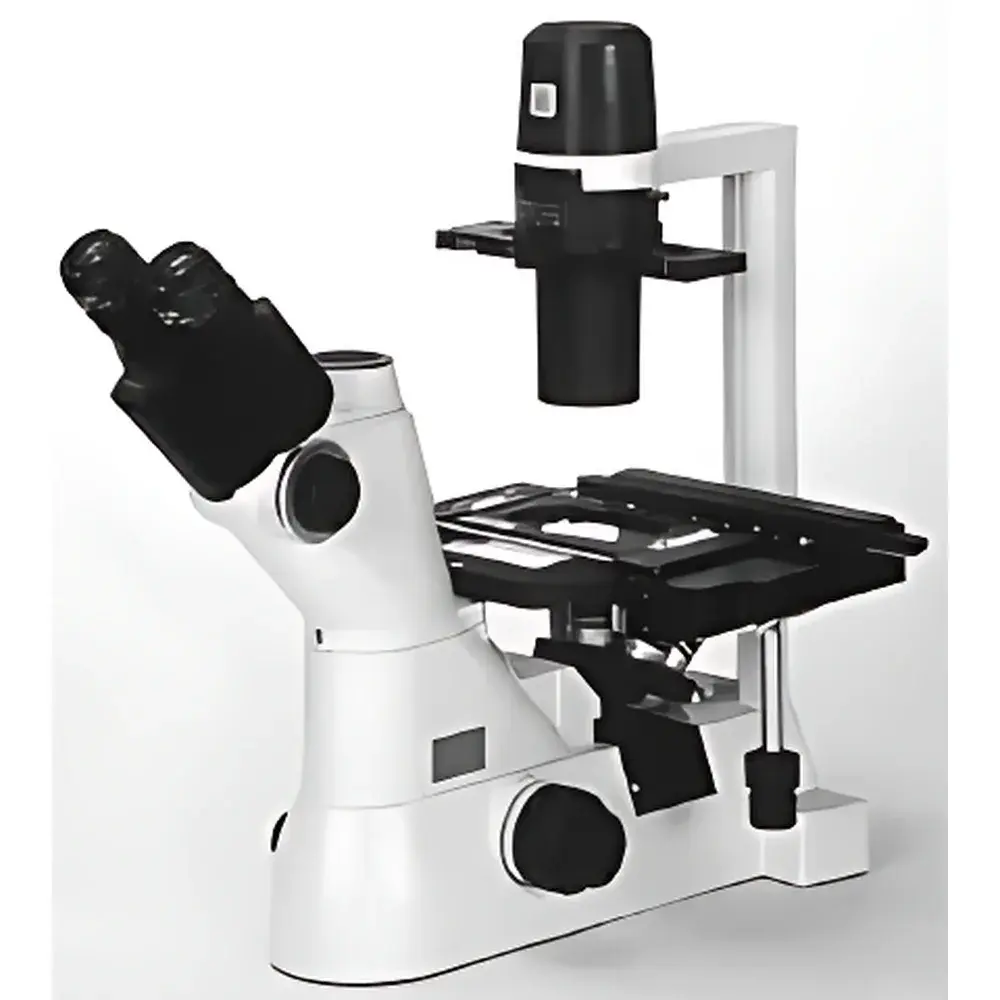
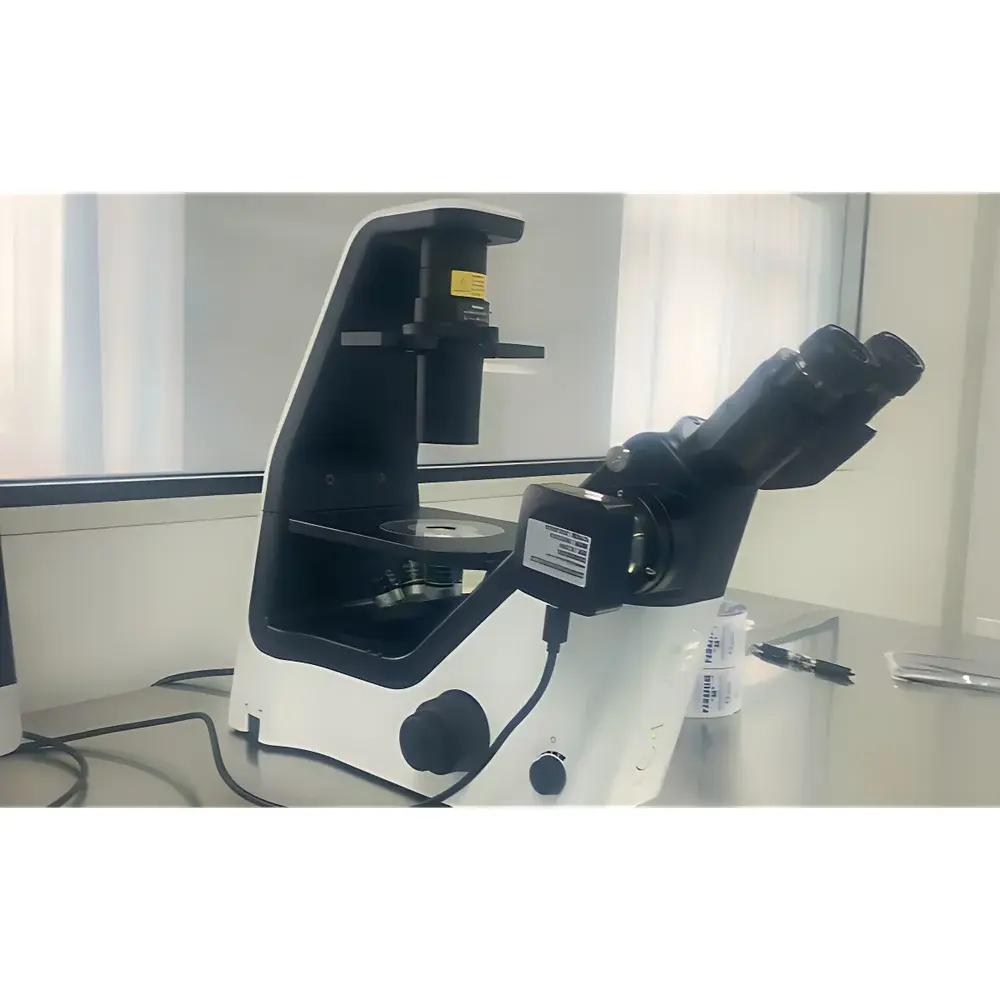
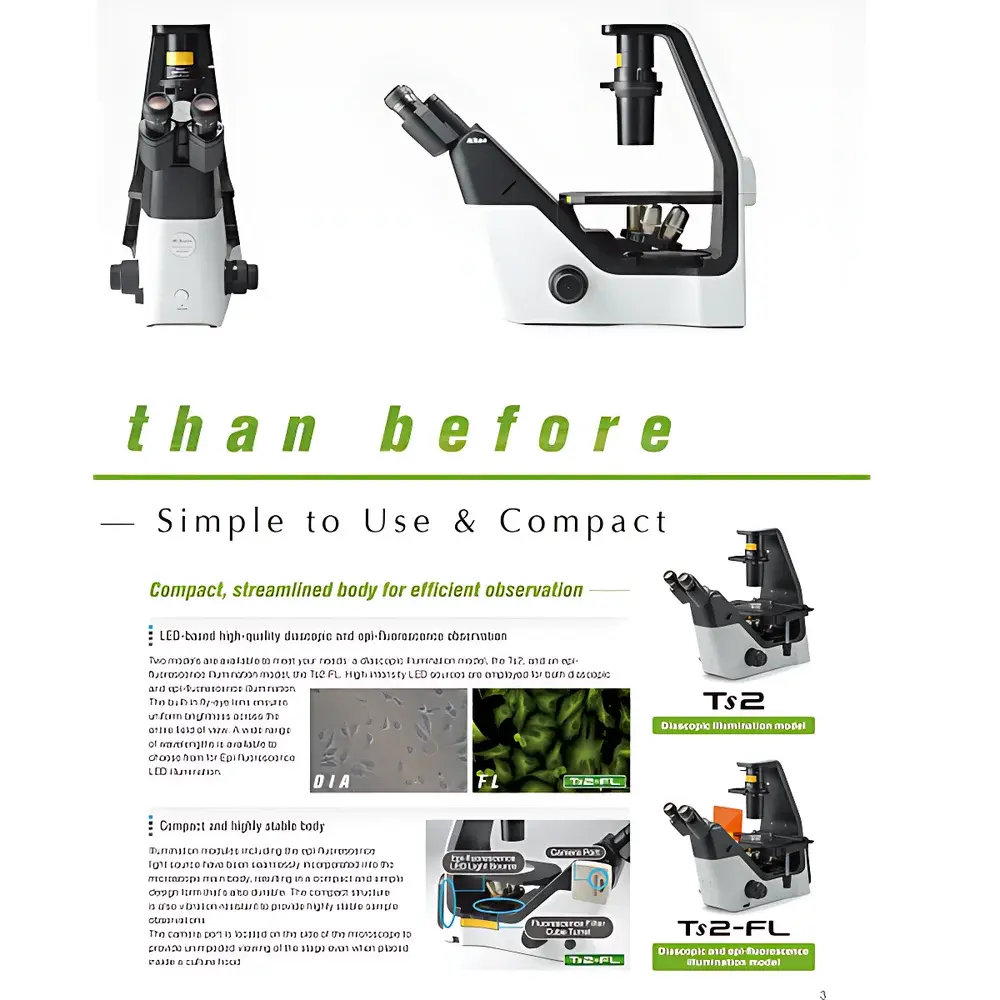
Nikon TS2 Inverted Biological Microscope
| Brand | Nikon |
|---|---|
| Origin | Germany |
| Model | TS2 |
| Microscope Type | Inverted Microscope |
| Eyepiece Configuration | Trinocular |
| Optical System | CFI60 Infinity-Corrected |
| Focusing Mechanism | Coaxial Coarse/Fine Adjustment |
| Working Distance | Up to 75 mm (with LWD condenser) |
| Condenser Options | Long Working Distance (NA 0.3, WD 75 mm) and Hoffman Modulation Contrast (NA 0.4, WD 44 mm) |
| Fluorescence Capability | Optional Epi-Fluorescence Attachment (up to two filter cubes, 50 W mercury lamp) |
| Camera Port | Standard C-mount compatible port for Nikon digital cameras and third-party imaging systems |
| Ergonomic Design | 45° inclined trinocular head, 400 mm eye-point height, adjustable interpupillary distance (50–75 mm) |
| Stage Height | 195 mm above bench surface |
| Stage Clearance | 190 mm between stage and condenser |
| Phase Contrast | Equipped with Nikon ADL (Apodized Diffraction-Limited) Phase Contrast Objectives |
| Compliance | Designed for GLP-compliant documentation workflows |
Overview
The Nikon TS2 Inverted Biological Microscope is an engineered evolution of the widely adopted TS100 platform—designed specifically for routine cell culture monitoring, live-cell observation, and basic in vitro life science applications. Built upon Nikon’s proven CFI60 optical architecture (60 mm parfocal distance, infinity-corrected), the TS2 delivers high-fidelity image formation with long working distance objectives and optimized numerical aperture performance. Its inverted configuration positions the objective lenses beneath the specimen stage—enabling unobstructed access to culture vessels such as Petri dishes, multi-well plates, and T-flasks while maintaining stable focus during extended time-lapse experiments. The system employs a robust mechanical design featuring vibration-damping chassis construction, coaxial focusing controls, and precision-machined optical pathways—all calibrated to ensure reproducible alignment and minimal drift under standard laboratory conditions.
Key Features
- CFI60 Infinity-Optical Platform: Ensures consistent magnification fidelity across all objective magnifications and enables seamless integration with advanced contrast modalities including phase contrast, Hoffman modulation contrast (HMC), and epi-fluorescence.
- ADL Apodized Phase Contrast Objectives: Nikon’s proprietary apodization technology eliminates halo artifacts common in conventional phase contrast imaging, delivering enhanced edge definition and broader tonal gradation—particularly critical for unstained, low-contrast biological specimens such as primary neurons or stem cell colonies.
- Ergonomic Trinocular Head: 45° inclined viewing angle with 400 mm eye-point height accommodates both seated and standing operators; interpupillary adjustment range (50–75 mm) ensures comfortable binocular observation across diverse user anthropometrics.
- High-Clearance Mechanical Stage: 195 mm stage height and 190 mm clearance between stage and condenser permit direct imaging of large-volume culture containers without disassembly or repositioning.
- Modular Illumination Architecture: Integrated 6 V / 30 W halogen Köhler illumination with dual-filter holder, heat-absorbing glass, and diffuser slide; optional 50 W mercury arc lamp housing for fluorescence excitation with standardized filter cube compatibility (over 35 Nikon-certified cubes available).
- Digital Imaging Readiness: C-mount camera port supports direct coupling to Nikon DS-Fi3, DS-Ri2, or third-party scientific CMOS/CCD sensors; compatible with NIS-Elements acquisition software for timestamped image capture, Z-stack generation, and metadata-embedded archiving.
Sample Compatibility & Compliance
The TS2 is routinely deployed in academic core facilities, biotech QC labs, and pharmaceutical process development environments where regulatory traceability and procedural consistency are essential. Its optical stability and repeatable mechanical calibration support adherence to ISO/IEC 17025 requirements for measurement uncertainty management. When paired with NIS-Elements AR or BR editions, the system meets audit-ready criteria for GLP and GMP documentation—including electronic signatures, instrument usage logs, and version-controlled acquisition protocols compliant with FDA 21 CFR Part 11 Annex 11 guidelines. Specimen compatibility spans adherent mammalian cell lines (HEK293, HeLa, CHO), suspension cultures (Jurkat, THP-1), embryoid bodies, organoids, and primary explants housed in standard tissue cultureware (e.g., Corning Costar, Falcon).
Software & Data Management
While the TS2 operates as a standalone optical instrument, its imaging interface is fully interoperable with Nikon’s NIS-Elements suite—a modular platform supporting quantitative morphometric analysis, multi-channel fluorescence registration, and automated cell counting workflows. Acquisition parameters (exposure time, gain, gamma, ROI selection) are stored in EXIF-compliant metadata headers, enabling retrospective validation of imaging conditions. For laboratories requiring full audit trails, optional NIS-Elements AR (Advanced Research) licenses provide role-based access control, electronic lab notebook (ELN) synchronization, and encrypted database logging—satisfying internal SOPs and external inspection standards such as MHRA, EMA, and USP .
Applications
- Real-time monitoring of cell proliferation, confluence, and morphology in monolayer and 3D culture systems
- Plaque assay quantification in virology and bacteriology workflows
- Hematological differential counts using standardized blood smear preparations
- Microinjection and patch-clamp electrophysiology support when integrated with Narishige or Sutter micromanipulators
- Time-lapse imaging of embryonic development, wound healing assays, and drug-induced cytotoxicity screening
- Fluorescent protein expression tracking (eGFP, mCherry, tdTomato) under routine culture conditions
FAQ
Is the TS2 compatible with motorized stages or autofocus systems?
The TS2 does not include built-in motorization; however, it accepts third-party motorized XY stages (e.g., Prior ProScan III) and hardware autofocus modules via TTL trigger interfaces when used with NIS-Elements-controlled imaging setups.
Can the TS2 be upgraded to support DIC (Differential Interference Contrast)?
No—DIC is not supported on the TS2 platform due to optical path constraints in the inverted light path design; HMC and phase contrast remain the primary contrast enhancement methods.
What is the maximum flask size that can be imaged without removing the lid?
Standard T-175 flasks (175 cm² surface area) fit within the 190 mm stage-to-condenser clearance; lids must be partially vented or removed to prevent condensation-induced optical distortion during prolonged observation.
Does Nikon provide service calibration certificates for ISO 17025 traceability?
Yes—Nikon Metrology Services offers factory-certified optical alignment verification with documented uncertainty budgets aligned to ISO/IEC 17025:2017 requirements upon request.
Are replacement parts such as condensers or filter cubes covered under warranty?
Mechanical and optical components carry a 24-month limited warranty from date of installation; consumables (bulbs, filters) and user-replaceable accessories are excluded per Nikon’s global service policy.