
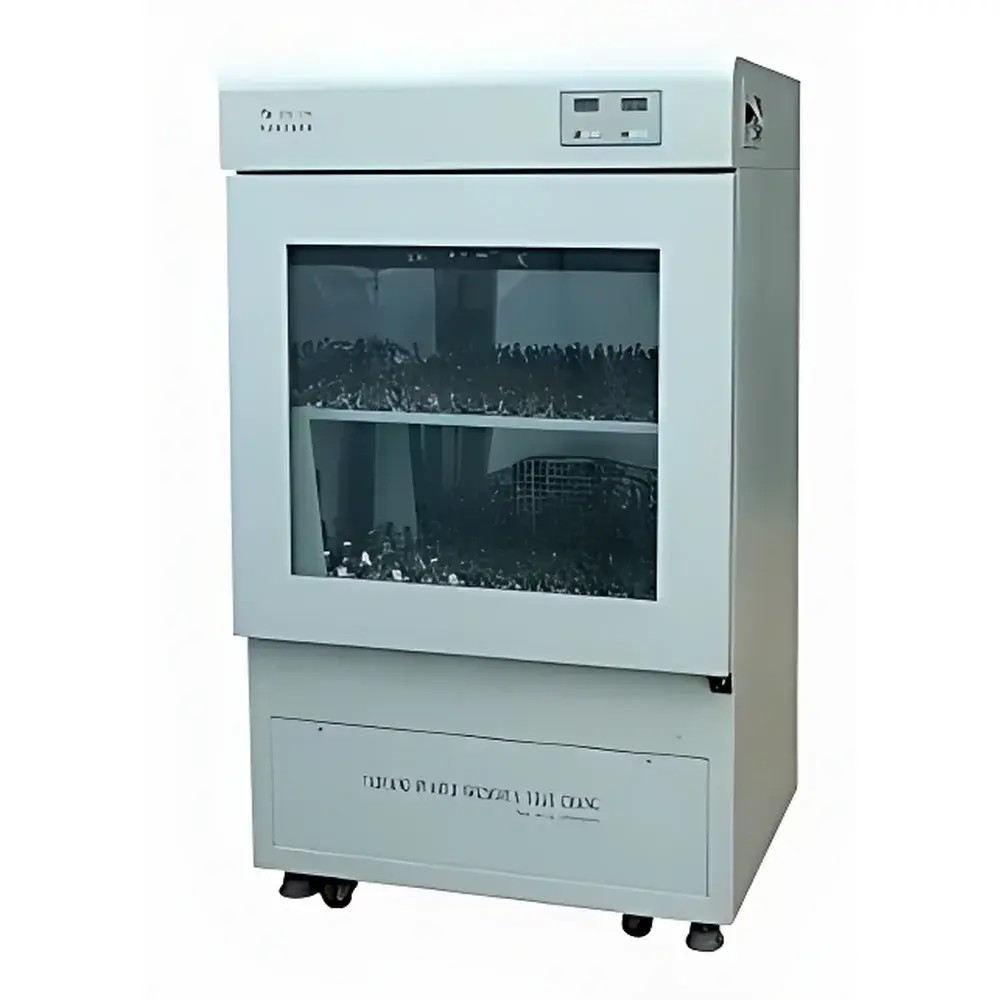
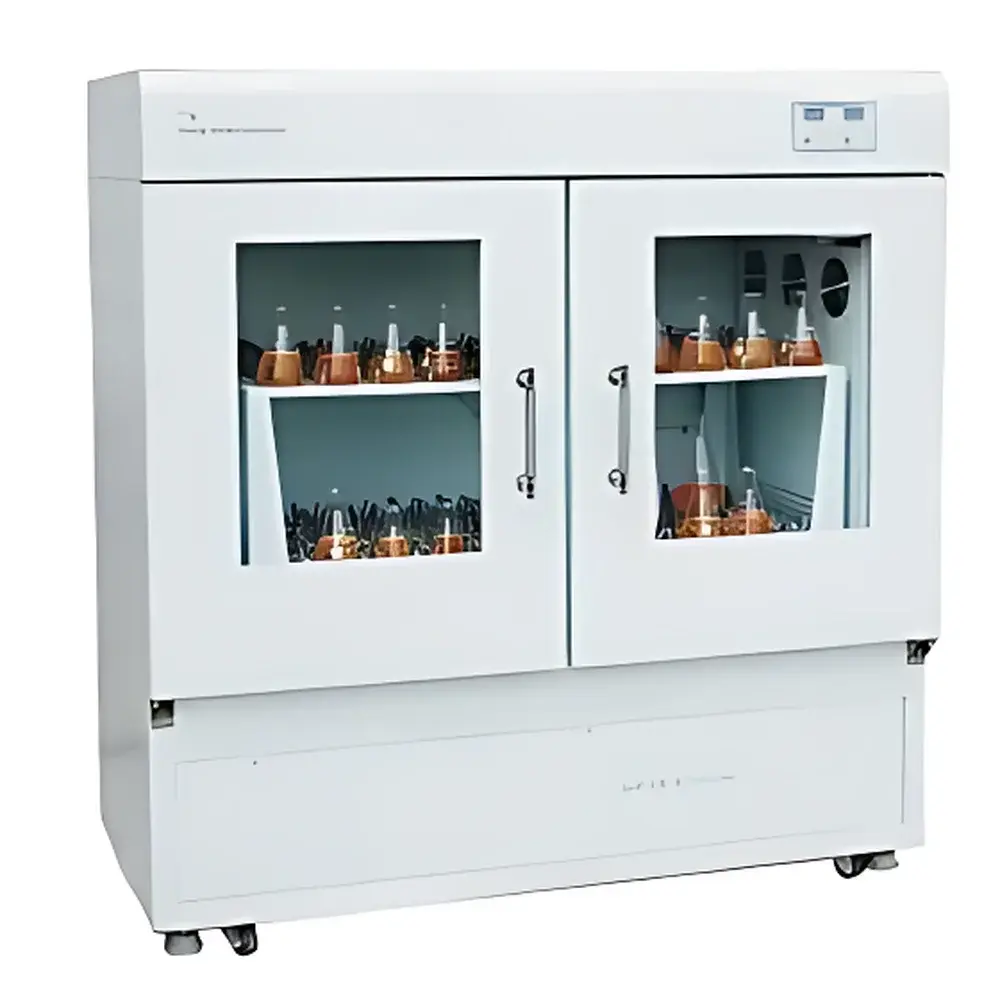
Taicang HYG-A Full-Temperature Orbital Shaker Cabinet
| Origin | Jiangsu, China |
|---|---|
| Manufacturer Type | Distributor |
| Product Category | Domestic |
| Model | HYG-A |
| Price | USD 3,500 (approx.) |
| Instrument Type | Air-Bath Constant-Temperature Orbital Shaker |
| Timer Range | 0–999 min |
| Oscillation Frequency | 40–280 rpm |
| Orbit Diameter | 26 mm |
| Temperature Range | 5°C to 60°C (at ambient 25°C) |
| Temperature Accuracy | ±0.1°C |
| Temperature Uniformity | ±0.5°C |
| Shelf Count | 2-tier |
| Tray Dimensions | 710 × 450 mm |
| Capacity per Shelf | 15 × 1000 mL or 24 × 500 mL or 35 × 250 mL Erlenmeyer flasks |
| Display | LED digital |
| Input Power | 1200 W |
| Overall Dimensions (W×D×H) | 900 × 750 × 1530 mm |
| Net Weight | 180 kg |
| Power Supply | 220 V, 50 Hz |
| Interior Lighting | 20 W |
Overview
The Taicang HYG-A Full-Temperature Orbital Shaker Cabinet is a vertically oriented, dual-shelf laboratory shaker engineered for precise, reproducible cultivation of microbial, mammalian, and insect cell cultures under tightly controlled thermal and mechanical conditions. It operates on the principle of orbital shaking—generating a consistent circular motion with a fixed 26 mm orbit diameter—to ensure homogeneous suspension of cells and nutrients while minimizing shear stress. Unlike water-bath or refrigerated shakers, the HYG-A employs an air-bath heating and cooling system, enabling rapid temperature equilibration across the entire chamber without condensation risk or media dilution. Its operational range of 5°C to 60°C (at 25°C ambient) supports both mesophilic fermentation and low-temperature induction protocols, making it suitable for applications ranging from recombinant protein expression to antibiotic susceptibility testing. The cabinet’s robust steel frame, double-layer insulated enclosure, and PID-controlled thermoregulation architecture deliver high thermal stability—±0.1°C accuracy and ±0.5°C uniformity across both shelves—meeting foundational requirements for GLP-compliant microbiological process development.
Key Features
- Dual independent stainless-steel shelves (710 × 450 mm each), each supporting up to 15 × 1000 mL Erlenmeyer flasks or equivalent volumetric configurations
- Adjustable orbital speed from 40 to 280 rpm with digital feedback control and real-time rpm display
- Microprocessor-based PID temperature controller with LED interface, supporting ramp-hold programming and auto-recovery after power interruption
- Integrated 20 W interior LED lighting for visual monitoring without thermal load interference
- Over-temperature and over-speed safety cutoffs, plus motor overload protection and door-open alarm
- Low-noise brushless DC motor drive ensuring long-term operational reliability and minimal vibration transmission to adjacent equipment
Sample Compatibility & Compliance
The HYG-A accommodates standard culture vessels—including glass and PETG Erlenmeyer flasks (250 mL, 500 mL, 1000 mL), baffled flasks, and custom spring-loaded mesh trays—without requiring vessel-specific clamps. Its chamber geometry and airflow design prevent hot/cold spots, satisfying ISO 13408-2 (aseptic processing) thermal uniformity expectations for non-sterile benchtop bioreactor support. While not certified for GMP manufacturing environments, the unit complies with IEC 61010-1:2010 safety standards for laboratory electrical equipment and meets electromagnetic compatibility (EMC) Class B requirements per CISPR 11. Its timer function (0–999 min) supports unattended overnight runs compatible with ASTM E2500-13 guidance for equipment qualification in pharmaceutical R&D settings.
Software & Data Management
The HYG-A operates via an embedded microcontroller with local LED interface only—no external PC connectivity or proprietary software suite. All parameters (temperature setpoint, rpm, timer duration) are entered and monitored directly on the front panel. For laboratories requiring audit trails or electronic records, third-party data loggers (e.g., Omega OM-DAQPRO-5300 or Testo 177-T4) may be integrated via analog 0–5 V or 4–20 mA output signals (available upon request with optional I/O module). The absence of network interfaces ensures compliance with FDA 21 CFR Part 11 when used in standalone mode, eliminating validation overhead associated with connected instruments.
Applications
- Batch cultivation of Escherichia coli, Bacillus subtilis, and Pichia pastoris under defined temperature and agitation profiles
- Seed train expansion for upstream bioprocess development in 250–1000 mL scale
- Enzyme activity assays requiring simultaneous thermal and kinetic control
- Mycological growth studies (e.g., Aspergillus, Penicillium) across extended incubation periods
- Media optimization experiments involving oxygen transfer rate (OTR) correlation with orbital speed and temperature
- Quality control testing of antimicrobial agents using broth microdilution methods (CLSI M07-A10)
FAQ
Is the HYG-A suitable for sterile applications?
The cabinet is not ISO Class 5 certified nor equipped with HEPA filtration; it is intended for non-sterile, enclosed-vessel cultivation only. Sterility must be maintained externally via laminar flow hoods or isolators.
Can the two shelves operate at different temperatures or speeds?
No—the HYG-A maintains uniform temperature and identical oscillation parameters across both shelves. For independent dual-zone control, consider the HYG-C series.
What is the minimum operating temperature at 30°C ambient?
The specified 5°C lower limit assumes 25°C ambient. At 30°C ambient, minimum achievable temperature is approximately 8–10°C due to heat exchange limitations.
Does the unit include calibration documentation?
Factory calibration certificates for temperature and speed sensors are available upon request (NIST-traceable, ±0.2°C and ±2 rpm uncertainty).
Is the HYG-A compatible with 110 V / 60 Hz power systems?
Standard configuration is 220 V / 50 Hz. A custom 110 V / 60 Hz version can be supplied with modified transformer and motor winding—lead time +4 weeks.




