
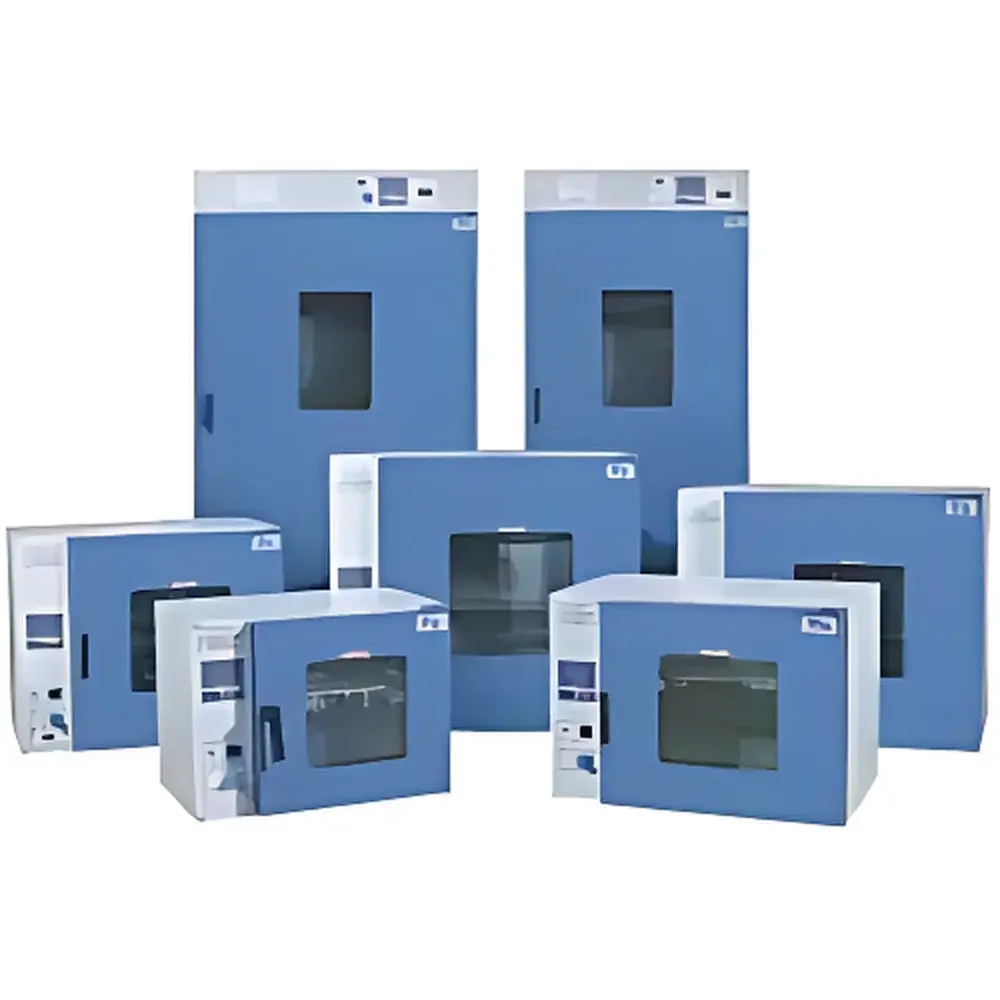
Jiayuanxing DHG-9076A Forced-Air Drying Oven
| Origin | Shanghai, China |
|---|---|
| Manufacturer Type | Authorized Distributor |
| Country of Origin | China |
| Model | DHG-9076A |
| Power Supply | 220 V / 50 Hz |
| Temperature Range | RT +10 °C to 250 °C |
| Temperature Uniformity | ±1 °C |
| Temperature Resolution | 0.1 °C |
| Chamber Volume | 76 L |
| Internal Dimensions (W×D×H) | 450 × 400 × 450 mm |
| External Dimensions (W×D×H) | 740 × 618 × 630 mm |
| Standard Shelving | 3 adjustable stainless steel trays |
| Timer Range | 1–9999 minutes |
| Operating Ambient Temperature | +5 to +40 °C |
| Input Power | 2050 W |
Overview
The Jiayuanxing DHG-9076A Forced-Air Drying Oven is a precision-engineered laboratory drying system designed for consistent thermal processing of samples across research, quality control, and production environments. Utilizing horizontal forced-air convection with a rear-mounted centrifugal blower and optimized baffle configuration, the oven ensures uniform heat distribution throughout the chamber—critical for applications requiring reproducible moisture removal, preheating, sterilization validation, or thermal stability testing. Its microprocessor-based PID temperature controller delivers stable setpoint maintenance within ±1 °C across the full operating range (RT +10 °C to 250 °C), with 0.1 °C resolution for fine-grained process control. Constructed with double-wall insulation and a high-grade cold-rolled steel exterior with powder-coated finish, the DHG-9076A balances thermal efficiency, mechanical durability, and operator safety in accordance with IEC 61010-1 safety standards for laboratory equipment.
Key Features
- Forced-air circulation system with adjustable airflow velocity and directional baffles to minimize thermal gradients
- PID-controlled digital temperature regulator with real-time display, auto-tuning capability, and over-temperature cut-off protection
- Three-layer insulated chamber featuring mineral wool insulation and seamless stainless-steel interior (SUS304) for corrosion resistance and easy decontamination
- Three standard adjustable stainless-steel shelves (load capacity: 15 kg per shelf), compatible with optional reinforced trays for heavy-duty use
- Programmable timer (1–9999 minutes) supporting single-stage or multi-step drying protocols with audible end-of-cycle alert
- Front-access door with dual-seal silicone gasket and magnetic latch to maintain chamber integrity during operation
- Compliance-ready design: meets general requirements of ISO 17025 for calibration traceability and supports GLP documentation workflows
Sample Compatibility & Compliance
The DHG-9076A accommodates a broad spectrum of sample types—including glassware, metal parts, polymer specimens, pharmaceutical excipients, soil aggregates, and biological substrates—without risk of cross-contamination or thermal degradation when operated within specified parameters. Its uniform temperature profile (validated per ASTM E2207 “Standard Practice for Calibration of Ovens and Furnaces”) ensures compliance with routine drying procedures outlined in USP , ISO 787-2, and GB/T 29249–2012. While not certified for Class I Division 1 hazardous locations, the unit incorporates fail-safe circuitry (including independent mechanical over-temperature limiter) and conforms to CE marking requirements under the Low Voltage Directive (2014/35/EU) and EMC Directive (2014/30/EU). For regulated environments, optional data logging modules enable audit-ready temperature records aligned with FDA 21 CFR Part 11 requirements when paired with validated software.
Software & Data Management
The DHG-9076A operates as a standalone instrument with embedded firmware; no external PC is required for basic operation. Optional RS-485 serial interface (Modbus RTU protocol) enables integration into centralized lab management systems for remote monitoring, parameter synchronization, and event logging. When used with third-party SCADA or LIMS platforms, temperature setpoints, runtime status, alarm events, and cycle completion signals can be captured and archived. For laboratories requiring electronic record retention, an optional USB data logger (sold separately) provides timestamped CSV output of chamber temperature at user-defined intervals (1–60 sec), supporting internal QA reviews and regulatory audits under ISO/IEC 17025 Clause 7.7.
Applications
- Moisture content determination per AOAC 950.46 and ASTM D2231 for food, feed, and agricultural commodities
- Drying of filter papers, crucibles, and volumetric glassware prior to gravimetric analysis
- Curing of coatings, adhesives, and composite laminates in materials science labs
- Stabilization of reference standards and hygroscopic reagents in analytical chemistry workflows
- Pre-conditioning of test specimens for tensile, impact, and hardness testing per ISO 291 and ASTM D618
- Residual solvent removal from synthesized organic compounds in pharmaceutical R&D
FAQ
What is the maximum recommended load volume for optimal temperature uniformity?
For consistent performance across the chamber, total sample volume should not exceed 60% of internal capacity (≤45.6 L). Overloading may impair airflow and increase temperature deviation beyond ±1 °C.
Can the DHG-9076A be used for sterilization of instruments?
No. This model is not validated for microbiological sterilization (e.g., dry-heat sterilization per ISO 17665). It is intended for drying, baking, and thermal conditioning only.
Is calibration documentation included with shipment?
A factory calibration certificate (traceable to NIM, China) is provided, covering temperature accuracy at three points (100 °C, 150 °C, 200 °C). On-site IQ/OQ validation support is available upon request.
Does the oven support ramp-soak programming?
The base model does not include multi-segment programming. For time-temperature profiling, the DHG-9076A-PRO variant (with optional programmable controller) is recommended.
What maintenance is required to sustain long-term accuracy?
Quarterly verification of temperature uniformity using calibrated thermocouples and annual recalibration of the main sensor are advised. Air intake filters should be cleaned every 3 months in dusty environments.



