
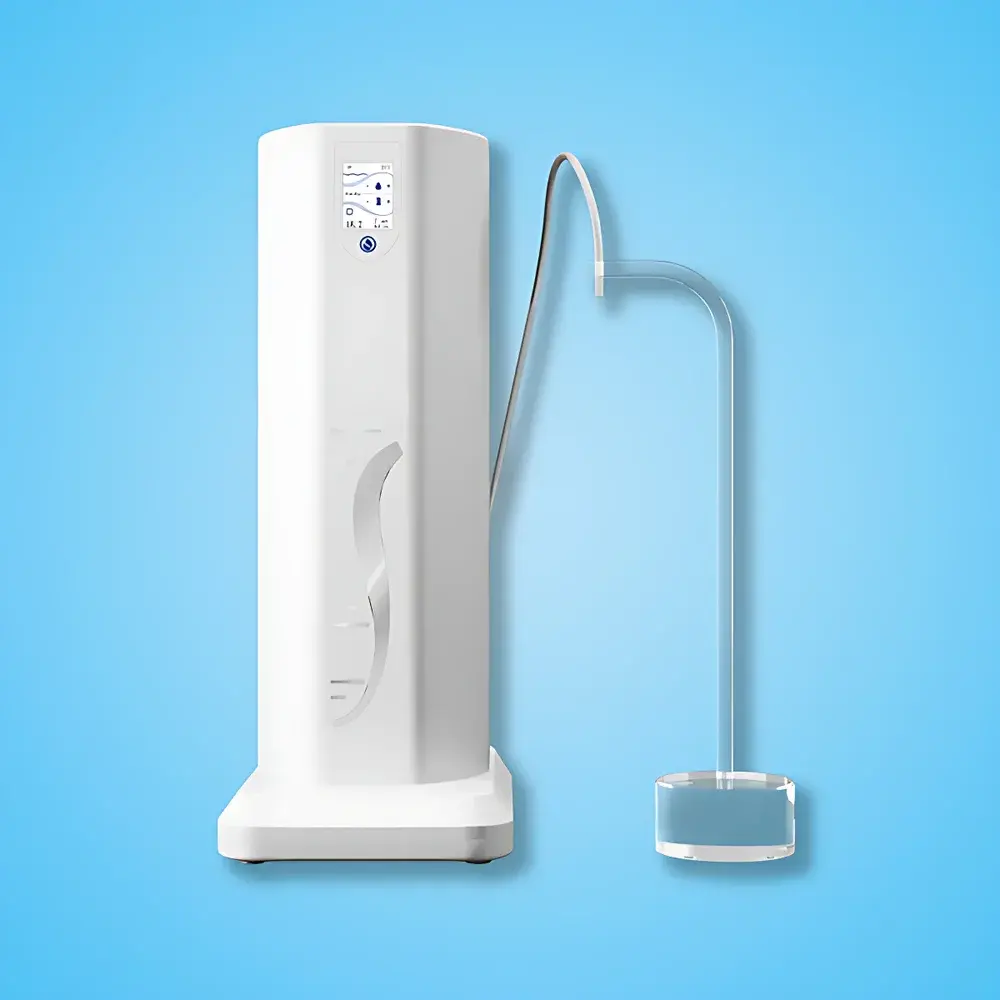
RephiLe Genie De-ion Trace Analysis Grade Point-of-Use Ultra-Pure Water Polishing Terminal
| Brand | RephiLe |
|---|---|
| Origin | Shanghai, China |
| Manufacturer Type | Direct Manufacturer |
| Regional Classification | Domestic (China) |
| Model | Genie De-ion |
| Price Range | USD 4,200 – 7,000 (FOB) |
| Purified Water Grade | Type I (ASTM D1193-20) |
| Resistivity | 18.2 MΩ·cm @ 25 °C |
| Heavy Metals & Soluble Silica | < 1 ppt |
| Total Organic Carbon (TOC) | < 5 ppb |
| Microbial Count / Endotoxin | < 0.001 EU/mL |
| Particulates (>0.1 µm) | Zero detectable particles ≥ 0.1 µm |
| Flow Rate | 0–1.5 L/min |
| Dimensions (W×D×H) | 21 × 29 × 53 cm |
| Weight | 8 kg |
Overview
The RephiLe Genie De-ion is a dedicated point-of-use (POU) ultra-pure water polishing terminal engineered for trace and ultra-trace elemental analysis applications requiring the highest level of ionic purity. It functions exclusively as a final-stage purification module—integrated downstream of RephiLe’s Genie G or Genie PURIST intelligent ultrapure water systems—to deliver Type I reagent water (per ASTM D1193-20 and ISO 3696:1987 Class 1) with sub-ppt ionic contamination levels. Its core principle relies on high-capacity, low-leaching ion-exchange media specifically formulated for ICP-MS-grade water production. Unlike general-purpose POU units, the Genie De-ion employs a proprietary ICP-optimized deionization cartridge that targets residual alkali metals (e.g., Na⁺, K⁺), transition metals (e.g., Fe³⁺, Cu²⁺), and anions (e.g., Cl⁻, SO₄²⁻) with exceptional selectivity and capacity retention under continuous flow. The system operates without regeneration chemicals or electrical conductivity feedback loops—ensuring stable output resistivity ≥18.2 MΩ·cm at 25 °C while eliminating drift-induced calibration uncertainty common in electrochemical monitoring architectures.
Key Features
- ICP-optimized dual-bed deionization cartridge with ultra-low extractables, validated for sustained sub-ppt metal removal across >1,000 L throughput.
- Integrated 0.1 µm hydrophilic polyethersulfone (PES) final filter—non-shedding, non-fouling, and certified endotoxin-free—prevents particulate ingress into sensitive nebulizers, sample introduction systems, and capillary interfaces.
- RFID-enabled smart cartridge identification: automatically logs installation date, usage hours, total volume processed, and real-time conductivity/resistivity trends; supports full audit trail per FDA 21 CFR Part 11 Annex 11 requirements.
- 2.4-inch industrial-grade capacitive touchscreen with glove-compatible interface: displays live resistivity, TOC (when paired with optional inline sensor), flow rate (0–1.5 L/min), cartridge life %, and system status—all in SI-compliant units.
- Chemically inert wetted path: all fluid-contact components (including tubing, manifold, and outlet nozzle) constructed from pharmaceutical-grade PFA, PEEK, and low-solubility acrylic—validated per USP for extractables profiling and certified metal-free (ICP-MS tested).
- Modular, space-efficient footprint (21 × 29 × 53 cm) with integrated footswitch port: enables hands-free operation in ISO Class 5 laminar flow hoods or cleanroom environments while meeting GLP/GMP ergonomic and contamination control standards.
Sample Compatibility & Compliance
The Genie De-ion is designed for compatibility with analytical platforms demanding ultra-low background interference—including but not limited to ICP-MS (Agilent 8900, Thermo Scientific Neptune XP), GF-AAS (PerkinElmer PinAAcle 900Z), HR-ICP-OES (Spectro Genesis), and high-resolution mass spectrometry sample introduction systems. All materials contacting water comply with ISO 15195:2018 (laboratory water specifications), ASTM D5127-21 (ultrapure water for semiconductor processing), and EP/USP purified water monographs. Endotoxin levels (<0.001 EU/mL) meet ISO 14644-1 Class 5 cleanroom requirements for critical rinsing applications. The unit’s leak-tight dual-seal quick-connect fittings and pressure-rated column housing (up to 6 bar) conform to EN 61000-6-3 EMC emission standards and CE machinery directive 2006/42/EC.
Software & Data Management
While standalone, the Genie De-ion integrates seamlessly with RephiLe’s GenieLink™ cloud platform via optional Ethernet/Wi-Fi module. System-generated logs—including timestamped resistivity values, flow-integrated volume counters, RFID cartridge metadata, and alarm events (e.g., low-flow detection, pressure differential alerts)—are stored locally (on-device SD card) and synchronized to secure AWS-hosted repositories. Audit trails support electronic signatures, role-based access control (RBAC), and automated report generation compliant with ISO/IEC 17025:2017 clause 7.7 and FDA 21 CFR Part 11 Subpart B §11.10(a). Data export formats include CSV, PDF, and XML for LIMS ingestion.
Applications
- Calibration standard preparation and blank matrix generation for ICP-MS multi-element quantification (e.g., environmental Pb isotopic ratio analysis, semiconductor wafer rinse validation).
- Routine daily rinsing of quartz torches, skimmer cones, and collision cells to prevent memory effects and polyatomic interferences (e.g., 40Ar35Cl⁺ on 75As⁺).
- Preparation of ultra-dilute reference materials (CRM) for metrological traceability in national measurement institutes (NMIs).
- Critical cleaning of photomasks, MEMS devices, and high-aspect-ratio etch tools in semiconductor front-end fabs.
- Cell culture media final filtration and stem cell differentiation buffer preparation where trace metal catalysis must be excluded.
FAQ
Can the Genie De-ion be used independently without a Genie G or Genie PURIST system?
No. It is a point-of-use polishing terminal only—it requires pre-treated Type II or Type I feed water (≥15 MΩ·cm) from a compatible RephiLe central system.
What validation documentation is provided with each unit?
Each shipment includes a Factory Acceptance Test (FAT) certificate verifying resistivity, TOC, endotoxin, and particle counts per ISO 8573-7; material compliance dossier (USP , RoHS, REACH); and IQ/OQ protocol templates aligned with EU GMP Annex 15.
How often must the deionization cartridge be replaced?
Under typical ICP-MS lab usage (20 L/day), replacement is required every 6–12 months—automatically calculated by RFID and displayed on-screen with 15% life remaining warning.
Is the 0.1 µm filter sterilizable via autoclaving?
No. The integrated PES filter is single-use and non-sterilizable; it is replaced concurrently with the deionization cartridge during scheduled maintenance.
Does the system support remote diagnostics?
Yes—via GenieLink™ cloud connectivity, authorized service engineers can perform real-time health checks, firmware updates, and predictive failure analysis without on-site visits.



