
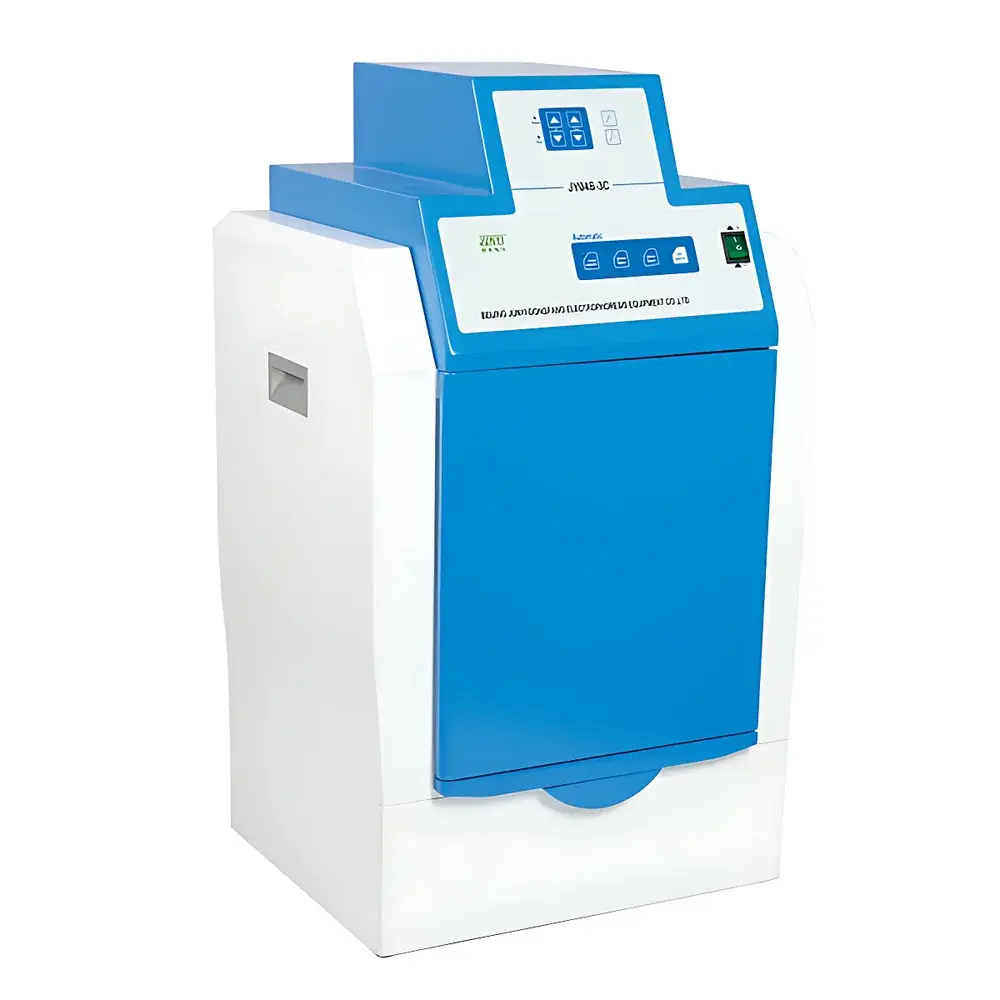
Junyi JY04S-3D Gel Imaging System
| Brand | Junyi |
|---|---|
| Origin | Beijing, China |
| Manufacturer Type | Authorized Distributor |
| Region of Manufacture | Domestic (China) |
| Model | JY04S-3D |
| Instrument Type | Standard Gel Imaging System |
| CCD Resolution | 3.0 Megapixels |
| Bit Depth | 10-bit |
| CCD Sensor Size | 2/3-inch |
| Detection Sensitivity | <20 pg double-stranded DNA stained with ethidium bromide (EB) |
| Signal-to-Noise Ratio | ≥56 dB |
| Lens | 8–48 mm focal length, 6× zoom, f/1.2 aperture |
Overview
The Junyi JY04S-3D Gel Imaging System is a dedicated digital imaging platform engineered for high-fidelity visualization, documentation, and quantitative analysis of nucleic acid and protein electrophoresis gels. It operates on the principle of fluorescence excitation and emission capture: UV transillumination (302 nm) or reflectance (254 nm / 365 nm) induces fluorescence in nucleic acid intercalating dyes (e.g., ethidium bromide, SYBR Safe), while visible white light enables Coomassie- or silver-stained protein gel documentation. The system integrates a scientific-grade, low-light-sensitive monochrome CCD sensor with 10-bit digitization and hardware-level noise suppression to ensure reproducible detection of faint bands—down to sub-20 pg dsDNA levels—without saturation or dynamic range compression. Its modular darkroom architecture isolates ambient light and UV radiation, meeting fundamental biosafety requirements for routine lab use.
Key Features
- Imported high-sensitivity monochrome CCD sensor (2048 × 1536 active pixels, 5.4 × 5.4 µm pixel pitch) with ≥56 dB signal-to-noise ratio and true 10-bit analog-to-digital conversion for linear intensity response across wide exposure ranges.
- Motorized 6× zoom lens (f/1.2, 8–48 mm focal length, 2/3-inch format) enabling precise framing of full-gel or region-of-interest imaging without mechanical repositioning.
- Dual-mode illumination: Transmitted UV (302 nm, 8 W) and reflected UV (254 nm & 365 nm, each 11 W) with integrated 590 nm bandpass emission filter optimized for EB and common alternatives; plus uniform white LED transilluminator for visible-light applications.
- Intelligent dark chamber with panel- and PC-based control over lens focus/zoom/aperture, UV/white light activation, and real-time preview—featuring automatic UV shutoff upon door opening, programmable UV delay-off timer, and motor protection logic for lens actuation.
- Slide-out gel tray with center-alignment LED indicator and detachable UV-cutting hood for safe, ergonomic excision of target bands under controlled illumination.
- Multi-layer anti-reflective coated optical filter stack minimizing stray light and background scatter, enhancing contrast and quantitative linearity in densitometric analysis.
Sample Compatibility & Compliance
The JY04S-3D accommodates standard vertical and horizontal electrophoresis gels up to 250 × 210 mm (visible) and 250 × 200 mm (UV transillumination). It supports agarose, polyacrylamide (PAGE), SDS-PAGE, native PAGE, and two-dimensional gels stained with ethidium bromide, SYBR Gold, GelRed, Coomassie Brilliant Blue, silver nitrate, and fluorescent protein tags. While not certified to ISO/IEC 17025 or FDA 21 CFR Part 11 out-of-the-box, its hardware design aligns with GLP-aligned laboratory practices: audit-trail-capable software (via optional upgrade), deterministic exposure control, non-volatile image metadata logging (timestamp, lens settings, illumination mode), and physical UV containment verified per IEC 62471 (Photobiological Safety of Lamps). All UV lamps are shielded with interlocked access doors and fail-safe cutoff circuitry.
Software & Data Management
The system ships with proprietary GelAnalysis Pro software (Windows-compatible, USB/RS232 interface) supporting real-time image acquisition, auto-exposure optimization, background subtraction, lane/band detection, molecular weight calibration, relative quantification (integrated density), and annotation tools. Export formats include TIFF (uncompressed, 10-bit), PNG, JPEG, and CSV for downstream statistical analysis. Image metadata—including exposure time, gain, lens position, and illumination source—is embedded in EXIF-compliant headers. Optional modules enable PDF report generation with customizable templates, batch processing of multi-gel experiments, and DICOM export for institutional LIMS integration. Software updates are distributed via secure HTTPS portal; no cloud storage or telemetry is enabled by default.
Applications
- Post-electrophoresis documentation and semi-quantitative analysis of PCR products, restriction digests, plasmid preps, and genomic DNA fragments.
- Verification of cloning efficiency, CRISPR editing outcomes, and RNA integrity (via agarose gel electrophoresis).
- Protein expression profiling using SDS-PAGE and Western blot validation (with chemiluminescence adapters, sold separately).
- Educational laboratory instruction: real-time band visualization, molecular weight estimation, and comparative analysis across sample sets.
- Quality control in molecular diagnostics labs where reproducible gel documentation supports SOP-driven workflows and internal audit readiness.
FAQ
What is the maximum gel size supported by the JY04S-3D?
The system accepts gels up to 250 mm (W) × 210 mm (L) for visible-light imaging and 250 mm × 200 mm for UV transillumination.
Does the system support chemiluminescent detection?
No—the JY04S-3D is optimized for fluorescence and visible-light imaging. Chemiluminescence requires extended exposure times and enhanced cooling; compatible models (e.g., JY04S-3E) are available separately.
Is the software compliant with 21 CFR Part 11 requirements?
The base software does not include electronic signature, audit trail, or role-based access control. These features are available in the validated GelAnalysis Pro v5.2+ package (requires IQ/OQ documentation and site-specific configuration).
Can I replace the 302 nm UV transilluminator with a safer alternative?
Yes—optional 365 nm or blue-light (470 nm) transilluminators are available as field-upgrade kits to reduce DNA damage during prolonged exposure.
What maintenance is required for long-term CCD performance?
No routine sensor cleaning is needed. We recommend annual verification of lens calibration and UV lamp output intensity using NIST-traceable reference standards.




