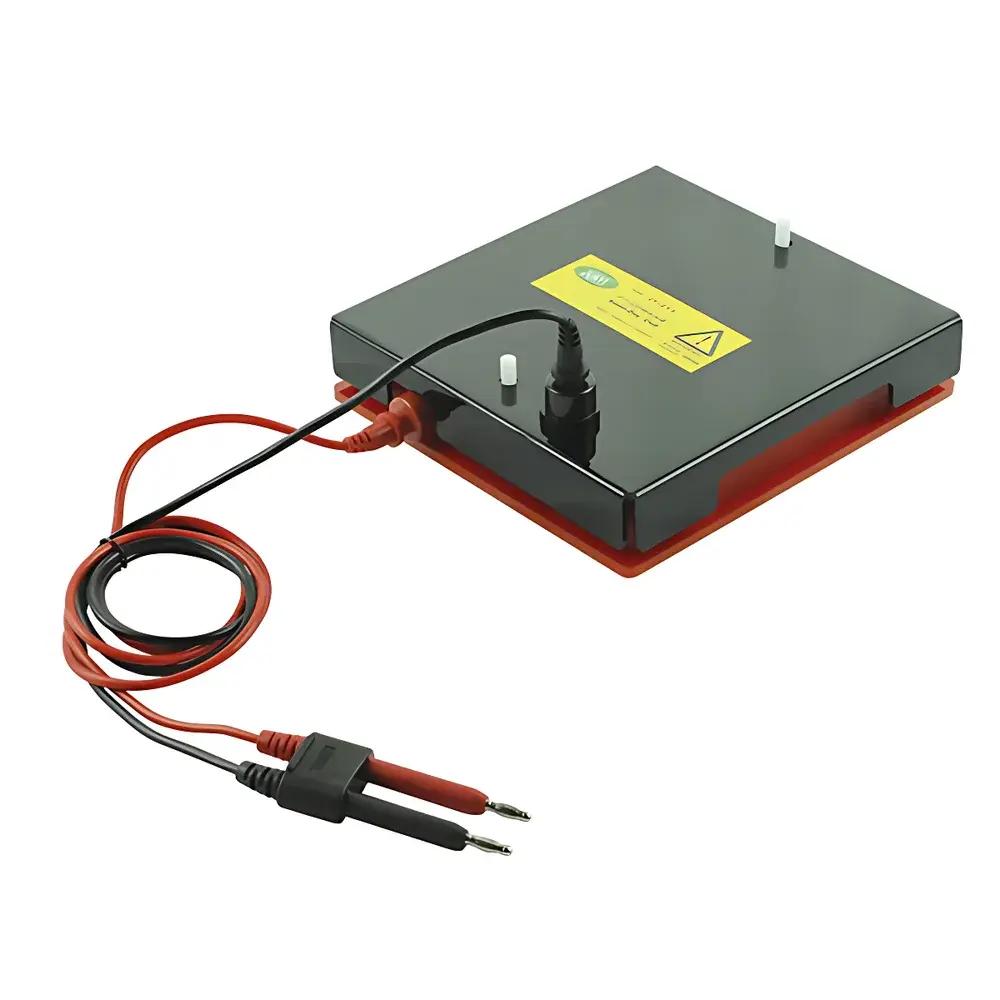
Junyi JY-ZY3 Semi-Dry Electrophoretic Transfer Tank
| Brand | Junyi |
|---|---|
| Origin | Beijing, China |
| Model | JY-ZY3 |
| Instrument Type | Semi-Dry Electrophoretic Transfer Apparatus |
| Main Component | Transfer Tank |
| Gel Format | 140 × 140 mm |
| External Dimensions (L×W×H) | 185 × 175 × 40 mm |
| Net Weight | 1.4 kg |
| Safety Feature | Automatic Power Cut-off Upon Lid Opening |
| Buffer Volume Requirement | Minimal (Semi-Dry Configuration) |
| Transfer Time | ≤60 min |
| Cooling | Passive (No External Cooling Required) |
| Compatibility | Standard Electrophoresis Power Supplies (No High-Current Source Needed) |
Overview
The Junyi JY-ZY3 Semi-Dry Electrophoretic Transfer Tank is a compact, benchtop electrophoretic blotting system engineered for efficient and reproducible protein or nucleic acid transfer from polyacrylamide or agarose gels to solid supports—including nitrocellulose, PVDF, and nylon membranes. Unlike traditional wet or tank-style transfer systems, the JY-ZY3 operates on the semi-dry principle: an electric field is applied across a thin, buffer-saturated sandwich assembly consisting of gel, membrane, and filter papers—minimizing resistance and enabling rapid, high-efficiency macromolecular migration via electroendosmosis and electrophoretic force. Its design eliminates reliance on high-current power supplies, making it compatible with standard laboratory electrophoresis units (typically 0–300 V, 0–400 mA output). The unit’s low thermal generation ensures stable transfer conditions without active cooling—critical for preserving epitope integrity during western blot workflows and reducing post-transfer background.
Key Features
- Compact footprint (185 × 175 × 40 mm) optimized for space-constrained bioscience labs and core facilities.
- Semi-dry architecture requiring only minimal buffer volume—typically 10–20 mL per run—reducing reagent cost and waste disposal burden.
- Integrated safety interlock: electrical circuit is automatically interrupted upon lid opening, complying with IEC 61010-1 requirements for laboratory electrical equipment.
- Uniform electrode alignment and parallel plate compression ensure consistent field distribution across the full 140 × 140 mm transfer area—minimizing edge effects and band distortion.
- Chemically resistant ABS housing with corrosion-resistant stainless-steel electrodes for long-term durability under repeated SDS-containing buffer exposure.
- No external cooling required: thermal dissipation is managed passively through low-resistance current path design and short transfer duration.
Sample Compatibility & Compliance
The JY-ZY3 accommodates standard mini-gel formats up to 140 × 140 mm, supporting both vertical and horizontal slab gels used in SDS-PAGE, native PAGE, and agarose-based nucleic acid electrophoresis. It is validated for use with common transfer buffers (e.g., CAPS, Tris-Glycine-Methanol, and low-pH glycine variants) and standard blotting membranes. While not certified to ISO/IEC 17025, the device conforms to general safety and electromagnetic compatibility (EMC) expectations outlined in EN 61326-1 for laboratory analytical instruments. Its operational simplicity and lack of moving parts support GLP-aligned documentation practices when integrated into validated western blot protocols.
Software & Data Management
As a standalone hardware platform, the JY-ZY3 does not incorporate embedded firmware, microprocessor control, or digital connectivity. All operational parameters—including voltage, current, and run time—are externally defined by the user-selected power supply. This analog architecture enhances reliability, eliminates firmware update dependencies, and simplifies audit readiness in regulated environments where traceability of manual protocol execution is required. Users maintain full control over transfer conditions via calibrated power supply dials or programmable ramp settings—facilitating SOP-driven replication across shifts and laboratories.
Applications
- Routine western blotting for protein detection using chemiluminescent, fluorescent, or colorimetric substrates.
- Eastern blotting for post-translational modification analysis (e.g., glycosylation, phosphorylation).
- Northern and Southern blotting for RNA/DNA hybridization assays.
- Preparative membrane-based recovery of resolved proteins for downstream mass spectrometry or activity assays.
- Teaching laboratory applications where safety, simplicity, and cost-effectiveness are prioritized without compromising transfer fidelity.
FAQ
What power supply specifications are recommended for optimal performance?
A standard electrophoresis power supply capable of delivering 15–25 V DC at 0.1–0.5 A is sufficient; no high-current (>1 A) capability is required.
Can the JY-ZY3 be used for high-molecular-weight protein transfer?
Yes—when paired with appropriate buffer composition (e.g., CAPS pH 11.0) and extended transfer times (up to 90 min), it achieves effective transfer of proteins >150 kDa.
Is the tank compatible with pre-cast gels from major vendors?
Yes—gels measuring ≤140 × 140 mm (including Bio-Rad Mini-PROTEAN®, Thermo Fisher Novex®, and Lonza FlashGel® formats) fit without modification.
How often should electrodes be cleaned, and what is the recommended method?
Electrodes should be wiped with deionized water and lint-free tissue after each use; periodic soaking in 10% acetic acid removes residual SDS deposits.
Does the unit support temperature monitoring during transfer?
No—temperature sensing is not integrated; however, empirical validation confirms surface temperature rise remains <3 °C above ambient during standard 60-min runs.