
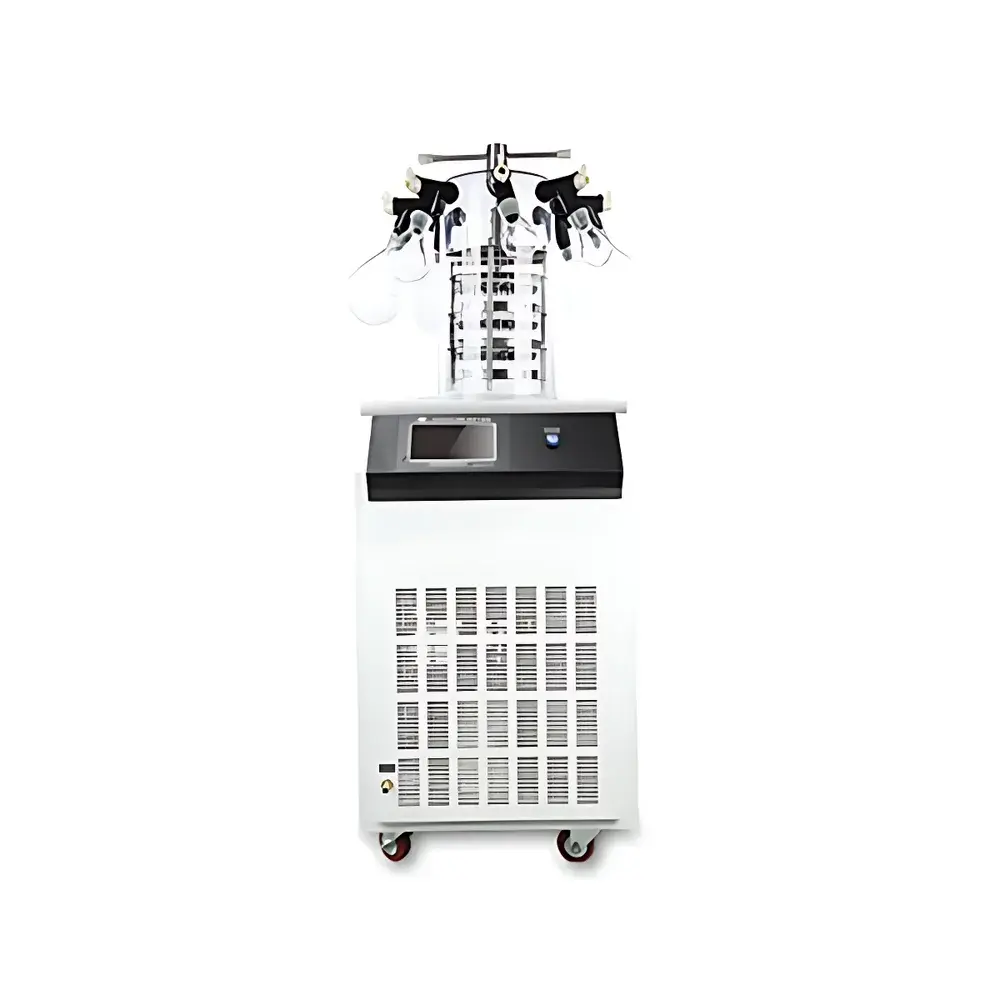
Scientz SCIENTZ-18ND/D Manifold-Type Freeze Dryer with Shelf Heating and Vacuum Stoppering
| Brand | Scientz |
|---|---|
| Origin | Zhejiang, China |
| Manufacturer Type | Direct Manufacturer |
| Instrument Type | Manifold Freeze Dryer with Hydraulic/Manual Stoppering |
| Application Scope | Laboratory Use |
| Lyophilization Area | 0.09 m² |
| Ultimate Vacuum (Empty Chamber) | ≤5 Pa |
| Condensate Capacity (24 h) | 6 kg/24 h |
| Cold Trap Temperature (Empty) | ≤−56 °C |
| Dimensions (L×W×H) | 670 × 525 × 910 mm + 480 mm (Chamber Height) |
Overview
The Scientz SCIENTZ-18ND/D is a laboratory-scale manifold-type freeze dryer engineered for precise, reproducible lyophilization of heat-sensitive biological, pharmaceutical, and material science samples. It operates on the principle of sublimation under deep vacuum: frozen aqueous or solvent-based samples are dried without passing through the liquid phase, preserving structural integrity, bioactivity, and chemical conformation. The system integrates a heated shelf platform (36 V silicone rubber heating plates), a high-efficiency dual-stage refrigeration unit, and a vacuum-controlled stoppering mechanism—enabling in-situ vial sealing post-drying to maintain sterility and prevent rehydration. Designed for space-constrained lab environments, its compact footprint (670 × 525 × 910 mm base + 480 mm chamber height) supports benchtop deployment while delivering industrial-grade performance metrics—including ≤−56 °C cold trap temperature and ≤5 Pa ultimate vacuum—critical for low-eutectic-point formulations and high-moisture-load batches up to 6 kg per 24-hour cycle.
Key Features
- Manifold configuration with eight standard 24/29 mm O.D.歧管 ports, compatible with globally standardized lyophilization flasks and stopper-ready vials
- Heated shelf system with PID-controlled temperature regulation (range: ambient to +60 °C), featuring over-temperature cutoff protection and programmable ramp/soak profiles
- Imported high-reliability compressor with optional −80 °C dual-stage cascade refrigeration upgrade for ultra-low eutectic drying
- 7-inch true-color capacitive touchscreen interface running an industrial-grade embedded OS; real-time display of cold trap temperature, chamber vacuum, shelf temperature, and elapsed time
- Automated vacuum sequencing logic: vacuum pump activation delayed until cold trap reaches preset temperature, extending pump service life and minimizing oil backstreaming
- Optically transparent, one-piece polycarbonate drying chamber—chemically resistant, shatterproof, and fully sealable—with integrated inert gas inlet valve (N₂ or Ar)
- Electric defrost function for rapid cold trap regeneration, reducing total cycle time by up to 30% compared to passive thawing
Sample Compatibility & Compliance
The SCIENTZ-18ND/D accommodates diverse sample formats including serum vials (10–50 mL), microbiological culture tubes, plant tissue segments, nanoparticle suspensions, and protein solutions. Its validated vacuum stability and thermal uniformity meet baseline requirements for GLP-compliant sample preparation workflows. While not certified to ISO 22000 or FDA 21 CFR Part 11 out-of-the-box, the system supports audit-ready data management when paired with Scientz’s optional PC-based freeze-drying software (SCIENTZ-FreezePro), which logs timestamped parameter sets, user actions, and alarm events with tamper-proof file encryption—facilitating traceability in regulated environments such as USP , EP 2.9.40, and ISO 13485-aligned labs.
Software & Data Management
Freeze-drying protocols are stored directly on-device (≥100 cycles) and exportable via USB flash drive in CSV format for offline analysis. The embedded operating system records all critical process variables at user-defined intervals (1–60 s), enabling retrospective reconstruction of drying curves. Optional FreezePro software provides advanced visualization tools—including comparative overlay of multiple runs, deviation alerts against reference profiles, and automatic calculation of primary drying endpoint via pressure rise test (PRT) algorithms. All data files include digital signatures and metadata headers compliant with ALCOA+ principles (Attributable, Legible, Contemporaneous, Original, Accurate, Complete, Consistent, Enduring, Available).
Applications
This instrument serves cross-disciplinary research and quality control applications: microbial strain preservation (bacteria, yeast, viruses); lyophilized vaccine and monoclonal antibody formulation development; botanical extract stabilization for phytochemical analysis; freeze-drying of soil/sediment matrices prior to heavy metal or organic contaminant quantification (EPA Method 3545A); nanomaterial dispersion preservation to inhibit agglomeration; and pre-analytical processing of clinical specimens (serum, plasma, CSF) for metabolomics and proteomics. Its manifold architecture allows parallel processing of heterogeneous sample types—e.g., bacterial cultures in one flask, plant extracts in another—without cross-contamination risk.
FAQ
What is the maximum batch capacity for vial-based lyophilization?
The system supports up to eight 20-mL vials simultaneously using standard KIMAX®-compatible necks; total condensate load must remain within 6 kg/24 h to maintain ≤−56 °C cold trap performance.
Can the shelf heating function be disabled during primary drying?
Yes—shelves operate independently of the vacuum and refrigeration systems; heating can be deactivated at any stage to enforce purely radiative/conductive drying conditions.
Is remote monitoring supported?
Local Ethernet connectivity is available via optional RS485-to-Ethernet module; integration with LabVantage or Thermo Fisher SampleManager requires custom API mapping through Scientz’s technical support team.
What vacuum pump models are recommended?
Dual-stage oil-sealed rotary vane pumps (e.g., Edwards RV8, Agilent IDP-10) with ≥4 m³/h pumping speed and integrated oil mist filter are advised for optimal long-term vacuum stability and contamination control.
Does the system comply with CE or UL safety standards?
The SCIENTZ-18ND/D conforms to IEC 61010-1:2010 for electrical safety and electromagnetic compatibility (EMC Class B); full CE marking documentation is provided upon request for EU market deployment.



