
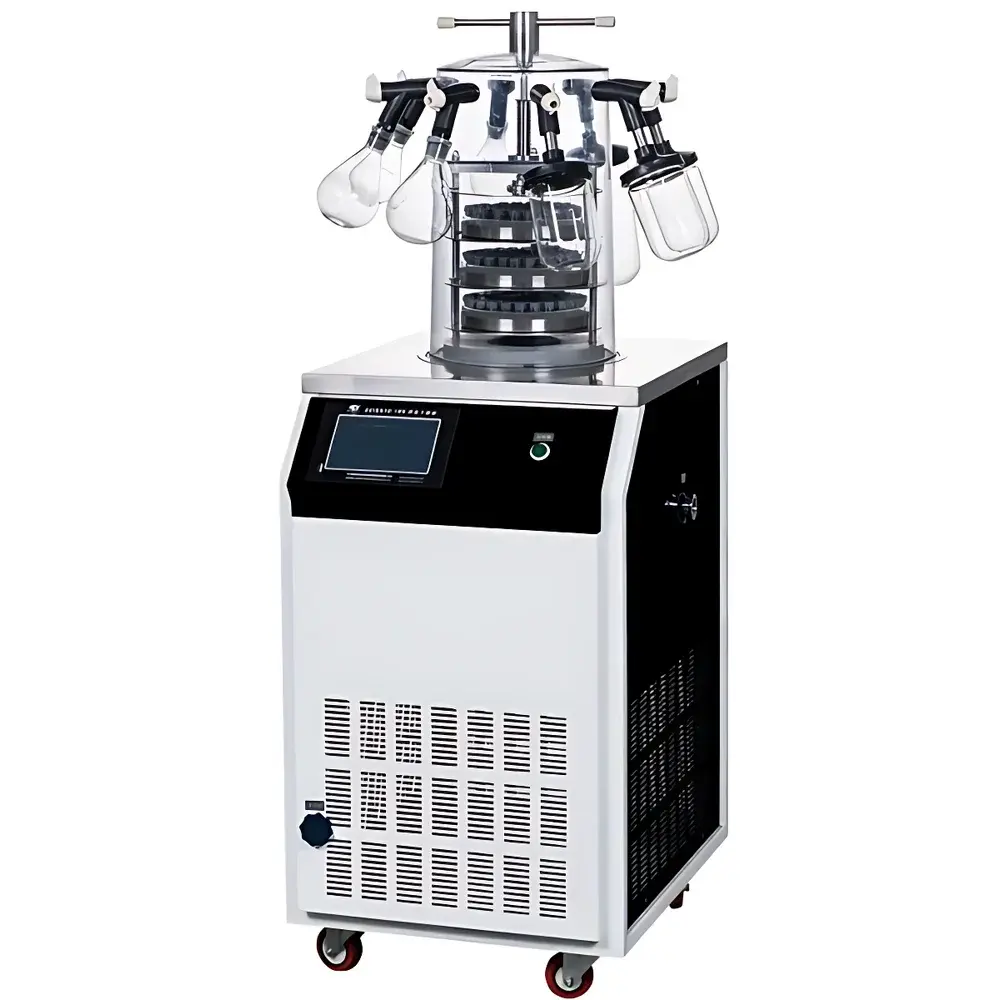
Scientz SCIENTZ-18N/D Manifold-Type Laboratory Freeze Dryer with Hydraulic Stoppering
| Brand | Scientz |
|---|---|
| Origin | Zhejiang, China |
| Manufacturer Type | Direct Manufacturer |
| Region | Domestic (China) |
| Model | SCIENTZ-18N/D Manifold-Type with Stoppering |
| Instrument Type | Stoppering-Compatible Manifold Freeze Dryer |
| Application Scope | Laboratory R&D and Process Development |
| Lyophilization Area | 0.09 m² |
| Ultimate Vacuum (No Load) | ≤5 Pa |
| Condensate Capacity (24 h) | 6 kg/24 h |
| Cold Trap Temperature (No Load) | ≤−56 °C |
| Dimensions (L×W×H) | 670 × 525 × 910 + 480 mm |
Overview
The Scientz SCIENTZ-18N/D is a benchtop manifold-type laboratory freeze dryer engineered for precise, reproducible lyophilization of heat-labile biological and pharmaceutical samples under controlled vacuum and sub-zero conditions. Operating on the principle of sublimation—where ice transitions directly from solid to vapor phase below the triple point of water (0.01 °C, 611 Pa)—this system enables dehydration without thermal degradation. It is specifically designed for small-batch process development, stability studies, and pre-formulation work involving serum, vaccines, monoclonal antibodies, microbial cultures, tissue specimens, and other sensitive biologics. The integrated hydraulic stoppering mechanism allows for in-situ vial sealing under vacuum post-drying, eliminating exposure to ambient moisture or oxygen and ensuring long-term integrity of sterile, reconstitutable dosage forms. Its modular architecture supports both flask-based and vial-based drying workflows, making it suitable for method optimization prior to scale-up in production-grade freeze dryers.
Key Features
- High-efficiency dual-stage refrigeration system using internationally certified Secop (formerly Danfoss) compressors, achieving cold trap temperatures ≤−56 °C (no load); optional −80 °C configuration available with cascade refrigeration.
- 7-inch full-color TFT touch screen interface running an industrial embedded ARM9 control platform (32 MB RAM / 128 MB Flash), enabling real-time monitoring, multi-step program editing, and intuitive navigation.
- Automated data logging with time-stamped freeze-drying profiles; supports graphical display of chamber pressure, condenser temperature, shelf temperature (if equipped), and vacuum trends—both live and historical.
- Optically transparent, one-piece polycarbonate drying chamber with high impact resistance, chemical inertness, and hermetic seal integrity—enabling full visual observation of sublimation front progression and cake morphology.
- KF-25 quick-connect vacuum interface between main unit and external vacuum pump ensures leak-tight coupling, rapid assembly/disassembly, and compatibility with ISO-KF standard pumps (e.g., Edwards, Agilent, Leybold).
- Integrated inert gas backfill valve (N₂ or argon compatible) for controlled atmosphere reconstitution and oxygen-sensitive sample handling.
- Intelligent vacuum pump protection logic: vacuum pump activation is inhibited until cold trap reaches user-defined setpoint (e.g., −40 °C), extending pump service life and reducing oil contamination risk.
- Onboard storage for ≥100 freeze-drying protocols; data export via USB flash drive for offline analysis using Scientz’s PC-based LyoView software (Windows-compatible, CSV export, curve overlay, annotation tools).
Sample Compatibility & Compliance
The SCIENTZ-18N/D accommodates up to eight standard KIMAX®-compatible 24/29 or 29/32 neck flasks (250–1000 mL), or up to eight 22 mm vials per manifold arm. Standard configuration includes eight stainless-steel manifold arms with PTFE-sealed stopcocks and universal O-ring interfaces for seamless integration with commercially available lyophilization vials (12 mm, 16 mm, 22 mm diameters). For regulatory-aligned workflows, the system supports GLP-compliant operation when paired with audit-trail-enabled software (optional LyoView Pro license) and meets mechanical safety requirements per IEC 61010-1. While not certified for GMP manufacturing, its design aligns with foundational principles of FDA 21 CFR Part 11 (electronic records/signatures readiness), ISO 22000 prerequisite programs, and ASTM F2476-22 (Standard Guide for Lyophilization Process Development).
Software & Data Management
The embedded controller logs all critical process parameters at configurable intervals (1–60 s), including vacuum pressure (Pirani gauge), cold trap surface temperature, chamber temperature (optional RTD probe), and elapsed time. All datasets are stored internally with timestamping and can be exported as UTF-8 encoded CSV files. Scientz’s LyoView desktop application provides advanced visualization—including derivative curves (dP/dt), comparative protocol overlays, and automatic endpoint detection based on pressure rise test (PRT) algorithms. Optional LyoView Pro adds electronic signature capability, user role management, and 21 CFR Part 11 audit trail generation—facilitating compliance with quality systems in regulated R&D environments.
Applications
- Pre-clinical formulation development of parenteral biologics, including mAbs, peptides, and mRNA-LNPs.
- Stability testing per ICH Q1 guidelines under accelerated and real-time storage conditions.
- Microbial preservation (bacteria, yeasts, fungi) for culture collections and diagnostic reagent manufacturing.
- Tissue engineering scaffold dehydration while preserving extracellular matrix architecture.
- Process parameter mapping (shelf temperature, chamber pressure, primary drying time) for DOE-based lyophilization cycle optimization.
- Small-scale cGMP batch simulation for tech transfer to commercial freeze dryers (e.g., SP Scientific, GEA, IMA).
FAQ
Does the SCIENTZ-18N/D support automated stoppering during vacuum?
Yes—the hydraulic stoppering actuator operates under vacuum conditions, enabling sterile, moisture-free vial sealing immediately after primary drying concludes.
Can the system be validated for IQ/OQ/PQ?
While the base unit does not ship with formal validation documentation, its modular sensors, calibrated gauges, and deterministic control logic support third-party qualification per ASTM E2500 and ISPE Good Automated Manufacturing Practice (GAMP 5) frameworks.
Is the cold trap temperature uniform across the entire surface?
Temperature uniformity is ±2 °C across the Φ300 mm condenser surface under no-load conditions, verified by IR thermography during factory acceptance testing.
What vacuum pump models are recommended for optimal performance?
We recommend two-stage oil-sealed rotary vane pumps with ultimate vacuum ≤1×10⁻² Pa and pumping speed ≥8 m³/h (e.g., Edwards RV8, Agilent DS-202, or Leybold TRIVAC D8B). Oil-free scroll pumps may be used but require careful evaluation of water vapor tolerance.
How is defrosting managed between cycles?
Manual defrost is standard; optional electric defrost kit (SCIENTZ-EDF) enables programmable, timed heating of the cold trap—reducing downtime by up to 40% compared to passive air-thaw methods.



