
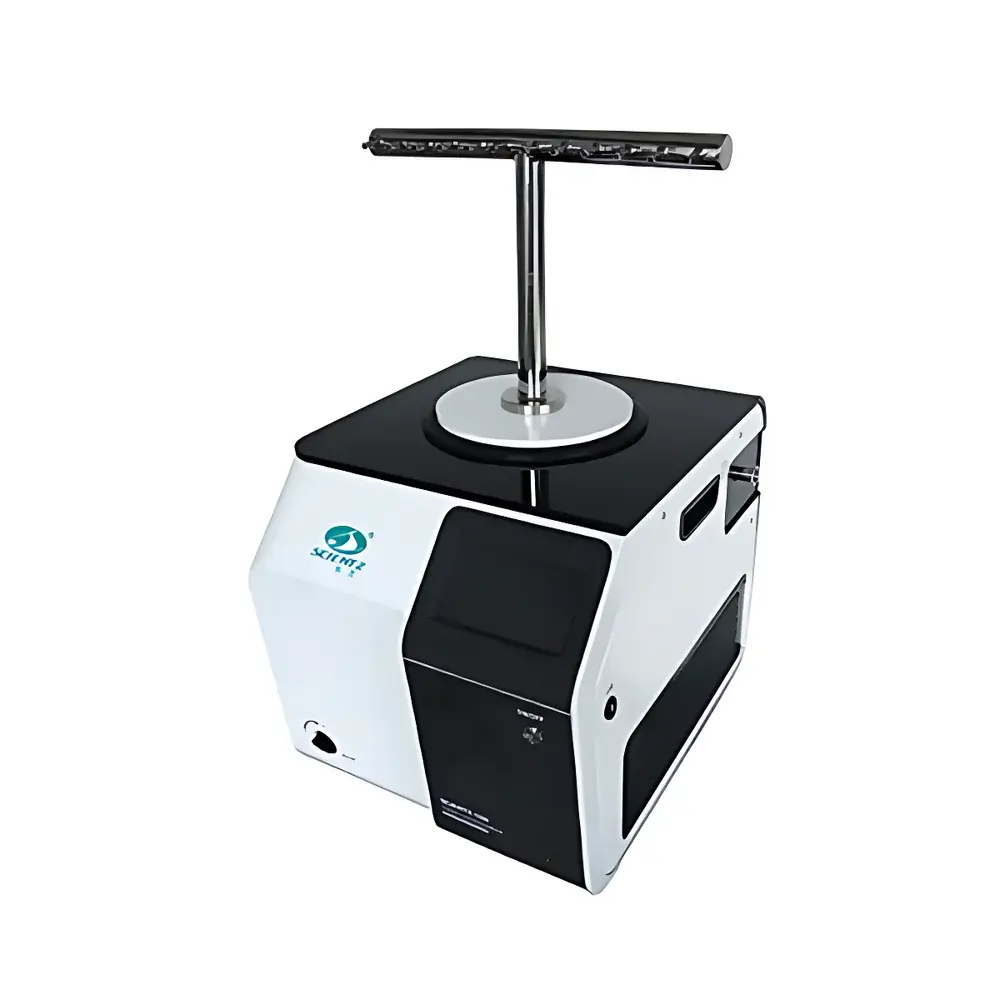
Scientz SCIENTZ-18ND/E Stoppering-Type Benchtop Freeze Dryer with Heated Shelf
| Brand | Scientz |
|---|---|
| Origin | Zhejiang, China |
| Manufacturer Type | Direct Manufacturer |
| Instrument Type | Stoppering (T-type Vial Rack) Freeze Dryer |
| Application Scope | Laboratory Use |
| Lyophilization Area | 0.09 m² |
| Ultimate Vacuum (No Load) | ≤5 Pa |
| Condensate Capacity (24 h) | 6 kg/24 h |
| Cold Trap Temperature (No Load) | ≤−56 °C |
| Dimensions (L×W×H) | 670 × 525 × 910 mm + 480 mm (height with chamber lid raised) |
Overview
The Scientz SCIENTZ-18ND/E is a compact, benchtop stoppering-type freeze dryer engineered for precision lyophilization in research and development laboratories. It operates on the principle of sublimation under high vacuum: frozen aqueous samples are dried directly from solid to vapor phase without passing through the liquid state—preserving thermolabile structures including proteins, enzymes, nucleic acids, vaccines, and microbial cultures. Unlike conventional tray-based systems, the SCIENTZ-18ND/E integrates a T-shaped vial rack configuration compatible with standard 13 mm or 22 mm serum vials, enabling controlled stoppering post-drying while maintaining sterile integrity. Its heated shelf system employs PID-controlled silicon rubber heating plates operating at 36 V safety voltage, delivering stable, overshoot-free temperature ramping across the entire shelf surface. This capability supports systematic optimization of primary and secondary drying stages—critical for establishing scalable freeze-drying protocols prior to pilot or GMP manufacturing.
Key Features
- Heated shelf with precise ±0.5 °C temperature control (range: −50 °C to +60 °C), optimized for process development and small-batch formulation studies
- High-efficiency dual-stage refrigeration system using imported compressors; standard cold trap reaches ≤−56 °C (no load); optional −80 °C configuration available for low-eutectic-point formulations
- 7-inch true-color touchscreen interface with industrial-grade embedded OS—supports real-time monitoring of shelf temperature, cold trap temperature, chamber pressure, and elapsed time
- Automated data logging: all critical parameters stored internally with timestamped freeze-drying curves; exportable via USB to PC for analysis in Excel or third-party software
- Transparent polycarbonate drying chamber—single-piece molded for corrosion resistance, optical clarity, and leak-tight sealing; enables full visual observation of ice sublimation and cake formation
- Vacuum management logic: pump activation delayed until cold trap reaches preset temperature, extending pump service life and reducing oil backstreaming risk
- Optional accessories include vacuum oil mist filter, auto pressure-differential valve, eutectic point tester, and programmable vacuum control for heat transfer optimization
Sample Compatibility & Compliance
The SCIENTZ-18ND/E accommodates diverse biological and chemical matrices—including bacterial/viral suspensions, monoclonal antibody solutions, plant extracts, nanomaterial dispersions, soil/sludge homogenates, and pharmaceutical intermediates. Its design conforms to fundamental requirements outlined in USP , ISO 22042:2021 (freeze-drying equipment qualification), and ASTM F2476–21 (standard guide for lyophilization cycle development). While not certified for GMP production, its audit-ready data logging, user-access-level password protection, and electronic signature support align with GLP documentation practices. The system meets CE electromagnetic compatibility (EMC) and low-voltage directives, and complies with IEC 61010-1 for laboratory electrical safety.
Software & Data Management
Data acquisition is fully automated and time-stamped per ICH-GCP and FDA 21 CFR Part 11 principles (when used with optional audit trail module). Up to 100 complete lyophilization cycles can be stored onboard. Each record includes shelf temperature profiles, vacuum pressure trends, condenser temperature history, and event markers (e.g., shelf heating start, vacuum break, stopper compression). Export formats include CSV and XML. The included PC software allows overlay comparison of multiple runs, deviation analysis against reference curves, and generation of summary reports suitable for internal review or regulatory submission preparation.
Applications
This instrument serves as a core tool in academic and industrial R&D settings where reproducible, small-scale lyophilization is required. Typical use cases include: stabilization of labile biologics (e.g., mRNA-LNPs, CRISPR-Cas complexes); preparation of reference standards for food safety testing (pesticide residue, mycotoxin analysis); preservation of microbial strains and viral vectors; drying of botanical extracts without thermal degradation; processing of nanostructured catalysts to prevent agglomeration; and conditioning of environmental samples (soil, sediment, wastewater biofilms) prior to elemental or metagenomic analysis. Its heated shelf functionality makes it especially valuable for DOE-based process mapping—determining optimal annealing steps, ramp rates, and endpoint criteria for novel formulations.
FAQ
What is the maximum vial capacity supported by the SCIENTZ-18ND/E?
The unit accepts up to eight standard 13 mm or 22 mm serum vials using the included T-type stainless steel rack. Custom racks for multi-well plates or larger containers are available upon request.
Can the system perform in-situ stoppering?
Yes—the integrated stoppering mechanism allows manual or semi-automated compression of rubber stoppers after primary drying completion, minimizing moisture reabsorption during chamber venting.
Is remote monitoring supported?
The device does not feature built-in Ethernet or Wi-Fi connectivity; however, exported CSV files can be imported into LabVantage, Empower, or custom LIMS platforms for centralized tracking.
What maintenance intervals are recommended for the vacuum pump?
With continuous operation, oil change is advised every 500 hours; installation of an optional oil mist filter extends service intervals by up to 40% and reduces particulate contamination in the chamber.
Does the system support validation protocols (IQ/OQ/PQ)?
While the base model lacks factory-issued validation documents, Scientz provides traceable calibration certificates for temperature and pressure sensors, along with test templates aligned with ASTM E2500 and EU Annex 15 guidelines—enabling users to execute qualification in-house or with third-party vendors.
Related Products



