
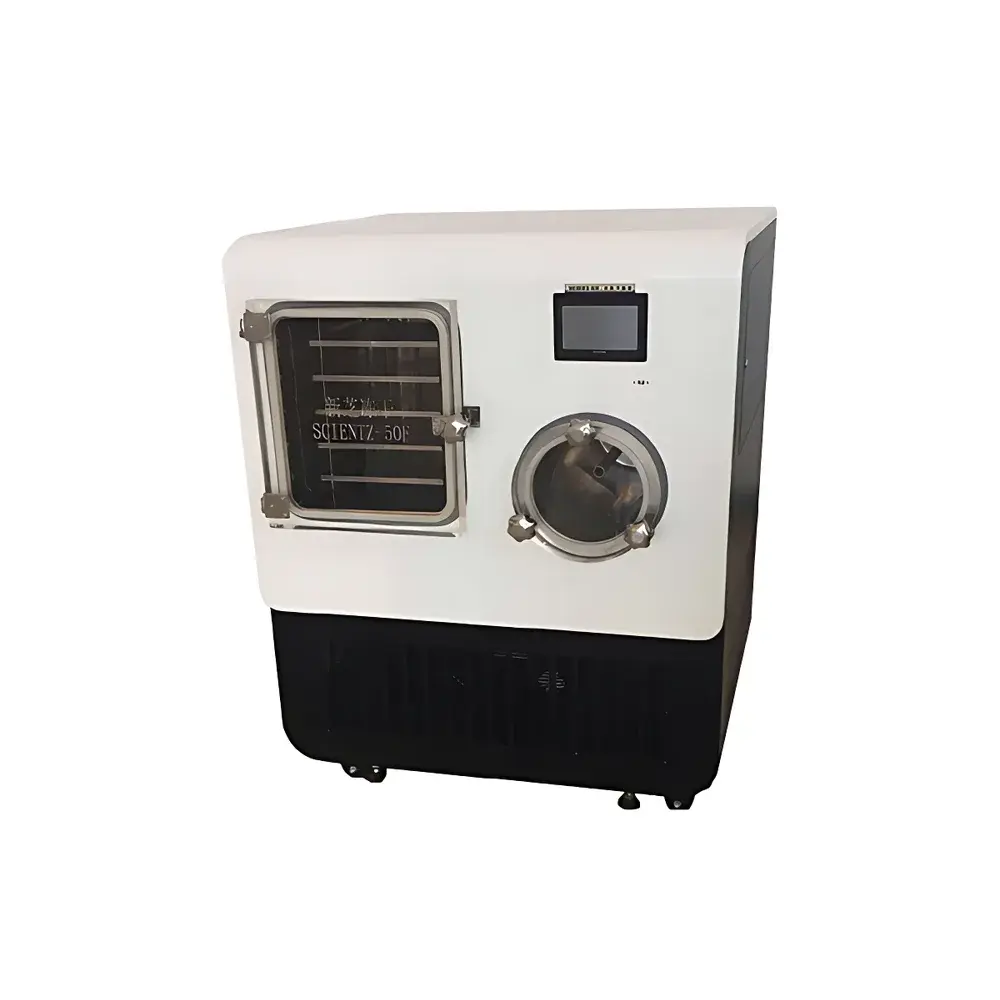
Scientz SCIENTZ-50F/A Pilot-Scale In-Situ Shelf Freeze Dryer with Silicone Oil Heating
| Brand | Scientz |
|---|---|
| Origin | Zhejiang, China |
| Manufacturer Type | Direct Manufacturer |
| Instrument Type | Standard Shelf-Type Freeze Dryer |
| Application Scope | Pilot-Scale |
| Lyophilization Area | 0.54 m² |
| Ultimate Vacuum (No Load) | ≤5 Pa |
| Ice Capacity (24 h) | 10 kg/24 h |
| Cold Trap Temperature (No Load) | ≤−70 °C |
| Main Unit Dimensions (L×W×H) | 1150 × 850 × 1480 mm |
Overview
The Scientz SCIENTZ-50F/A is a pilot-scale, in-situ shelf freeze dryer engineered for precise thermal control and reproducible lyophilization of thermally sensitive biological, pharmaceutical, and research-grade materials. It operates on the principle of sublimation under deep vacuum—where frozen water transitions directly from solid to vapor without passing through the liquid phase—preserving structural integrity, bioactivity, and chemical fidelity of labile compounds. Designed for process development and small-batch production, this unit integrates silicone oil as the heat transfer medium for shelf temperature control, enabling high-fidelity replication of critical drying parameters including primary drying ramp rates, hold temperatures, and secondary drying profiles. Its architecture supports full-cycle lyophilization—from pre-freezing through primary and secondary drying—within a single chamber, eliminating manual sample transfer and minimizing contamination risk. The system complies with fundamental engineering requirements for GMP-aligned process validation, including traceable temperature logging, programmable multi-stage ramps, and audit-ready data storage.
Key Features
- Silicone oil heating system ensures ±1 °C shelf temperature uniformity and stable thermal gradients across the 0.54 m² drying area
- Cascade refrigeration system achieves cold trap temperatures ≤−70 °C (no load), enhancing water vapor capture efficiency and reducing recondensation risk
- Industrial-grade PLC controller with 7-inch color touchscreen interface; real-time display of shelf temperature, product temperature (via optional PT100 probes), vacuum pressure, and cold trap temperature
- Programmable freeze-drying protocols: up to 40 customizable recipes, each supporting up to 40 time–temperature–vacuum segments; built-in linear, ramp, and hold-to-temperature modes
- Automatic data logging with timestamped records stored internally and exportable via USB; compliant with basic 21 CFR Part 11 data integrity expectations (user access levels, electronic signatures, audit trail)
- Corrosion-resistant cold trap with external coil design and smooth RA ≤ 0.5 µm stainless steel shelf surface for easy cleaning and residue-free operation
- Integrated vacuum protection logic: automatic pump shutdown upon overpressure or oil-backstreaming detection; optional vacuum differential valve and oil mist filter available
Sample Compatibility & Compliance
The SCIENTZ-50F/A accommodates diverse sample formats—including serum vials, glass flasks, Petri dishes, and plasma bottles—without requiring chamber modification. Its shelf configuration supports both standard lyophilization and stoppering (with optional movable shelf). The system meets foundational laboratory safety and material compatibility standards: cold trap and chamber surfaces are constructed from 304 stainless steel; viewing door uses aviation-grade transparent acrylic for impact resistance and UV stability. While not certified to ISO 22000 or EU Annex 1 out-of-the-box, its hardware and software architecture enables qualification per ASTM F2692 (Standard Guide for Validation of Freeze Drying Processes) and supports IQ/OQ/PQ documentation workflows. It is routinely deployed in labs adhering to GLP, ISO/IEC 17025, and internal GMP-like quality systems for analytical method development and stability studies.
Software & Data Management
The embedded control software provides dual-mode operation: fully automated protocol execution or manual parameter override for exploratory process optimization. All operational parameters—including shelf setpoints, vacuum setpoints, and duration per segment—are logged at user-defined intervals (default: 30 s) with millisecond-level timestamp resolution. Historical cycles can be replayed graphically on-screen or exported as CSV files for offline analysis in MATLAB, Python, or commercial CQA tools. User management includes three-tier permission levels (Operator, Supervisor, Administrator), supporting role-based access control for SOP enforcement. Optional remote monitoring via Ethernet or Wi-Fi (with secure TLS 1.2 handshake) allows integration into centralized lab infrastructure. Data backup is supported via USB flash drive; power failure triggers automatic save-and-resume functionality, preserving cycle continuity when paired with an external UPS.
Applications
This freeze dryer serves cross-disciplinary applications where preservation of molecular conformation and functional activity is non-negotiable. In biopharmaceutical R&D, it supports formulation screening of monoclonal antibodies, viral vectors, and mRNA-LNPs. Academic labs use it for cryopreservation of microbial cultures, fungal spores, and plant tissue explants. Environmental researchers apply it to soil and sediment matrices prior to elemental or metagenomic analysis. Food science groups employ it for nutrient retention studies in functional ingredients and probiotic powders. Materials scientists utilize its low-temperature dehydration capability to prevent nanoparticle agglomeration during catalyst synthesis. Additionally, it is validated for archival drying of historical documents and museum specimens where dimensional stability and pH neutrality are critical.
FAQ
Does the SCIENTZ-50F/A support in-chamber pre-freezing?
Yes—the unit features integrated shelf refrigeration capable of cooling shelves to ≤−45 °C prior to vacuum application, enabling true in-situ freezing without external ultra-low temperature freezers.
Can product temperature be monitored in real time during drying?
Yes—optional calibrated PT100 sensors can be inserted into representative vials or placed on shelf surfaces; readings are synchronized with shelf and vacuum data in the log file.
Is the system compatible with regulatory submissions?
While not pre-certified, its deterministic control architecture, electronic audit trail, and configurable alarm thresholds align with FDA guidance for process validation and data integrity in early-phase development environments.
What vacuum pump options are recommended for optimal performance?
A corrosion-resistant dual-stage rotary vane pump rated ≥12 m³/h (e.g., Edwards RV8 or similar) is advised; optional oil mist filtration and automatic differential valves mitigate backstreaming risks in long-duration cycles.
How is cleaning and maintenance performed on the cold trap?
The external coil design allows wipe-down with ethanol or isopropanol; ice removal is facilitated by manual defrost mode with controlled shelf warming to avoid thermal shock to the trap surface.



