
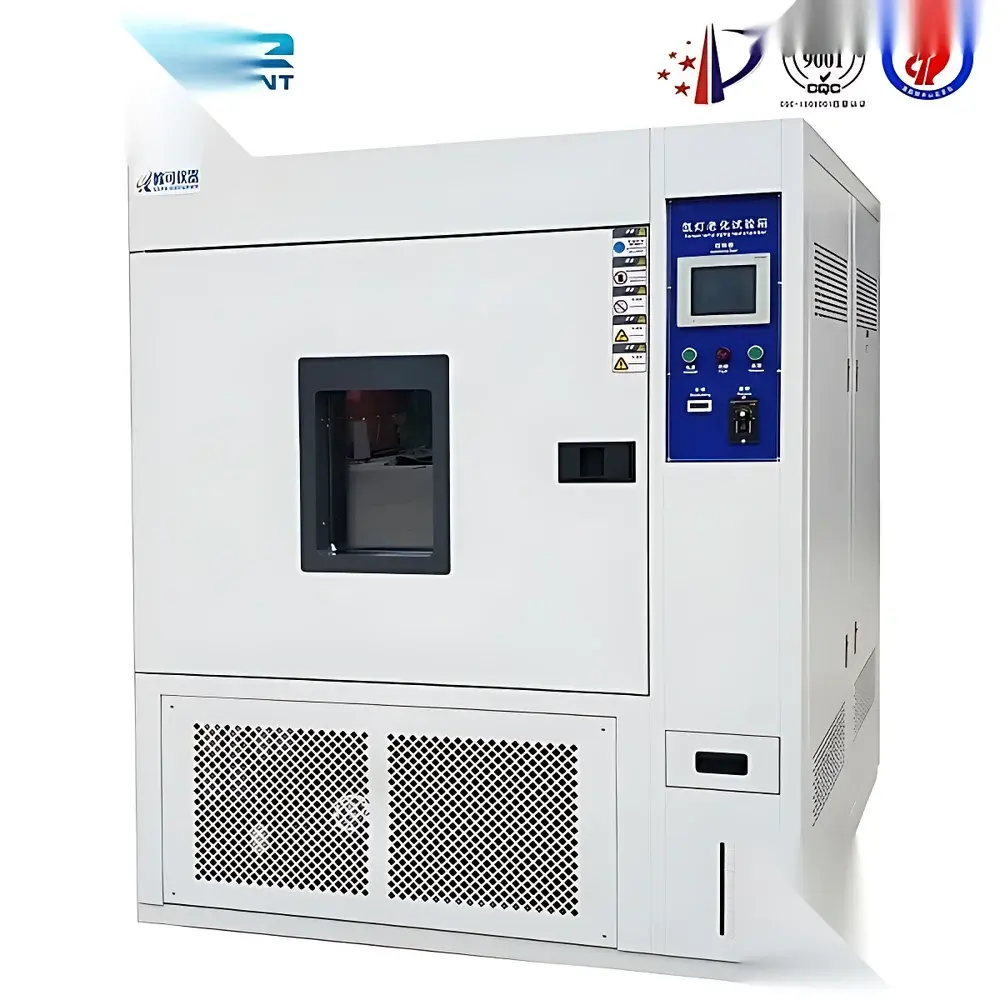
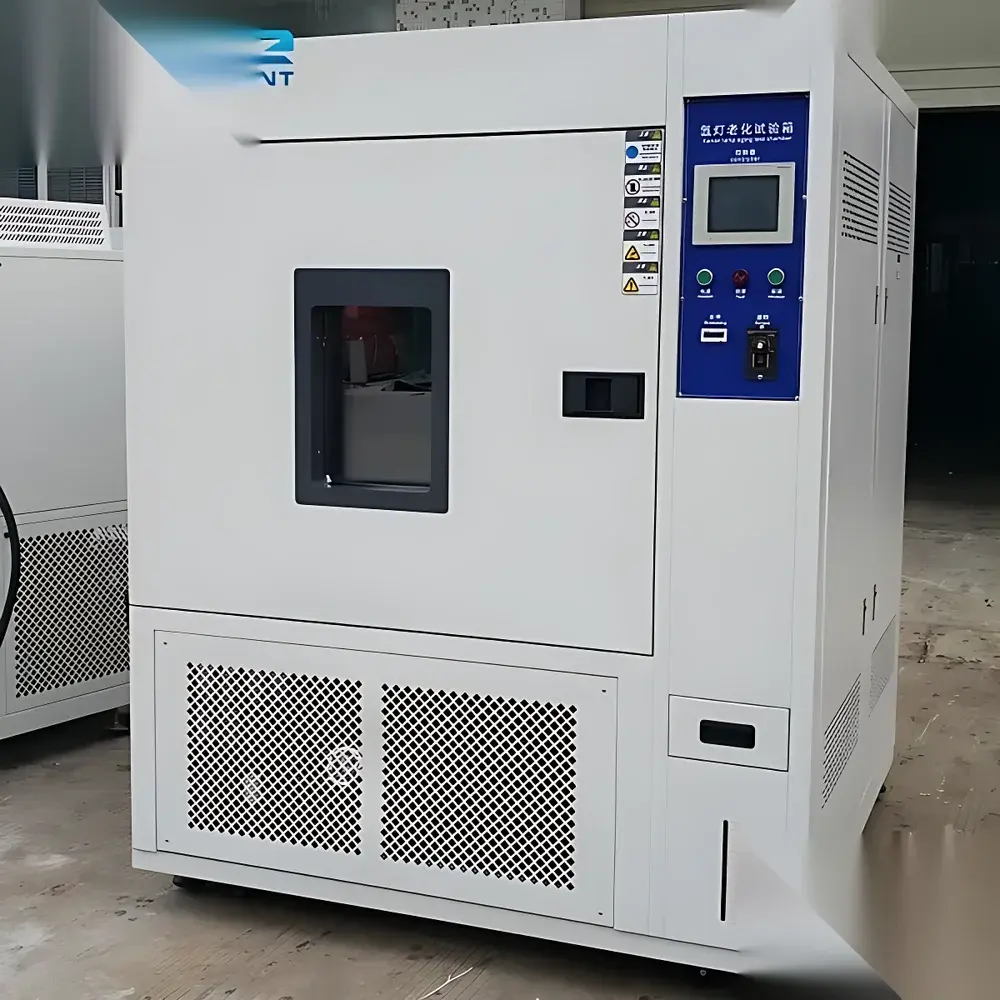
Xenon Arc Weathering Test Chamber
| Key | Power Supply: 380 V AC / 50 Hz |
|---|---|
| Total Power | 9 kW |
| Xenon Lamp | 6 kW water-cooled long-arc lamp (full solar spectrum) |
| Irradiance Control Range | 350–850 nm, nominal 550 W/m² |
| Optional Monitoring Wavelengths | 340 nm or 365 nm |
| Temperature Range | (RT + 10)°C to 70°C |
| Temperature Uniformity | ±2°C |
| Sample Rotation Speed | ≥1 rpm (stepless adjustment) |
| Wet/Dry Cycle Options | 60 min irradiation / 12 min spray or 102 min / 18 min |
| Chamber Interior Dimensions | 950 × 950 × 900 mm |
| Spray Pressure | 78–127 kPa |
| UV Cut-off Filter | <255 nm blocked (0%), 400–800 nm transmittance >90% |
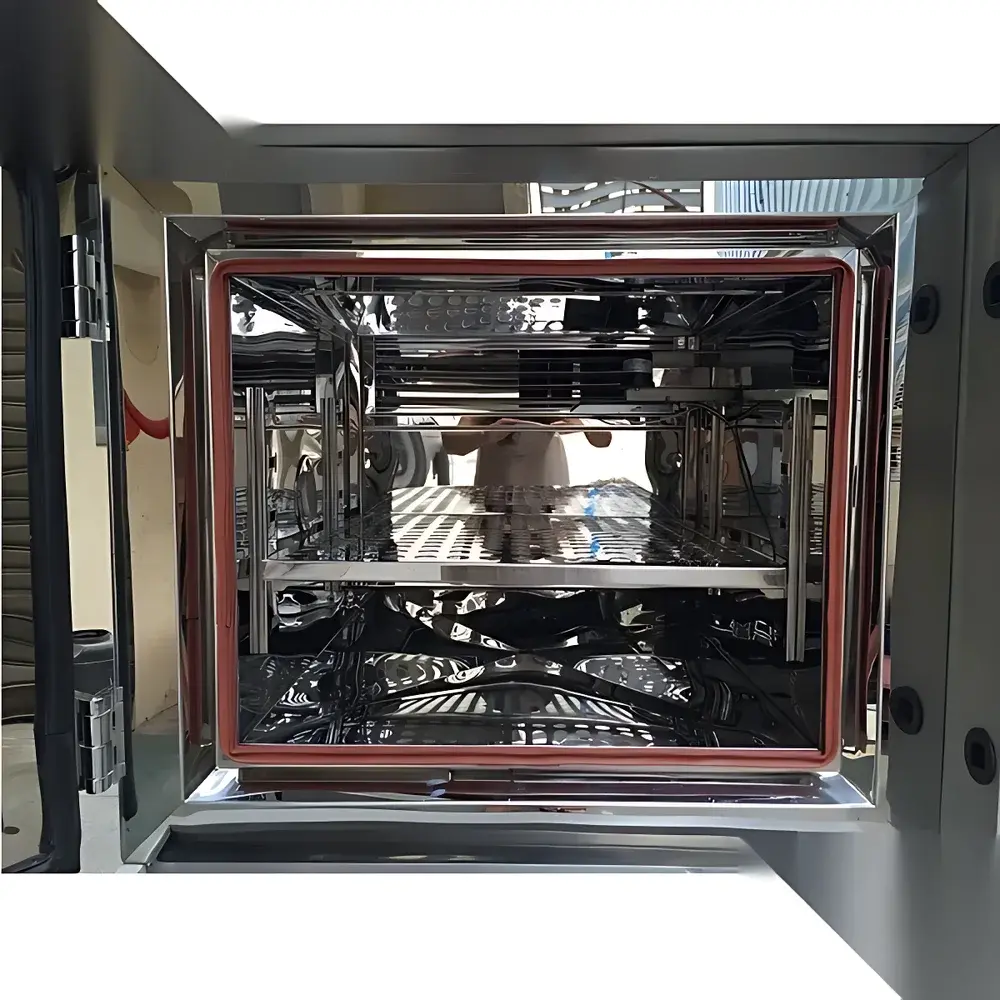
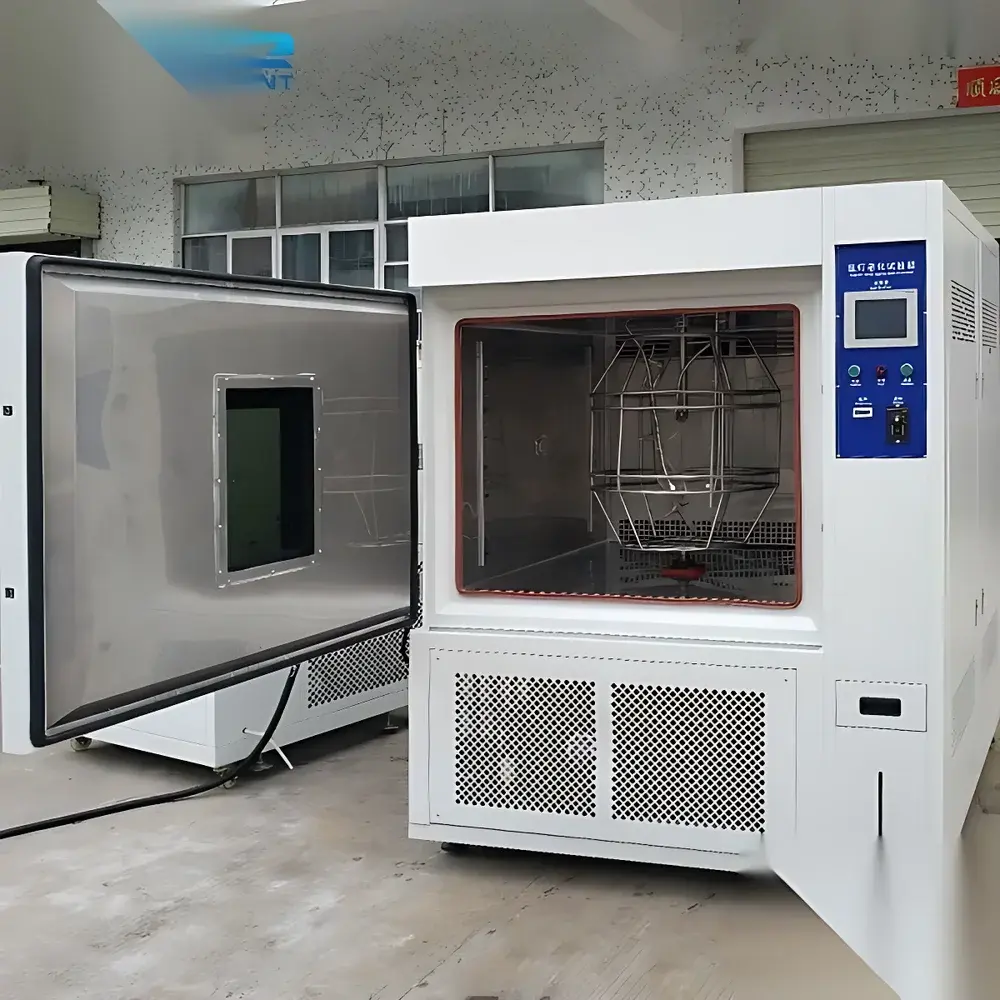
| Construction | Cold-rolled steel exterior with powder coating, SUS304 stainless steel interior, silicone rubber door seal |
| Control System | South Korean TEMI850 touchscreen controller |
| Cooling | Closed-loop chiller system for xenon lamp |
| Radiation Measurement | Fiber-optic coupled broadband radiometer |
| Temperature Sensing | Wireless black panel thermometer (BPT) or black standard thermometer (BST) |
| Safety | Interlocked cooling-water circuit, overtemperature/overcurrent/short-circuit protection, low-water cutoff, grounding protection |
Overview
The Xenon Arc Weathering Test Chamber is an engineered environmental simulation system designed to replicate the photodegradative effects of natural sunlight, moisture, and thermal cycling on polymeric, coated, textile, automotive, and architectural materials. Based on the principles of xenon arc irradiation—where a high-intensity, water-cooled 6 kW long-arc lamp emits a continuous spectrum closely matching terrestrial solar radiation (300–2500 nm)—this chamber enables accelerated aging under controlled, repeatable conditions. Unlike UV fluorescent or metal halide sources, xenon arc technology provides full-spectrum fidelity, particularly critical for evaluating color fading, gloss loss, chalking, cracking, and embrittlement mechanisms governed by photochemical reactions across UV, visible, and near-infrared bands. The chamber integrates calibrated irradiance control (550 W/m² in the 350–850 nm band), programmable wet/dry cycles, and precise black panel temperature regulation to emulate real-world exposure profiles defined in ASTM G155, ISO 4892-2, SAE J2527, and GB/T 16422.2.
Key Features
- Full-Spectrum Xenon Source: 6 kW water-cooled long-arc lamp delivering spectrally stable output with spectral power distribution traceable to NIST-calibrated reference standards; equipped with optical filters to meet specific spectral cut-offs per test method requirements.
- Fiber-Optic Irradiance Monitoring: Radiometric measurement via fiber-optic coupling eliminates thermal drift errors common in direct-sensor configurations, ensuring long-term stability and traceable irradiance control at user-selectable monitoring wavelengths (340 nm or 365 nm).
- Wireless Black Panel Thermometry: Integrated BPT/BST sensors transmit real-time surface temperature data without wiring interference, enabling accurate thermal load assessment on test specimens during irradiation.
- Closed-Loop Chiller Integration: Dedicated refrigerated cooling unit maintains optimal lamp jacket temperature, extending lamp life and stabilizing spectral output—critical for multi-week test campaigns requiring high reproducibility.
- Programmable Cyclic Exposure: Dual-cycle capability (60/12 min or 102/18 min irradiation/spray sequences) supports both ASTM D4329-compliant UV/wet protocols and ISO 4892-2 daylight/moisture cycles; spray pressure regulated between 78–127 kPa for uniform droplet distribution.
- Rotating Sample Rack: Motor-driven carousel rotates at ≥1 rpm (infinitely adjustable), ensuring uniform angular exposure across all specimen positions within the 0.63 m² effective irradiance field.
- Robust Control Architecture: South Korean TEMI850 touchscreen controller with embedded logic for sequence programming, data logging, alarm management, and password-protected parameter access—designed for GLP-compliant operation.
Sample Compatibility & Compliance
This chamber accommodates flat or contoured specimens up to standard ISO 4892-2 mounting dimensions (e.g., 75 × 150 mm or 100 × 100 mm), including painted panels, plastic sheets, textile swatches, elastomeric seals, and coated composites. Specimen holders are fabricated from corrosion-resistant SUS304 stainless steel, and the viewing window uses tempered borosilicate glass compliant with EN 12150-1 impact resistance requirements. The system meets structural and electrical safety requirements per IEC 61000-6-2 (EMC immunity) and IEC 61000-6-4 (EMC emissions), and its operational parameters align with calibration traceability frameworks outlined in ISO/IEC 17025. While not inherently FDA 21 CFR Part 11 compliant, audit trails and electronic record integrity can be implemented via external LIMS integration when paired with optional data export modules.
Software & Data Management
The TEMI850 controller supports local data storage of setpoints, actual values, alarms, and cycle logs for ≥30 days. Export is available via USB interface in CSV format for post-processing in MATLAB, Excel, or statistical analysis platforms. Optional Ethernet connectivity enables remote monitoring and centralized fleet management across multiple chambers. All temperature, irradiance, and timing events are timestamped with millisecond resolution, satisfying documentation requirements for internal quality audits and third-party validation reports. Firmware updates are performed via secure USB upload, maintaining version control and change history per ISO 9001 clause 7.5.3.
Applications
Used extensively in R&D laboratories and quality assurance departments, this chamber supports material qualification against automotive OEM specifications (e.g., Ford CETP 00.00-L-467, GMW 14124), aerospace coatings (AMS 3095), building product durability (ASTM D4798), and consumer electronics housing validation (IEC 60068-2-5). It is routinely deployed to benchmark comparative aging performance of pigment systems, UV stabilizers, and polymer matrix formulations; to validate batch-to-batch consistency in production lots; and to generate predictive lifetime models using Arrhenius-based acceleration factors derived from controlled temperature-irradiance stress combinations.
FAQ
What spectral range does the xenon lamp cover, and how is it filtered?
The lamp emits a continuous spectrum from ~270 nm to >2500 nm. Standard optical filtering ensures 90% transmission between 400–800 nm, approximating terrestrial sunlight as specified in ISO 4892-2.
Is the irradiance value adjustable, and how is it calibrated?
Yes—irradiance is continuously monitored and automatically regulated via closed-loop feedback. Calibration is performed using a NIST-traceable broadband radiometer; users may select 340 nm or 365 nm as the control wavelength depending on application-specific degradation sensitivity.
How is specimen temperature controlled during testing?
Black panel temperature (BPT) is measured wirelessly and regulated via proportional-integral-derivative (PID) control of chamber air circulation and auxiliary heating. Temperature uniformity is maintained within ±2°C across the sample plane per ISO 4892-2 Annex A.
What safety interlocks prevent lamp damage?
A mandatory water-flow interlock prevents lamp ignition unless chiller flow and temperature are within specification. Continuous monitoring triggers automatic lamp shutdown and system halt upon detection of low coolant flow, elevated lamp jacket temperature, or power supply anomaly.



