
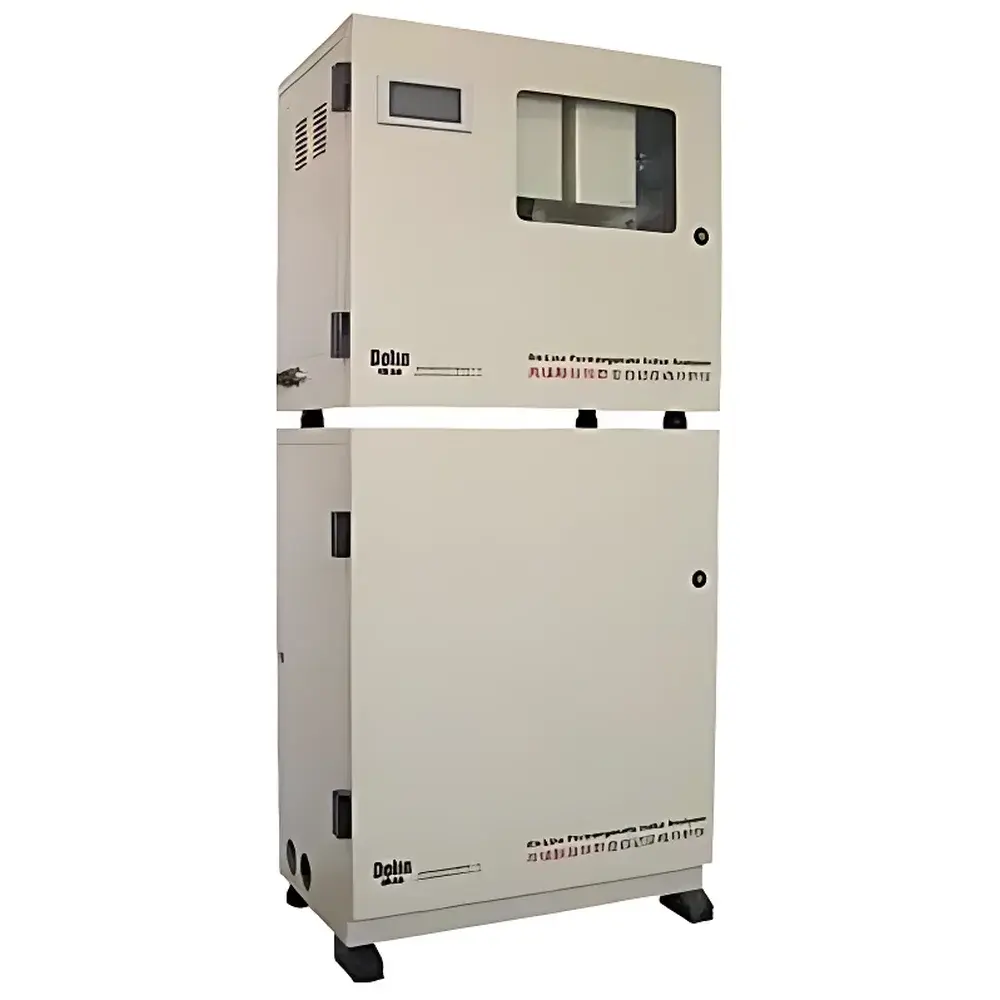
XHZ2006 Permanganate Index Online Analyzer
| Origin | Hebei, China |
|---|---|
| Manufacturer Type | Authorized Distributor |
| Origin Category | Domestic (China) |
| Model | XHZ2006 |
| Pricing | Available Upon Request |
| Measurement Principle | Flow Injection Analysis (FIA) |
| Measurement Range | 0–100 mg/L KMnO₄ |
| Accuracy | ±5% FS |
| Precision | ±5% FS |
| Detection Limit | 0.1 mg/L |
| Resolution | 0.1 mg/L |
| Minimum Cycle Time | 12 min |
| Dimensions | 620 × 1400 × 500 mm |
| Weight | 100 kg |
| Power Supply | 200 V, 50 Hz |
| Power Consumption | 200 W |
| Pump Type | Ceramic High-Pressure Injection Pump |
| Sample Handling | Direct injection, no pretreatment or cleaning required |
Overview
The XHZ2006 Permanganate Index Online Analyzer is an industrial-grade, fully automated water quality monitoring instrument engineered for continuous, unattended determination of the permanganate index (CODMn) in natural waters, drinking water sources, and effluent streams. Unlike conventional batch-mode laboratory methods (e.g., ISO 8467 or GB/T 5750.7–2006), this analyzer implements a robust Flow Injection Analysis (FIA) architecture—validated as the only commercially deployed FIA-based online solution for permanganate index measurement worldwide. The system operates under controlled thermal and pressure conditions (120 °C, 0.5 MPa) to ensure complete oxidation of organic matter by potassium permanganate in acidic medium, followed by photometric detection of residual permanganate at 525 nm. Its design prioritizes long-term operational integrity in remote or semi-automated monitoring environments—including national surface water quality stations, municipal drinking water intake points, transboundary river sections, and regulatory compliance laboratories.
Key Features
- World’s only field-deployed online analyzer utilizing validated Flow Injection Analysis (FIA) for permanganate index quantification—eliminating manual titration and associated operator variability.
- Ceramic high-pressure injection pump delivers exceptional durability and metrological stability under sustained thermal/pressure cycling; supports >10,000 injection cycles without recalibration.
- No sample filtration, digestion, or post-measurement cleaning required—enables true “inject-and-read” operation with zero downtime between analyses.
- Low reagent consumption: ≤0.3 mL per analysis of 0.01 mol/L KMnO₄ and H₂SO₄ solutions; average operational cost approximates USD $0.005 per sample.
- Minimum analysis cycle time of 12 minutes—achievable due to integrated high-efficiency heat exchange and rapid optical signal stabilization.
- Modular electronics architecture using globally certified components (IEC 61000-4 EMC compliant, UL 61010-1 safety certified); designed for 24/7 operation in ambient temperatures from 5 °C to 40 °C.
- Front-access service layout and tool-free module replacement reduce mean time to repair (MTTR) to <30 minutes.
Sample Compatibility & Compliance
The XHZ2006 accepts raw water samples directly from open-channel intakes, pressurized pipelines, or low-flow grab samplers without pre-filtration or pH adjustment. It maintains performance across turbidities up to 100 NTU and suspended solids ≤50 mg/L. Method equivalence has been verified against reference procedures per ISO 8467:2021 (Water quality — Determination of permanganate index) and Chinese Standard GB/T 5750.7–2006. Data outputs comply with national environmental monitoring data transmission protocols (HJ 212–2017) and support audit-ready reporting for GLP/GMP-aligned laboratories. While not intrinsically 21 CFR Part 11 compliant, optional firmware modules provide electronic signature capability, audit trail logging, and user role-based access control for regulated environments.
Software & Data Management
Embedded Linux-based controller runs proprietary firmware with dual-mode operation: autonomous scheduled measurement (intervals configurable from 12 to 1440 minutes) or external trigger via Modbus RTU/TCP or dry-contact input. Real-time concentration values, temperature/pressure sensor diagnostics, reagent level status, and error logs are transmitted via RS-485, Ethernet, or optional 4G LTE. Local SD card storage retains ≥12 months of second-level timestamped data (concentration, baseline absorbance, pump stroke count, thermal profile). PC software (Windows/Linux/macOS) enables method configuration, calibration curve management, QC charting (X-bar/R charts), and export to CSV, PDF, or XML formats compatible with LIMS integration.
Applications
- Continuous surveillance of source water quality at municipal drinking water treatment plant intakes.
- Transboundary water quality monitoring at national border river sections and reservoir inflow/outflow points.
- Early-warning detection of organic pollution events in rivers, lakes, and estuaries.
- Long-term trend analysis for ecological status assessment under EU WFD or China’s “River Chief System” frameworks.
- Supplemental verification of laboratory CODCr measurements where chloride interference prohibits dichromate use.
- Research applications requiring high-frequency permanganate index time-series data (e.g., diurnal organic load studies).
FAQ
Does the XHZ2006 require daily maintenance or reagent replenishment?
No routine daily maintenance is required. Reagents (KMnO₄ and H₂SO₄ solutions) are typically replenished every 7–14 days depending on measurement frequency; the system alerts users via LED and digital interface when levels fall below threshold.
Can it operate in freezing ambient conditions?
The analyzer is rated for 5–40 °C ambient operation. For sub-zero deployments, an optional heated enclosure (IP55-rated, thermostatically controlled) must be specified at time of order.
Is calibration traceable to national standards?
Yes—calibration is performed using NIST-traceable potassium hydrogen phthalate (KHP) standard solutions, with documented uncertainty budgets meeting ISO/IEC 17025 requirements for accredited labs.
What communication protocols does it support for SCADA integration?
Standard protocols include Modbus RTU (RS-485), Modbus TCP/IP, and analog 4–20 mA output (isolated, configurable range). Optional OPC UA and MQTT gateways are available upon request.
How is data security handled during remote transmission?
All network communications use TLS 1.2 encryption; local storage employs write-protected file systems. Firmware updates require signed packages verified via embedded public-key cryptography.
Related Products







