
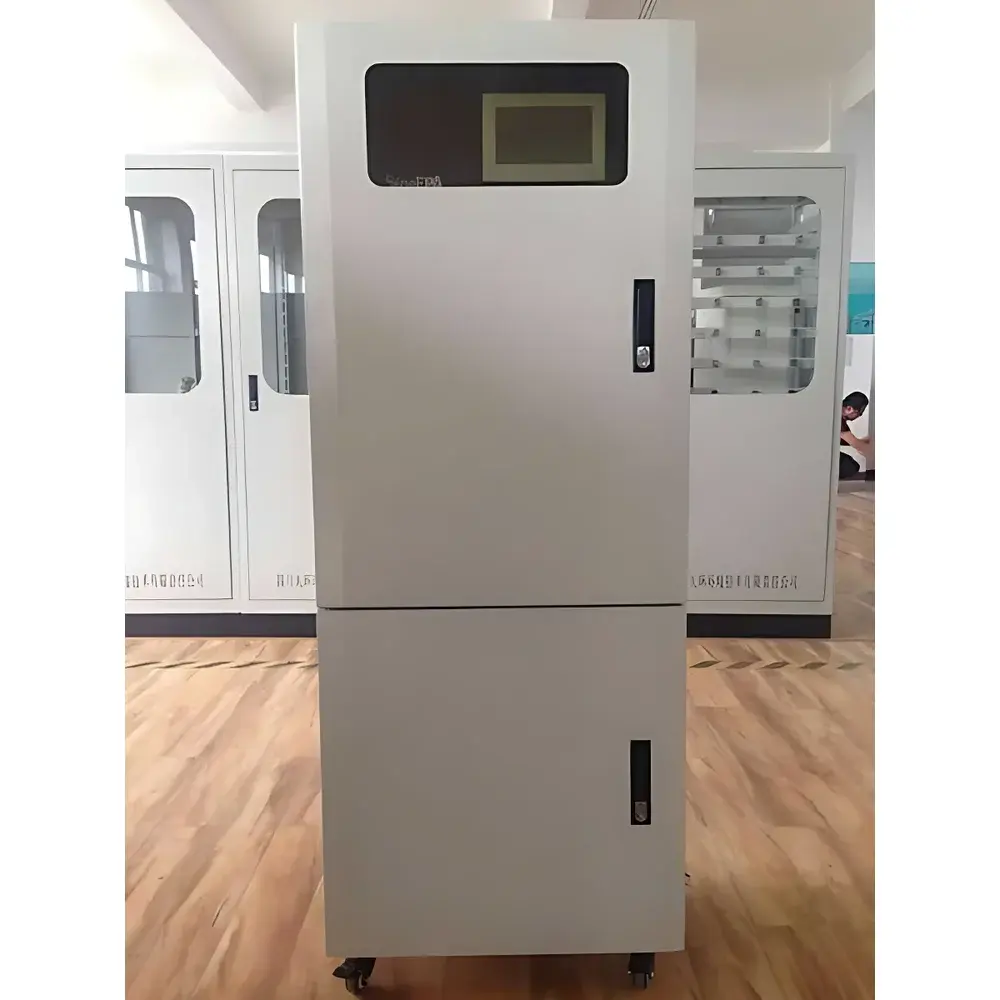
SAIL HERO SERES 2000 Ni Total Nickel Online Analyzer
| Brand | SAIL HERO |
|---|---|
| Origin | Hebei, China |
| Manufacturer Type | Manufacturer |
| Origin Category | Domestic |
| Model | SERES 2000 Ni |
| Instrument Type | Online Analyzer |
| Detection Principle | Photometric Method (High-Temperature Oxidation + Dimethylglyoxime Complexation) |
| Target Analyte | Nickel (Total Ni) |
| Analysis Time | ≤40 min |
| Accuracy/Trueness | ±10% |
| Resolution | 0.005 mg/L |
| Detection Limit | 0.005 mg/L |
| Repeatability | ±5% |
| Measurement Range | 0–2.0 mg/L (customizable extension available) |
| Calibration Frequency | Monthly (automated) |
| Measurement Modes | Interval mode (1–9999 min programmable) and Fixed-time mode |
| Temperature Control Precision | High-stability PID-controlled heating system |
| Sample Introduction | Non-contact peristaltic pumping with modified PTFE tubing |
| Optical System | High-precision photometer at 530 nm |
| Digestion System | High-pressure, high-temperature oxidation module |
| Reagent Delivery | Infrared photoelectric metering system |
| Valve System | Imported multi-position selector valve |
Overview
The SAIL HERO SERES 2000 Ni Total Nickel Online Analyzer is an industrial-grade, fully automated water quality monitoring instrument engineered for continuous, unattended quantification of total nickel concentration in aqueous matrices—including surface water, wastewater effluent, industrial discharge streams, and drinking water treatment influents. It operates on the standardized high-temperature oxidation–dimethylglyoxime (DMG) photometric method, compliant with core principles outlined in EPA Method 200.7, ISO 8288:1986, and GB/T 11910–1989. The analytical sequence begins with acid digestion under elevated temperature and pressure to ensure complete oxidation of all nickel species (including organically bound, colloidal, and particulate forms) into soluble Ni²⁺ ions. Following neutralization with sodium hydroxide, the sample is buffered with ammoniacal solution in the presence of iodine as an oxidant stabilizer; nickel then selectively complexes with dimethylglyoxime to form a stable, soluble, wine-red chelate. This complex exhibits maximal molar absorptivity at 530 nm, enabling highly specific spectrophotometric detection using a precision optical path and thermally stabilized photodiode array.
Key Features
- Robust high-pressure, high-temperature digestion module ensures >98% oxidation efficiency for refractory nickel species—critical for regulatory compliance in industrial wastewater monitoring.
- Non-contact fluid handling architecture: peristaltic pumping with imported modified PTFE tubing eliminates metallic leaching and chemical corrosion, extending service life beyond 18 months under continuous operation.
- High-accuracy infrared photoelectric reagent metering system delivers volumetric precision of ±0.5% across full reagent delivery range (10–500 µL), minimizing inter-batch variability.
- Thermally isolated 530 nm photometric cell with dual-beam compensation and automatic zero-reference correction reduces drift to <0.002 AU/h, ensuring long-term baseline stability.
- Multi-position ceramic selector valve (imported) rated for >500,000 cycles, supporting low-maintenance operation with field-replaceable rotor seals and no tool-required actuation.
- Programmable measurement scheduling: users define interval-based sampling (1–9999 minutes) or synchronized fixed-time acquisition (e.g., hourly or on-the-hour), compatible with SCADA and DCS integration via Modbus RTU/TCP.
Sample Compatibility & Compliance
The SERES 2000 Ni is validated for use with turbidities up to 100 NTU and suspended solids concentrations ≤150 mg/L without filtration—enabled by integrated inline sediment settling and flow-through optical path design. It meets functional requirements for continuous emission monitoring systems (CEMS) under China’s HJ 353–2019 and HJ 355–2019 standards for water pollution source monitoring. Data integrity conforms to ALCOA+ principles: all measurements include embedded timestamps, operator ID (if authenticated), calibration event logs, and error flags. Audit trails are retained for ≥180 days and exportable in CSV/Excel format for GLP/GMP documentation. While not FDA 21 CFR Part 11–certified out-of-box, the system supports external validation protocols for regulated pharmaceutical or semiconductor facility applications.
Software & Data Management
The embedded Linux-based controller runs SAIL HERO’s proprietary SERES OS v4.2, featuring a web-accessible interface (HTTPS, TLS 1.2) with role-based access control (admin/operator/viewer). Real-time chromatogram-like trend visualization displays absorbance kinetics, digestion progress, and calibration status. All raw photometric data (absorbance vs. time), calculated concentrations, QC flag codes (e.g., “CAL-OUT”, “DIG-FAIL”, “LOW-SIGNAL”), and environmental parameters (digestion temperature, optical lamp voltage, pump RPM) are logged at 1-second resolution. Data export supports FTP push, OPC UA server output, and direct SQL database write (via optional Ethernet-to-DB bridge module). Remote firmware updates and diagnostic telemetry are supported over secure SSH tunnel.
Applications
- Regulatory compliance monitoring at electroplating, battery manufacturing, and stainless steel production facilities subject to local discharge limits (e.g., China’s GB 21900–2008, EU IED Annex I).
- Process control feedback loop in nickel recovery units—enabling real-time adjustment of pH, redox potential, and precipitant dosing.
- Early-warning detection in municipal wastewater treatment plant influent channels to prevent downstream catalyst poisoning in biological nutrient removal stages.
- Long-term trend analysis in watershed monitoring networks where seasonal geochemical mobilization of nickel from serpentine soils must be distinguished from anthropogenic inputs.
- Supporting ISO/IEC 17025-accredited laboratories performing accredited environmental testing—when operated under documented SOPs with traceable calibration standards.
FAQ
What sample pretreatment is required prior to analysis?
No filtration or centrifugation is needed for samples with ≤150 mg/L TSS. For highly particulate or oily influents, optional inline 5-µm mesh prefiltration is recommended to prevent valve clogging.
How frequently must the instrument be calibrated?
Automated daily zero/span verification is performed; full multi-point calibration is scheduled monthly per default, though frequency may be adjusted based on matrix stability and regulatory requirements.
Can the measurement range be extended beyond 2.0 mg/L?
Yes—range extension to 5.0 mg/L or 10.0 mg/L is achievable via hardware configuration change (optical path length adjustment) and recalibration with NIST-traceable standards.
Is the system compatible with existing SCADA infrastructure?
Yes—Modbus RTU (RS-485) and Modbus TCP (Ethernet) protocols are natively supported; register maps and function code documentation are provided in the Integration Manual.
What maintenance tasks require technician intervention?
Annual replacement of digestion reactor O-rings, biannual cleaning of photometer quartz cuvette, and quarterly inspection of PTFE tubing wear—average annual labor time: <2 hours.
Related Products







