
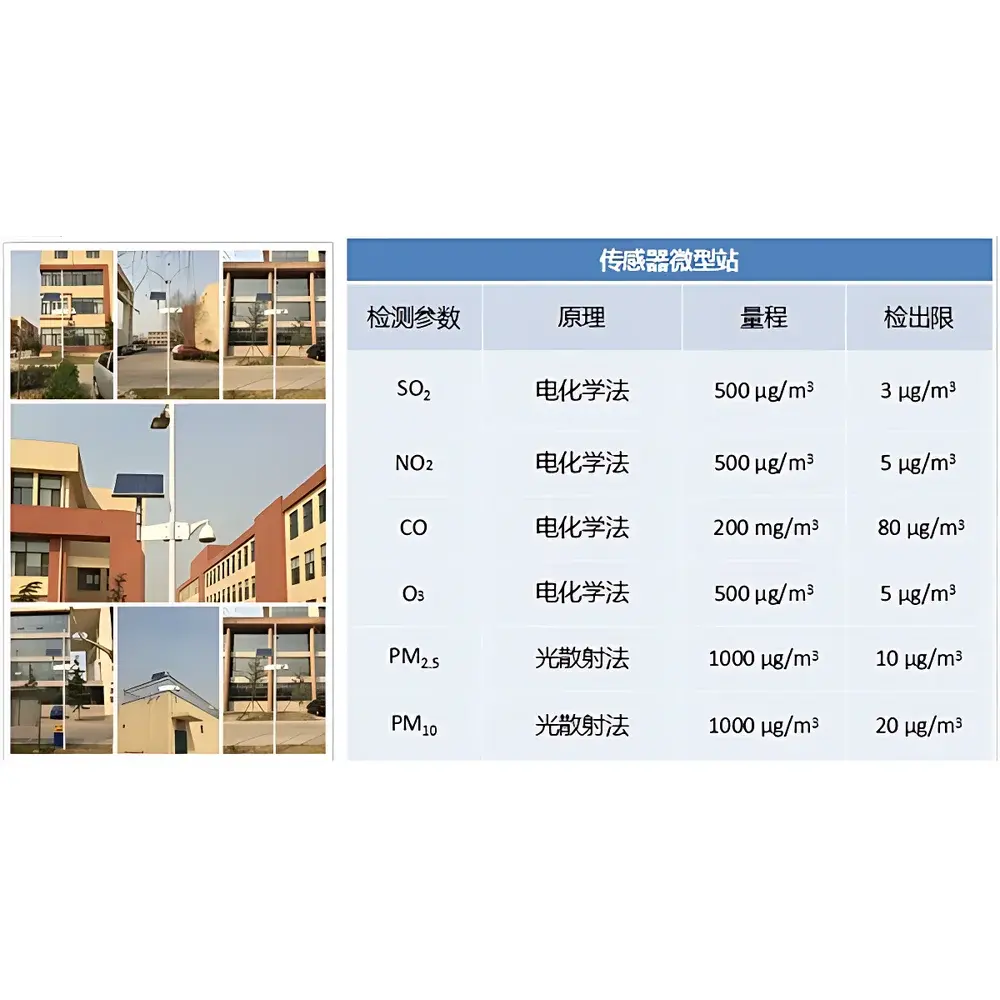
XHAQSN-804 Compact Multi-Parameter Atmospheric Monitoring Station
| Origin | Hebei, China |
|---|---|
| Manufacturer Type | Authorized Distributor |
| Origin Category | Domestic (PRC) |
| Model | XHAQSN-804 |
| Pricing | Upon Request |
| Measurement Principle | Hybrid Electrochemical & Optical Sensing |
| Measured Parameters | PM₂.₅, PM₁₀, Temperature, Relative Humidity |
| Power Supply | Flexible (DC 12 V / Solar Optional) |
| Communication | LTE-M/NB-IoT + Secure TLS 1.2 Encrypted Uplink |
| Data Resolution | 1–5 Minute Intervals |
| Compliance | CE-marked for Environmental Use |
| Enclosure Rating | IP65 |
Overview
The XHAQSN-804 Compact Multi-Parameter Atmospheric Monitoring Station is an engineered solution for high-density, real-time ambient air quality surveillance in urban, industrial, and peri-urban environments. Designed around a modular sensor architecture, it integrates calibrated electrochemical sensors for gaseous pollutants (where configured) and optical scattering-based particulate mass concentration detection—specifically optimized for PM₂.₅ and PM₁₀ quantification via laser nephelometry principles. Unlike traditional beta-attenuation or tapered element oscillating microbalance (TEOM) systems, the XHAQSN-804 employs low-power, field-stable optical modules with temperature- and humidity-compensated algorithms to minimize drift and enhance long-term reproducibility under variable climatic conditions. Its compact footprint (≤250 mm × 180 mm × 120 mm) and dual-mode power capability (12 V DC input or solar-rechargeable battery pack) enable rapid deployment across heterogeneous terrain—including lamp posts, building façades, traffic intersections, and school rooftops—without requiring civil infrastructure or dedicated power routing.
Key Features
- Multi-parameter co-location: Simultaneous acquisition of PM₂.₅, PM₁₀, ambient temperature (±0.3 °C), and relative humidity (±2 % RH) on a single embedded platform.
- Low detection limits: PM₂.₅ LOD < 1 µg/m³ (1σ, 1-minute average); PM₁₀ LOD < 2 µg/m³ under controlled calibration conditions.
- Time-resolved data output: Configurable reporting intervals from 1 to 30 minutes, supporting both burst-mode event capture and baseline trend analysis.
- Secure edge-to-cloud architecture: Onboard TLS 1.2 encryption, device-authenticated MQTT over NB-IoT/LTE-M, and automatic reconnection logic ensure data integrity during network handover or signal fluctuation.
- Field-maintainable design: Hot-swappable sensor cartridges with factory-traceable calibration certificates; no soldering or firmware flashing required during routine replacement.
- Environmental resilience: IP65-rated enclosure with UV-stabilized polycarbonate housing, operating range −20 °C to +50 °C, suitable for unattended operation across four seasons.
Sample Compatibility & Compliance
The XHAQSN-804 is validated for continuous monitoring of ambient outdoor air in accordance with national ambient air quality standards (e.g., China’s GB 3095-2012). While not certified as a reference-grade monitor per ISO 20983:2017 or EN 16450:2017, its performance characteristics align with the technical criteria for indicative measurement systems defined in EU Directive 2008/50/EC Annex VI. Sensor outputs are traceable to NIM (National Institute of Metrology, China) standards through documented calibration chains. The unit complies with electromagnetic compatibility requirements per GB/T 17626 series and meets RoHS Directive 2011/65/EU restrictions on hazardous substances. It supports audit-ready metadata logging—including sensor serial numbers, calibration dates, firmware versions, and GPS-assisted geotagging—for GLP-aligned data governance.
Software & Data Management
Data from distributed XHAQSN-804 nodes is ingested into a cloud-native SaaS platform supporting RESTful API integration with third-party GIS engines (e.g., ArcGIS Online, QGIS Cloud) and regulatory dashboards. The platform implements role-based access control (RBAC), granular permission tiers, and full audit trails compliant with ISO/IEC 27001 information security frameworks. All raw time-series measurements are stored with immutable timestamps and include QC flags (e.g., “low-signal”, “humidity saturation”, “sensor timeout”) to support transparent data qualification. Batch export options include CSV, NetCDF4, and JSON-LD formats, with optional alignment to AQI calculation protocols (US EPA, WHO, or MEPC China). Firmware updates are delivered over-the-air (OTA) with cryptographic signature verification.
Applications
- Urban air quality hotspot mapping at street-canyon scale for municipal environmental departments.
- Industrial fence-line monitoring to verify compliance with local emission thresholds and detect fugitive releases.
- School and hospital campus exposure assessment for epidemiological cohort studies.
- Validation and spatial interpolation of satellite-derived aerosol optical depth (AOD) products.
- Supporting dynamic traffic management systems by correlating PM spikes with vehicle flow patterns.
- Long-term trend analysis for regional Clean Air Action Plans aligned with national carbon neutrality targets.
FAQ
Is the XHAQSN-804 suitable for regulatory reporting purposes?
No—it is classified as an indicative monitoring system per international guidance documents and intended for screening, source identification, and public engagement—not for legally binding compliance verification.
What calibration frequency is recommended for field operation?
Biannual field calibration against a co-located reference monitor is advised; sensor cartridges include 12-month stability warranties with optional annual recalibration services.
Can the station operate independently without cellular coverage?
Yes—internal SD card logging retains up to 30 days of 1-minute data locally; transmission resumes automatically upon network recovery.
Does the system support custom parameter integration (e.g., NO₂, O₃)?
Hardware-level expansion is limited to the preconfigured sensor set; however, external analog/digital inputs (0–5 V, RS-485) allow integration with third-party gas analyzers via gateway configuration.
How is data security enforced between device and cloud?
End-to-end encryption uses TLS 1.2 with device-specific X.509 certificates; all API endpoints require OAuth 2.0 bearer tokens and rate-limiting policies.
Related Products







