
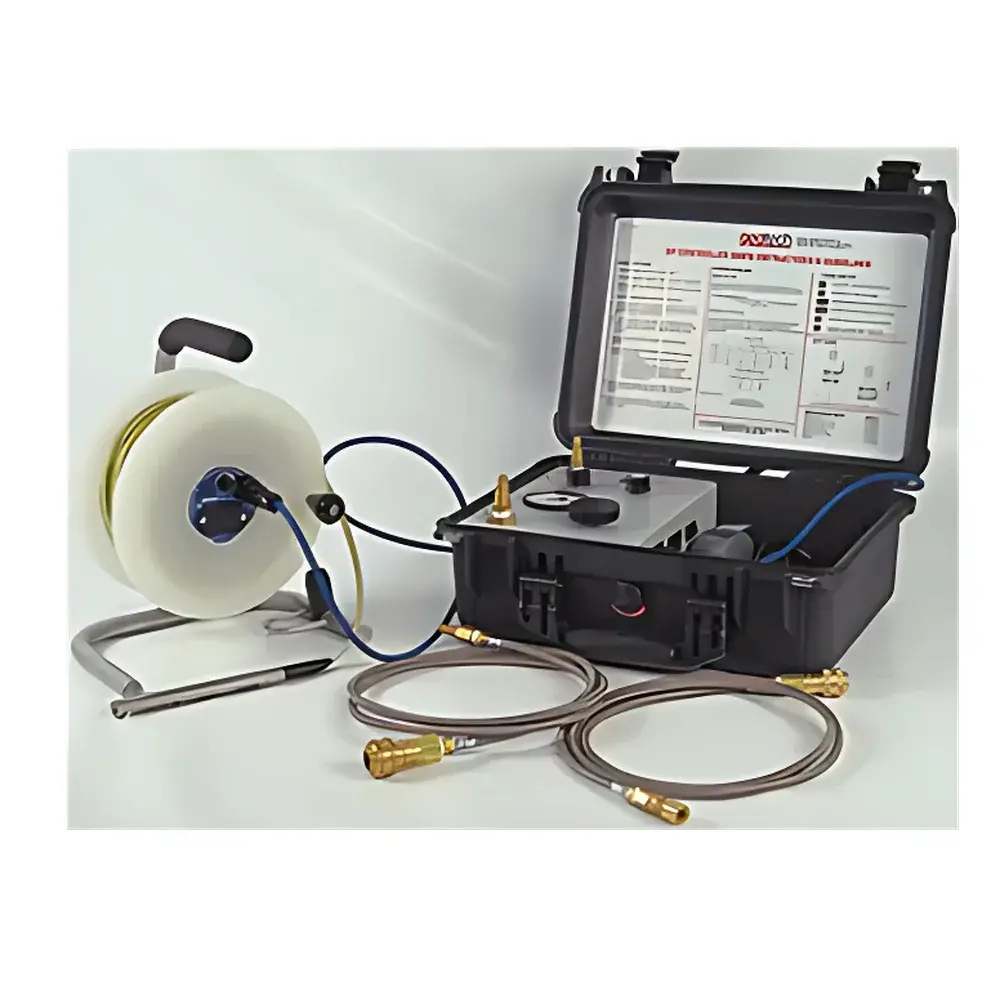
Geotech High-Pressure Deep-Well Bladder Pump
| Brand | SAIL HERO (Xianhe Environmental Protection) |
|---|---|
| Origin | Hebei, China |
| Manufacturer Type | Direct Manufacturer |
| Country of Origin | China |
| Model | 300 PSI / 500 PSI |
| Instrument Type | Manual Water Sampler |
| Power Input Options | DC/AC |
| Max. Operating Depth | 210 m (300 PSI) / 305 m (500 PSI) |
| Bladder Material | Virgin PTFE (Resin-Grade) |
| Housing Material | 316 Stainless Steel |
| Inlet Filter | Integrated Stainless Steel Sieve |
| Controller Features | Microprocessor-Based Timing, Over-Pressure Protection, Water-Level Drawdown Compatibility with DIP-Tape Sensors |
| Drop-Tube Compatible | Yes |
| Regulatory Compliance | Designed for ASTM D6771, EPA Method 502.2 & 8260-compliant VOC sampling workflows |
Overview
The Geotech High-Pressure Deep-Well Bladder Pump is an engineered solution for low-flow, low-disturbance groundwater sampling in deep-well environments—particularly where volatile organic compounds (VOCs), trace metals, or redox-sensitive analytes require minimal aquifer perturbation. Based on positive-displacement bladder actuation via regulated compressed air, the system operates on the principle of sequential inflation and deflation of a chemically inert PTFE bladder housed within a 316 stainless steel pump body. This mechanism isolates the sample from direct contact with air or mechanical components, preventing volatilization loss, oxidation, or cross-contamination. Unlike peristaltic or submersible turbine pumps, the bladder design eliminates moving parts in the fluid path and ensures zero oil or lubricant exposure—critical for compliance with U.S. EPA Method 502.2 (VOCs in groundwater) and ASTM D6771 (low-flow purge-and-trap sampling). The pump is rated for static water levels up to 305 meters (1000 ft), with optional drop-tube extension kits enabling deeper deployment while maintaining flow rates between 10–500 mL/min—fully adjustable via microprocessor-controlled duty cycles.
Key Features
- Two pressure-rated configurations: 300 PSI (210 m max depth) and 500 PSI (305 m max depth), each equipped with high-integrity stainless steel pressure valves and fine-resolution air regulators
- Microprocessor-based controller with programmable inflation/deflation timing, enabling precise low-flow rate control and reproducible drawdown profiles
- Resin-grade virgin PTFE bladder—certified extractables-free per USP Class VI and FDA 21 CFR 177.1550—ensuring negligible leachables during extended sampling campaigns
- 316 stainless steel pump housing and inlet assembly, corrosion-resistant in aggressive geochemical matrices including sulfide-rich or saline aquifers
- Integrated 100-micron stainless steel inlet sieve to retain suspended solids >100 µm, reducing bladder abrasion and extending service life beyond 5,000 operational cycles
- Portable controller housed in ruggedized transit case with dual power input support (12 V DC vehicle battery or 100–240 V AC universal input)
- Internal over-pressure safety cutoff prevents bladder rupture under transient air supply surges
- Direct compatibility with Geotech GeoControl PRO and BP-series controllers, enabling seamless integration into existing field data acquisition ecosystems
Sample Compatibility & Compliance
The pump is validated for use in regulatory-compliant groundwater monitoring programs governed by U.S. EPA, ASTM International, and ISO standards. It meets the physical and material requirements of EPA Method 502.2 for VOC preservation, ASTM D6771 for low-flow sampling protocols, and ISO 5667-3:2018 for sampling equipment selection. Its all-PTFE wetted path and absence of elastomeric seals or lubricants eliminate interference with GC-MS analysis. The system supports GLP-aligned field documentation when paired with Geotech’s certified drawdown sensors and time-stamped controller logs—facilitating audit-ready records for state and federal regulatory submissions (e.g., RCRA, CERCLA, SDWA).
Software & Data Management
While the base controller operates as a standalone hardware unit, its digital I/O interface enables synchronization with third-party logging systems (e.g., Campbell Scientific CR1000X, Onset HOBO U20L) for automated water-level correlation. Optional firmware upgrades provide CSV-exportable operation logs—including cycle count, total runtime, average flow rate, and pressure-event timestamps—structured for import into LIMS platforms compliant with 21 CFR Part 11 (electronic signatures and audit trails). No proprietary cloud platform is required; raw log files are stored locally on removable microSD card with write-protected archival mode.
Applications
- Long-term monitoring well networks requiring representative VOC and SVOC profiling without aquifer mixing
- Pre-purge and low-flow well development prior to analytical sampling per EPA guidance
- Redox-sensitive parameter collection (e.g., Fe²⁺/Fe³⁺, Mn²⁺, dissolved oxygen) where minimal turbulence preserves speciation
- Regulatory compliance sampling at Superfund sites, landfill leachate plumes, and industrial brownfields
- Isotope hydrology studies requiring ultra-low disturbance to minimize isotopic fractionation during extraction
- Multi-level sampling systems (MLS) integrated with Geotech’s Solinst Waterloo system or Westbay MPD manifolds
FAQ
What is the maximum recommended static water level for continuous operation?
For the 500 PSI model, continuous operation is validated up to 305 m (1000 ft) static depth; however, sustained operation above 270 m requires verified air supply stability and ambient temperature control (5–40 °C).
Can this pump be used for drinking water supply wells?
No—it is designed exclusively for environmental sampling and monitoring, not potable water delivery; it lacks NSF/ANSI 61 certification for human consumption.
Is calibration required before each sampling event?
No routine calibration is mandated; however, pre-deployment verification of bladder integrity (via pressure hold test) and flow rate validation using a calibrated flowmeter are recommended per ASTM D6771 Section 7.3.
How does the system ensure VOC preservation during extraction?
By eliminating headspace exposure, minimizing turbulence, and avoiding hydrocarbon-based components, the PTFE/stainless steel architecture prevents adsorption, volatilization, or chemical degradation—key criteria outlined in EPA Method 502.2 Section 4.1.
Related Products







