
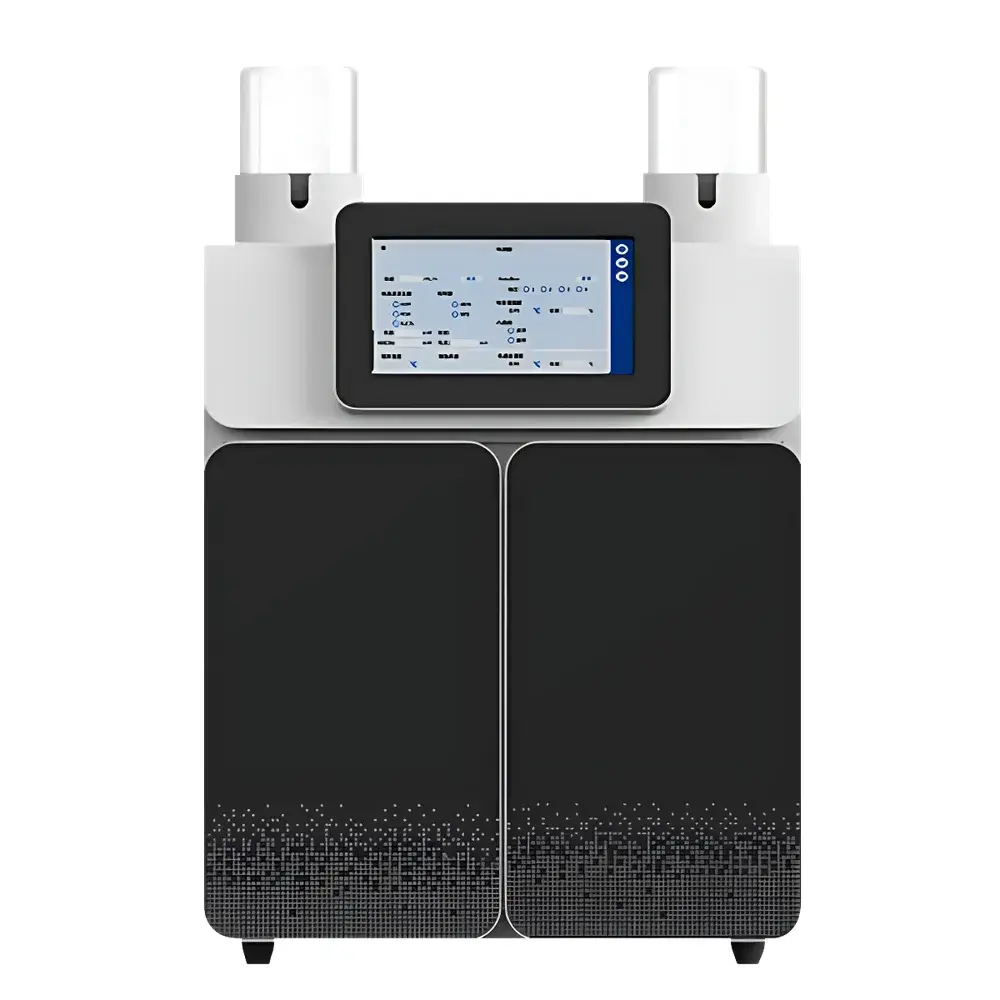
Yoke IC-hope1800SI Luban Series Dual-Channel Ion Chromatograph
| Brand | Yoke |
|---|---|
| Origin | Shanghai, China |
| Manufacturer Type | Direct Manufacturer |
| Instrument Type | Laboratory Benchtop Ion Chromatograph |
| Application Scope | General-Purpose Anion/Cation Analysis |
| Maximum Pump Pressure | 0–35 MPa |
| Flow Rate Range | 0.001–10.000 mL/min |
| Eluent Flow Rate | 0.1–5.0 mL/min |
| Max Operating Pressure | 35 MPa |
| Column Oven Temperature Range | 5–65 °C |
| Temperature Reproducibility | ≤ 0.1 °C |
| Eluent Concentration Range | 0.1–100 mM |
Overview
The Yoke IC-hope1800SI Luban Series Dual-Channel Ion Chromatograph is an integrated benchtop analytical system engineered for high-precision, simultaneous separation and quantification of inorganic anions and cations in complex aqueous matrices. Based on suppressed conductivity detection and high-pressure liquid chromatography principles, the instrument employs dual independent flow paths—each with dedicated eluent generation, separation column, suppressor, and detector—to enable true parallel analysis without cross-channel interference. Its core architecture follows ISO/IEC 17025-aligned design practices, incorporating full-plastic fluidic pathways (PEEK, PTFE, and chemically inert polypropylene) to eliminate metal ion leaching and ensure trace-level accuracy. The system operates under programmable gradient elution via an integrated electrolytic eluent generator (EG), eliminating manual eluent preparation and enabling precise, reproducible concentration control from 0.1 to 100 mM using only ultrapure water as feedstock.
Key Features
- Dual-channel architecture with physically isolated anion and cation flow paths—enabling concurrent, non-interfering analysis in a single run
- Integrated electrolytic eluent generator supporting automated gradient elution; eliminates bottled eluents and reduces carryover risk
- 10.0-inch industrial-grade capacitive touchscreen with embedded real-time control software displaying conductivity, current, flow rate, pressure, suppressor status, six-port valve position, and EG operational feedback
- Column oven with active Peltier-based temperature control (5–65 °C) and ≤0.1 °C thermal reproducibility—ensuring retention time stability and column longevity
- Full-system self-diagnostic capability: automatic valve position recognition, real-time flow path integrity monitoring, and scheduled maintenance cycles including auto-flush routines for pump heads, suppressors, and injection loops
- Industrial-grade electronic components with multi-layer EMI shielding and corrosion-resistant fluidic fittings compatible with strong acids (e.g., HNO₃, H₂SO₄), alkalis (e.g., NaOH, KOH), and miscible organic modifiers (e.g., methanol, acetonitrile)
- Modular expandability: supports optional UV/Vis absorbance detection (200–400 nm), pH, or conductivity modules for hybrid multi-parameter analysis of non-standard samples
Sample Compatibility & Compliance
The IC-hope1800SI is validated for analysis of environmental waters (drinking, surface, wastewater), food extracts, pharmaceutical excipients, battery electrolytes, and semiconductor process chemicals. Its all-plastic fluidic path meets USP requirements for low-metal leaching in purified water testing and complies with ASTM D4327 (anions) and D6919 (cations) methodologies. Data acquisition and instrument control support audit-trail-enabled operation per FDA 21 CFR Part 11 when deployed with validated networked software configurations. System logs retain full parameter history—including method files, calibration records, sequence tables, and hardware status timestamps—for GLP/GMP traceability and root-cause troubleshooting.
Software & Data Management
Control and data processing are managed through Yoke’s proprietary ChromoView™ software, available in both standalone touchscreen mode and synchronized PC interface. The software provides real-time chromatogram visualization with adjustable sampling frequency (1–10 Hz), peak integration using tangent skim or Gaussian deconvolution algorithms, and customizable reporting templates compliant with ISO 17025 Annex A. Raw data files (.ycd) are stored with embedded metadata (operator ID, instrument serial, method version, environmental sensor readings). All method changes, parameter edits, and manual interventions are timestamped and logged in an immutable audit trail. Export options include CSV, PDF, and CDF formats compatible with LIMS integration and third-party statistical packages (e.g., JMP, Minitab).
Applications
- Simultaneous quantification of F⁻, Cl⁻, NO₂⁻, Br⁻, NO₃⁻, PO₄³⁻, SO₄²⁻, and ClO₃⁻ in municipal drinking water per EPA Method 300.1
- Li⁺, Na⁺, NH₄⁺, K⁺, Mg²⁺, Ca²⁺, and transition metals (e.g., Fe²⁺/Fe³⁺ after chelation) in lithium-ion battery electrolyte formulations
- Organic acids (acetate, formate, oxalate) and inorganic anions in fermentation broths and biopharmaceutical process streams
- Chloride and sulfate ingress monitoring in concrete pore solutions per ASTM C1218
- Low-level bromide and iodide detection in iodized salt and dairy products using post-column derivatization-ready flow cell interfaces
FAQ
Does the IC-hope1800SI support regulatory-compliant data integrity?
Yes—the system supports electronic signatures, user access levels (admin/operator/auditor), and immutable audit trails aligned with FDA 21 CFR Part 11 and EU Annex 11 when configured with network authentication and encrypted storage.
Can the dual channels operate with different eluents and columns simultaneously?
Yes—each channel has independent eluent generation, column oven, suppressor, and detector control, allowing fully asynchronous methods (e.g., carbonate/bicarbonate gradient for anions; methanesulfonic acid isocratic for cations).
Is the eluent generator compatible with high-purity water systems?
It requires ≥18.2 MΩ·cm resistivity water with TOC <5 ppb; integrated inline degassing and particulate filtration are recommended for long-term EG electrode stability.
What maintenance intervals are recommended for routine operation?
The system performs automated daily flushes; suppressor regeneration is scheduled every 500 injections; pump seal replacement is advised at 10,000 operating hours or per pressure deviation diagnostics.
How is column temperature stability verified during validation?
Certified NIST-traceable PT100 sensors embedded in the oven block provide continuous logging; temperature accuracy is verified annually using calibrated dry-block calibrators per ISO/IEC 17025 Clause 6.4.



