
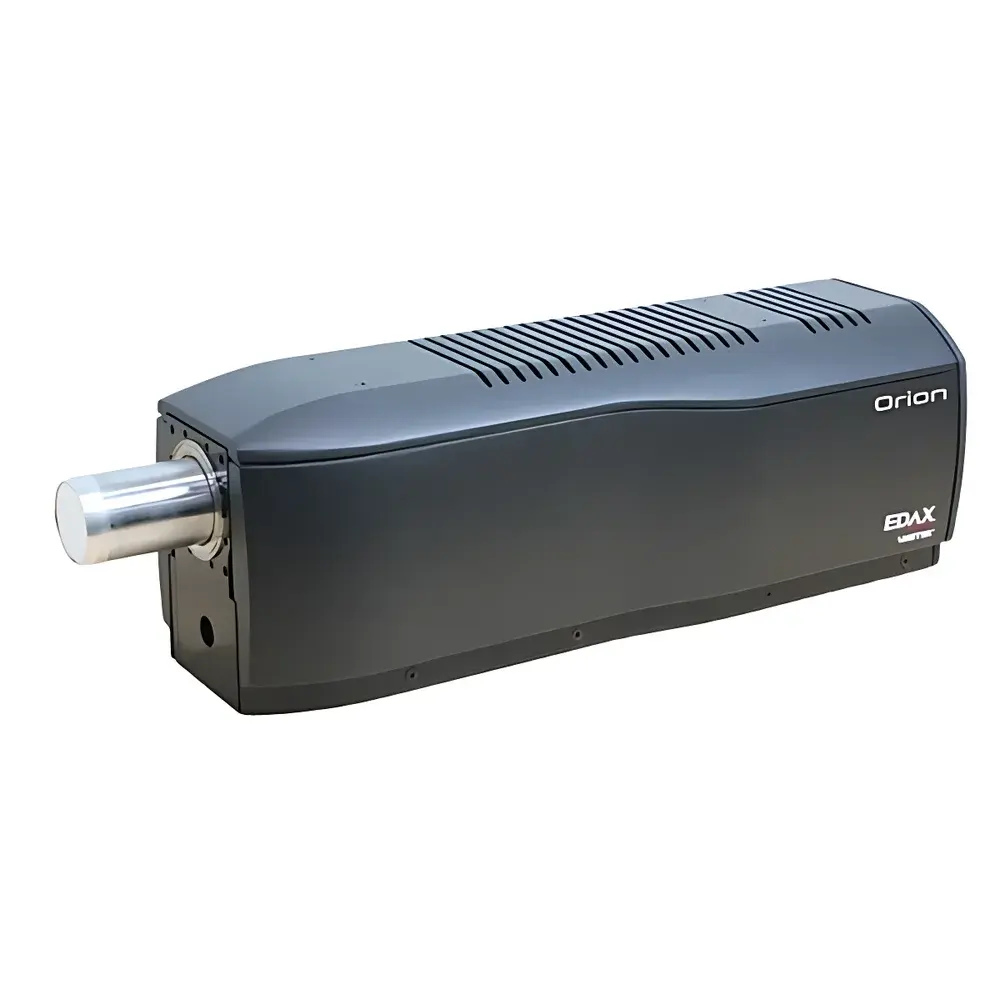
EDAX Orion EBSD Camera System
| Brand | EDAX |
|---|---|
| Origin | USA |
| Model | Orion |
| Angular Resolution | < 0.1° |
| Maximum Pattern Acquisition Rate | 1500 pts/s (Orion Plus) or 3000 pts/s (Orion Super) |
| Sensor Type | High-Sensitivity CMOS |
| Standard Pattern Size for High-Speed Calibration | 120 × 120 pixels |
| Confidence-Based Indexing Algorithm | Tri-Band Confidence Index (CI) |
| EDS-EBSD Synchronization | Fully Supported with EDAX EDS Detectors |
| Compliance | Designed for ASTM E112, ISO 11947, and USP <1086>–aligned microstructural characterization workflows |
Overview
The EDAX Orion EBSD Camera System is a high-performance electron backscatter diffraction (EBSD) detector engineered for precision crystallographic orientation mapping in scanning electron microscopy (SEM) environments. Operating on the fundamental principle of Kikuchi pattern formation—where elastically backscattered electrons interact with crystalline lattice planes to generate characteristic diffraction bands—the Orion system captures and indexes these patterns to determine local crystal orientation, phase identity, grain boundary character, and lattice strain distribution at sub-micron spatial scales. Unlike legacy CCD-based detectors, the Orion leverages a custom-designed, low-noise CMOS sensor architecture optimized for both speed and signal fidelity under variable beam conditions. Its real-time indexing engine implements EDAX’s proprietary Tri-Band Confidence Index algorithm, enabling robust pattern solution even on deformed, multiphase, or low-symmetry materials—without requiring additional hardware modules or post-acquisition refinement.
Key Features
- Two performance-tier configurations: Orion Plus (up to 1500 indexed points per second) and Orion Super (up to 3000 indexed points per second), both achieving >99% indexing success rate at full speed
- High-sensitivity CMOS sensor with optimized quantum efficiency and readout noise characteristics, enabling stable pattern acquisition at 120 × 120 pixel resolution during rapid scanning
- Angular orientation resolution better than 0.1°, validated using standard Ni and Si reference samples per ASTM E112 Annex A5 protocols
- Integrated confidence-indexed indexing engine that quantifies solution reliability per pixel, supporting statistically defensible grain reconstruction and misorientation analysis
- Native synchronization with EDAX EDS spectrometers (e.g., Octane Elite, TEAM EDS) for concurrent chemical and crystallographic data collection without time lag or spatial drift
- Hardware-level trigger alignment and shared SEM stage control ensure sub-pixel registration between EDS maps and EBSD orientation images
Sample Compatibility & Compliance
The Orion system demonstrates broad applicability across metallurgical, geological, ceramic, and advanced alloy systems—including severely deformed metals (e.g., cold-rolled Al alloys), nanocrystalline composites, twinned perovskites, and multiphase intermetallics. Its low-dose imaging capability supports beam-sensitive specimens such as battery cathode materials and organic-inorganic hybrids. From a regulatory standpoint, the Orion platform supports GLP/GMP-aligned workflows through audit-trail-enabled software logging (per FDA 21 CFR Part 11 requirements when used with OIM Analysis™ v8+), traceable calibration certificates (NIST-traceable angular scale verification), and compliance-ready reporting templates aligned with ISO 11947-1 (EBSD terminology) and ASTM E112-22 (grain size measurement standards).
Software & Data Management
Orion operates exclusively within EDAX’s OIM Analysis™ software suite, which provides end-to-end processing—from raw pattern import and dynamic background correction to grain reconstruction, texture pole figure generation, and phase boundary classification. The software includes automated drift correction, adaptive binning, and batch-processing pipelines compatible with high-throughput lab environments. All datasets retain full metadata (beam energy, working distance, tilt angle, detector geometry), enabling reproducible reprocessing and cross-laboratory comparison. Export formats include HDF5 (for Python/MATLAB integration), .ang (ASTM-standard orientation file format), and georeferenced TIFF stacks compatible with third-party tomography reconstruction tools.
Applications
- Quantitative grain structure analysis in additive-manufactured Ti-6Al-4V and IN718 components
- In-situ deformation studies tracking dislocation density evolution via Kernel Average Misorientation (KAM) mapping
- Phase transformation kinetics in heat-treated steels and shape-memory alloys
- Interface engineering of solid-state battery electrolyte/electrode boundaries
- Crystallographic texture evaluation in rolled aluminum sheets per ISO 8983
- 3D EBSD serial sectioning via FIB-SEM correlation workflows
FAQ
What is the minimum working distance required for optimal Orion performance?
Typical optimal working distance ranges from 15 mm to 22 mm depending on SEM chamber geometry and sample tilt (70° standard). Detector geometry is pre-calibrated for this range.
Does Orion support automated phase identification without prior EDS input?
Yes—pattern-based phase discrimination is performed via Hough-transform indexing against user-loaded crystal structure databases (CIF files), though EDS-EBSD correlation improves confidence in ambiguous cases.
Can Orion data be exported for machine learning training pipelines?
Yes—OIM Analysis supports direct export of indexed orientation matrices, confidence indices, and band contrast values in CSV and HDF5 formats, suitable for supervised training of CNN-based indexing models.
Is Orion compatible with field-emission SEMs operating below 5 kV?
Yes—low-voltage operation down to 3 kV is supported; however, pattern quality and indexing rate scale with beam current and landing energy, and may require minor optimization of camera gain and exposure settings.




