
XHCEMS-8000 Continuous Emission Monitoring System (CEMS) for CO₂ in Flue Gas
| Brand | SAIL HERO |
|---|---|
| Origin | Hebei, China |
| Manufacturer Type | Original Equipment Manufacturer (OEM) |
| Country of Manufacture | China |
| Model | XHCEMS-8000 |
| Detection Principle | Non-Dispersive Infrared (NDIR) |
| Measured Gases & Ranges | CO₂ (standard), with optional expansion to CH₄ and N₂O |
| Application Field | Environmental Compliance Monitoring |
| Regulatory Context | Designed for continuous compliance reporting per national emission standards (e.g., China’s HJ 75–2017, HJ 76–2017) and compatible with international CEMS framework requirements (e.g., EN 14181, US EPA PS-11/PS-15) |
Overview
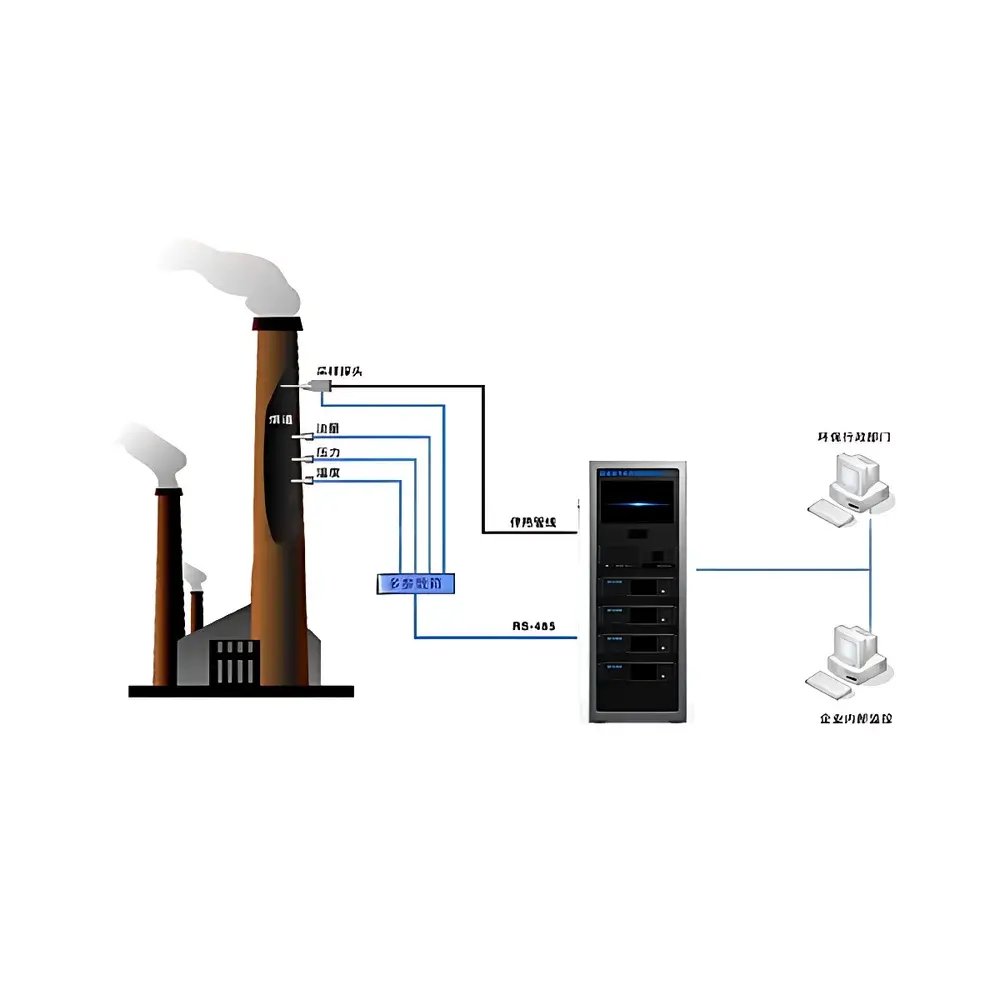
The XHCEMS-8000 Continuous Emission Monitoring System is an industrial-grade, stack-mounted flue gas analyzer engineered for regulatory-grade, real-time quantification of carbon dioxide (CO₂) emissions from combustion sources such as power plants, cement kilns, steel furnaces, and waste incinerators. Built upon non-dispersive infrared (NDIR) spectroscopy — a reference method recognized for its selectivity, stability, and linearity in CO₂ measurement — the system delivers high-reproducibility concentration data under harsh industrial conditions. Unlike extractive systems relying on ambient-temperature sampling lines, the XHCEMS-8000 employs hot-wet extraction: the probe and sample line are maintained at ≥180 °C to prevent condensation, acid dew point corrosion (e.g., from SO₃), and particulate deposition. Sample conditioning includes multi-stage filtration (coarse, medium, fine) and active dew point stabilization, ensuring consistent dry-basis gas composition prior to optical analysis. The system complies with fundamental CEMS architecture principles defined in ISO 14956 and supports traceability via integrated calibration gas ports, automated zero/span validation, and full audit trail logging.
Key Features
- Hot-extraction architecture with probe and transport line heated to ≥180 °C, eliminating water condensation and SO₃-induced corrosion
- Three-stage particulate filtration (probe-integrated + inline + pre-analyzer) to ensure long-term operational integrity in high-dust environments
- Dew point-controlled gas conditioning module delivering stable, low-humidity sample stream (<5 °C dew point) to the NDIR detector
- Integrated probe-level diagnostics: built-in calibration port, reverse-purge interface, and temperature/pressure monitoring for end-to-end system validation
- Modular sensor expansion capability: CO₂ is standard; CH₄ and N₂O measurement modules can be added without hardware redesign or software re-architecture
- Comprehensive fault detection suite: real-time alarms for flow rate deviation, temperature excursion, pressure loss, and out-of-range signal saturation, with timestamped event logging
- Automated maintenance scheduling: programmable reverse-purge cycles, self-calibration intervals, and configurable alarm thresholds aligned with HJ 75–2017 QA/QC protocols
Sample Compatibility & Compliance
The XHCEMS-8000 is validated for use across flue gas matrices typical of coal-fired, biomass, natural gas, and municipal solid waste combustion. It accommodates gas temperatures up to 300 °C, particulate loadings ≤10 g/m³, and moisture content up to 25 vol%. All wetted components — including the ceramic probe filter, PTFE-lined sample line, and stainless-steel conditioning manifold — resist acidic condensate and alkali salt deposition. The system meets Chinese national technical specifications HJ 75–2017 (CEMS installation, operation, and quality assurance) and HJ 76–2017 (performance testing and verification). Its architecture supports data integrity requirements analogous to those referenced in EN 14181 (QA procedures for automated measuring systems) and aligns with foundational elements of US EPA Method 3A and ASTM D6522 for CO₂ quantification. Full data traceability — including calibration logs, maintenance records, and raw spectral output — satisfies GLP-aligned recordkeeping expectations.
Software & Data Management
The embedded CEMS controller runs a deterministic real-time OS with dual redundant storage (SSD + SD card) for secure retention of 12+ months of second-level resolution data. All measurements — CO₂, O₂, flue gas temperature, static/dynamic pressure, velocity, and humidity — are synchronized and corrected to standardized conditions (dry, 101.325 kPa, 273.15 K) using onboard stoichiometric algorithms per GB/T 16157 and HJ/T 397. Data export formats include Modbus TCP, OPC UA, and ASCII CSV over Ethernet; native integration with China’s National Pollution Source Monitoring Platform (NPMP) is supported via encrypted HTTPS API. Audit trails capture every user action (e.g., calibration initiation, parameter change, alarm acknowledgment), with SHA-256 hashing applied to critical log entries. Optional firmware enables 21 CFR Part 11–compliant electronic signatures and role-based access control (RBAC) for multi-user operational environments.
Applications
- Continuous reporting of CO₂ mass emission rates (kg/h, t/day) for national greenhouse gas inventories and provincial emission trading schemes
- Real-time combustion efficiency optimization via concurrent CO₂/O₂ ratio analysis and excess air calculation
- Multi-gas compliance monitoring for co-emitted species (CH₄, N₂O) under evolving regulatory frameworks targeting short-lived climate pollutants
- Performance verification of carbon capture and storage (CCS) unit inlet/outlet streams
- Stack testing support during environmental impact assessments (EIAs) and periodic source testing per regulatory schedules
- Integration into plant-wide distributed control systems (DCS) for emission-aware process control logic
FAQ
Does the XHCEMS-8000 meet international CEMS certification requirements?
Yes — while certified per China’s HJ 75–2017, its core NDIR measurement methodology, hot-extraction design, and QA/QC architecture conform to functional equivalency with EN 14181 Level 2 and US EPA PS-11 performance criteria.
Can CO₂ measurement data be reported directly to government environmental platforms?
Yes — the system includes pre-configured communication drivers for China’s NPMP and supports custom API mapping for EU IED reporting portals or US EPA CDX submissions.
What maintenance intervals are recommended for long-term reliability?
Filter replacement every 3–6 months (depending on dust loading); quarterly zero/span verification with certified NIST-traceable gases; annual optical path inspection and detector recalibration.
Is remote diagnostics and software update capability available?
Yes — secure SSH and HTTPS-based remote access enables firmware updates, configuration review, and live diagnostic telemetry without on-site technician dispatch.
How is measurement uncertainty quantified and documented?
Uncertainty budgets are generated per ISO/IEC 17025 Annex A.3, incorporating contributions from calibration gas uncertainty, temperature/pressure transducer accuracy, spectral baseline drift, and flow measurement repeatability — all logged with each 15-minute average report.







