
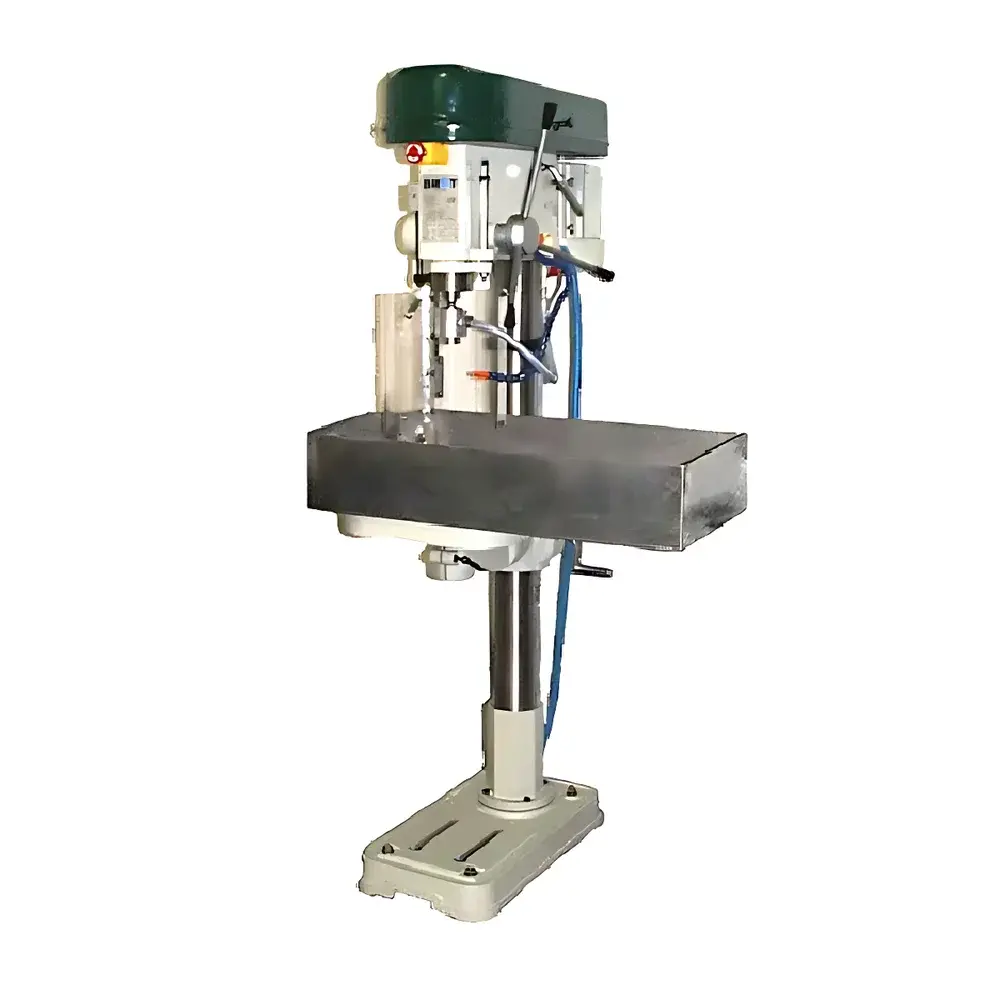
BROT-LAB Model 1.22.11 Vertical Core Drilling Machine
| Brand | French BROT-LAB |
|---|---|
| Origin | France |
| Manufacturer Type | Authorized Distributor |
| Origin Category | Imported |
| Model | 1.22.11 |
| Power Supply | 400 V, 3-phase, 50/60 Hz |
| Spindle Motor | 0.55 kW |
| Pump Motor | 150 W (recirculation only) |
| Spindle Speeds | 12 adjustable steps from 150 to 2,840 rpm |
| Core Diameter Range | Ø4 mm to Ø100 mm |
| Maximum Core Depth | 115 mm |
| Table Dimensions | 600 × 300 × 250 mm |
| Table Tilt Range | ±45° |
| Cooling Media | Water, oil, or liquid nitrogen (optional integrated recirculation system) |
| Drill Bit Internal Diameter | 1" (optional: 1.5", 2", 3", 4", or custom) |
| Noise Level | <70 dB(A) |
| Standard Accessories | Dual-clamp fixture, tilting table, safety guard |
| Optional Accessories | Integrated sediment-recycling water system, liquid nitrogen cooling module |
Overview
The BROT-LAB Model 1.22.11 is a precision-engineered vertical core drilling machine designed for controlled, low-vibration coring of geological, concrete, ceramic, and composite specimens in research laboratories and materials testing facilities. Operating on the principle of diamond-impregnated bit rotation under sustained axial load and active coolant delivery, it enables reproducible extraction of intact cylindrical cores within defined dimensional tolerances. Its rigid cast-iron base, adjustable tilting worktable, and modular coolant management system support both standard wet coring and cryogenic applications—particularly where thermal stability or microstructural preservation is critical (e.g., frozen soil, asphalt binders, or hydrated cement pastes). The machine complies with IEC 60204-1 for electrical safety and EN 61000-6-2/6-4 for electromagnetic compatibility, making it suitable for installation in ISO/IEC 17025-accredited testing environments.
Key Features
- Twelve-step mechanical belt-driven spindle speed control (150–2,840 rpm), enabling optimization for varying material hardness and diamond grit size.
- Dual-path coolant delivery system: pressurized internal flushing through hollow drill bits + external surface cooling at the bit–specimen interface, minimizing thermal cracking and bit wear.
- Manually adjustable tilting worktable with ±45° angular range and fine-height micrometer adjustment (0.01 mm resolution), facilitating angled coring and precise alignment relative to specimen anisotropy.
- Integrated chip and coolant recovery tray with sealed drainage channel, compatible with optional sediment-recycling filtration unit for extended operation without manual fluid replenishment.
- Interlocked safety guard with transparent polycarbonate shield and emergency stop circuit meeting EN ISO 13850 requirements.
- Modular design supporting field-upgradable configurations—including liquid nitrogen jacketed bit housing and cryo-stage integration for sub-zero coring down to –196°C.
Sample Compatibility & Compliance
The Model 1.22.11 accommodates specimens up to 300 × 300 × 300 mm (L × W × H) and accepts diamond core bits with internal diameters ranging from Ø4 mm to Ø100 mm (standard 1″ shank; optional metric or custom shanks available). It is routinely deployed in accordance with ASTM D2113 (Standard Practice for Diamond Core Drilling of Concrete), ISO 11467 (Rock core preparation for petrographic analysis), and EN 12390-1 (Testing hardened concrete — Part 1: Shape, dimensions and other requirements for specimens). All operational parameters—including speed selection, tilt angle, feed rate (manual), and coolant flow—are documented in the operator logbook to support GLP-compliant data traceability.
Software & Data Management
While the Model 1.22.11 operates via analog controls and does not feature embedded digital firmware, its mechanical repeatability and standardized mounting interfaces allow seamless integration into laboratory information management systems (LIMS) via external motion sensors and PLC-triggered logging. Optional USB-connected digital tachometers and coolant flow meters (supplied separately) generate timestamped CSV outputs compatible with LabArchives, Benchling, or custom SQL-based QA databases. Audit trails for maintenance intervals, bit usage cycles, and calibration verifications are maintained per ISO/IEC 17025 Clause 6.4.10.
Applications
- Geotechnical core sampling for porosity, permeability, and mineralogical analysis (e.g., sandstone, shale, basalt).
- Concrete quality assessment: extraction of cores for compressive strength testing (ASTM C42), chloride ion profiling, and microstructural imaging (SEM/CT).
- Advanced materials R&D: sectioning of fiber-reinforced polymers, battery electrode composites, and additive-manufactured metal parts.
- Paleoclimatology and glaciology: cryo-coring of ice cores with minimized fracturing using liquid nitrogen-cooled bits.
- Forensic engineering: non-destructive sampling of structural elements during failure investigations.
FAQ
Is the Model 1.22.11 compatible with automated feed systems?
No—this model features manual vertical feed control only. For motorized feed integration, consult BROT-LAB’s Model 1.22.11-AF variant (available upon request).
Can standard HSS or carbide bits be used?
No—only diamond-impregnated core bits with hollow center geometry are permitted due to the integrated internal coolant path and torque profile requirements.
What certifications accompany the machine upon shipment?
Each unit ships with CE Declaration of Conformity, Factory Calibration Certificate (spindle runout ≤ 0.02 mm), and RoHS/REACH compliance documentation.
Is on-site commissioning included?
Commissioning and basic operator training are provided by authorized BROT-LAB distributors as part of standard delivery terms for orders exceeding EUR 25,000.
How often must the coolant filtration system be serviced?
With continuous operation and standard water coolant, the optional sediment-recycling unit requires filter cartridge replacement every 200 operating hours or per visual inspection of turbidity.



