
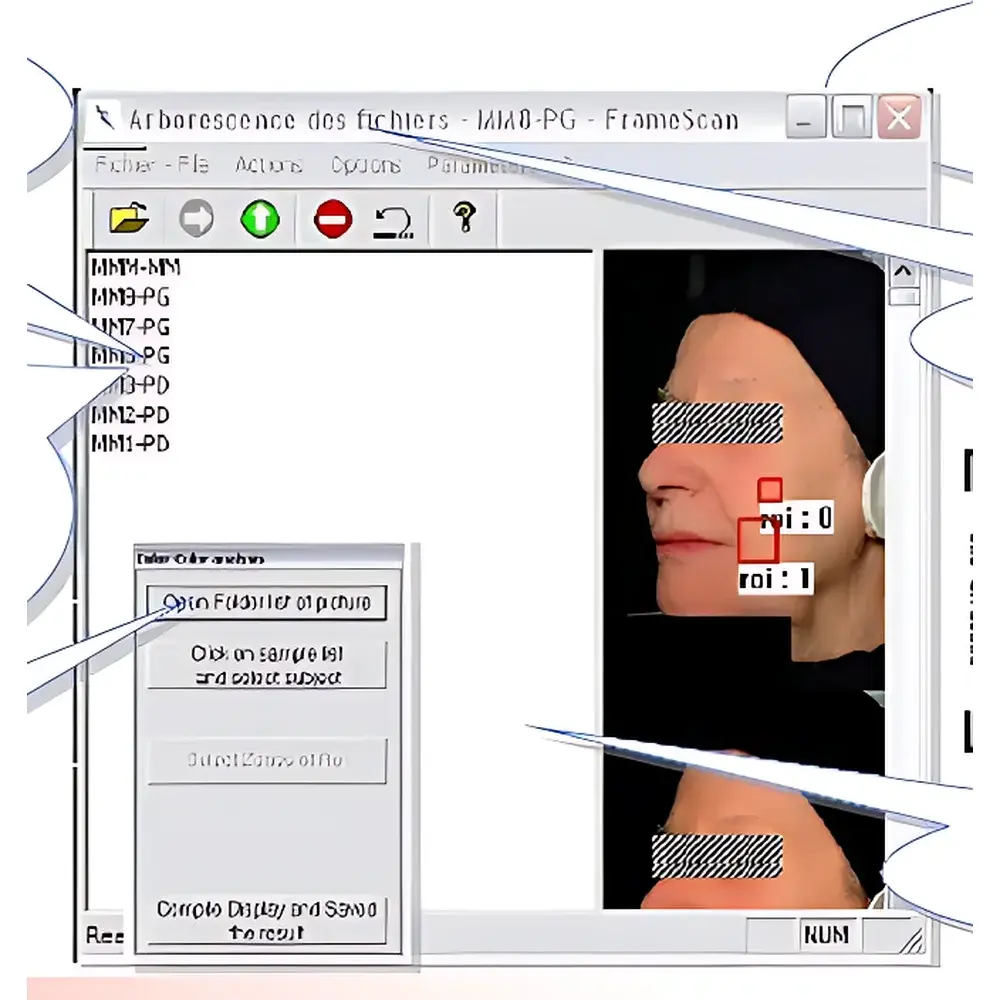
ORION FrameScan Skin Image Analysis Software
| Brand | ORION |
|---|---|
| Origin | France |
| Manufacturer Type | Authorized Distributor |
| Origin Category | Imported |
| Model | FrameScan |
| Pricing | Available Upon Request |
Overview
ORION FrameScan is a professional-grade, CE-marked skin image analysis software platform designed for objective, quantitative assessment of cutaneous parameters in clinical dermatology, cosmetic R&D, and regulatory-compliant efficacy testing. Built upon standardized digital imaging principles—including calibrated RGB-to-CIELAB color space conversion, multi-threshold segmentation algorithms, and spatial frequency-based wrinkle quantification—the software enables repeatable, operator-independent evaluation of morphological and chromatic features across longitudinal or cross-sectional study designs. It operates as a standalone application compatible with industry-standard dermatoscopic and macro-photographic imaging systems (e.g., VISIA, Antera, Canfield), supporting TIFF, PNG, and JPEG formats with embedded EXIF metadata preservation.
Key Features
- Pigmented Lesion Quantification: Automated detection and morphometric analysis of melanin-rich spots using adaptive hue-saturation-value (HSV) thresholding and connected-component labeling; outputs lesion count, area (mm²), mean diameter (µm), and spatial distribution entropy.
- Erythema Assessment: Spectrally weighted red-channel intensity mapping calibrated against standard color patches (BCRA II); reports erythema index (EI) per ISO 20195-1 and relative vascular density (%).
- Wrinkle Depth & Density Scoring: Gradient-based edge detection combined with local contrast normalization to compute wrinkle area ratio (WAR), average depth score (0–5 scale), and orientation anisotropy—aligned with SCORAD and EADV consensus guidelines.
- Colorimetric Measurement: Full CIE L*a*b* and L*C*h° space computation per ISO 8601 and ASTM D2244; includes inter-instrument variability compensation via reference tile calibration workflow.
- Mascara & Cosmetic Film Stability Tracking: Time-series image alignment with sub-pixel registration; quantifies pigment migration, film cracking, and smudge area expansion over 2h/4h/8h intervals per ISO 16128 Annex B protocols.
- Lash Length & Density Mapping: Binary skeletonization and endpoint detection algorithm optimized for high-magnification eyelash imagery; delivers mean lash length (mm), follicular density (follicles/cm²), and curvature index.
- Chromophore Separation Module: Multi-layer spectral unmixing (based on constrained non-negative matrix factorization) enabling independent visualization and quantification of melanin, hemoglobin, and collagen contributions within the epidermal-dermal junction.
Sample Compatibility & Compliance
FrameScan supports standardized imaging protocols compliant with ISO 24444 (sun protection testing), ISO 20195 (skin color measurement), and ICH M7 guidelines for photostability documentation. The software accommodates diverse subject populations—including Fitzpatrick skin types I–VI—and integrates with controlled lighting environments (D65 illuminant, 10° observer angle). All analytical outputs are traceable to NIST-traceable color standards (BCRA Series II tiles), and raw image archives retain full EXIF metadata for GLP audit readiness. The system meets EU Medical Device Regulation (MDR 2017/745) Annex I essential requirements for Class I software used in non-invasive diagnostic support.
Software & Data Management
FrameScan employs a relational SQLite database architecture with role-based access control (RBAC), encrypted storage (AES-256), and full audit trail functionality—including user login history, parameter modification timestamps, and export logs. Export options include CSV (for statistical packages such as SAS, R, or JMP), PDF summary reports with embedded annotated images, and XML files compliant with CDISC SDTM standards for regulatory submissions. The software supports FDA 21 CFR Part 11 compliance through electronic signature modules, configurable retention policies, and automated backup scheduling to network-attached storage (NAS) or cloud repositories (AWS S3, Azure Blob).
Applications
- Clinical trials evaluating anti-aging actives (retinoids, peptides, growth factors)
- Regulatory dossier preparation for cosmetic claims substantiation (EU Cosmetics Regulation EC No. 1223/2009, Annex I)
- In-vivo photoprotection studies (SPF, UVA-PF, critical wavelength)
- Post-procedure monitoring (laser resurfacing, chemical peels, microneedling)
- Formulation stability testing under thermal/humidity cycling (ICH Q1A)
- Objective grading of rosacea severity (ROSI scale) and melasma (MASI scoring)
- Academic research in biophysical skin science and ethnic dermatology
FAQ
Is FrameScan validated for use in FDA-submitted clinical studies?
Yes—FrameScan has been included in multiple IND-enabling dermatology trials; validation documentation (IQ/OQ/PQ protocols, precision/reproducibility data per ISO 5725) is available under NDA.
Can it integrate with third-party imaging hardware?
Yes—via TWAIN and WIA drivers; custom SDKs are provided for OEM integration with dermatoscopes and multispectral imagers.
Does it support multi-center study synchronization?
Yes—through centralized database deployment with TLS 1.2-encrypted client-server architecture and conflict-resolution logic for concurrent annotation.
What color calibration standards does it support?
BCRA Series II, X-Rite ColorChecker Passport, and ISO 12233 resolution charts; auto-calibration workflows include white balance, gamma correction, and chromatic adaptation (CIECAT02).
Is training and technical support available globally?
Yes—ORION-certified trainers deliver remote and on-site workshops; SLA-backed Level 3 engineering support covers software updates, bug resolution, and method transfer assistance.




