
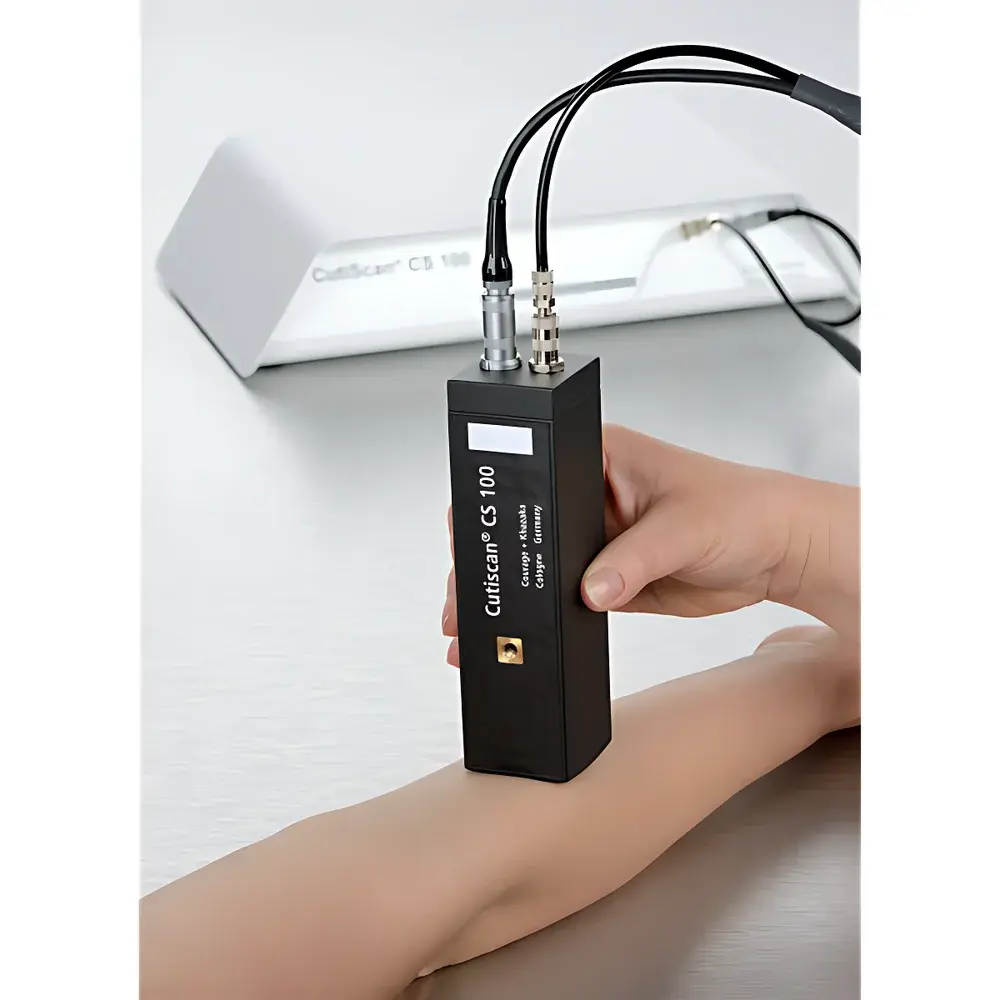
CK CutiScan CS100 Skin Viscoelasticity and Anisotropy Analyzer
| Brand | CK |
|---|---|
| Origin | Germany |
| Manufacturer Status | Authorized Distributor |
| Origin Category | Imported |
| Model | CS100 |
| Pricing | Upon Request |
Overview
The CK CutiScan CS100 Skin Viscoelasticity and Anisotropy Analyzer is a non-invasive, optical-based instrumentation platform engineered for quantitative assessment of cutaneous mechanical behavior under controlled negative pressure stimulation. It operates on the principle of dynamic suction-induced deformation imaging: a calibrated vacuum stimulus is applied to a defined skin area via a transparent acrylic probe head, while a high-resolution coaxial video microscope continuously captures real-time displacement of epidermal landmarks (e.g., pores, micro-ridges) during both suction and recovery phases. By analyzing temporal displacement profiles—specifically the magnitude, rate, and hysteresis of deformation—the system derives objective metrics of skin viscoelasticity (e.g., elasticity index, viscosity ratio, recovery half-time) and anisotropic response across orthogonal axes. Unlike static indentation or single-point elasticity meters, the CS100 provides spatially resolved, time-resolved data with sub-pixel displacement resolution, enabling discrimination between elastic recoil, viscous flow, and structural reorganization at the superficial dermal–epidermal junction.
Key Features
- Non-contact, non-invasive measurement using synchronized high-frame-rate video capture and programmable negative pressure control (range: 0–500 mbar, adjustable in 1 mbar increments)
- Integrated coaxial illumination and 10× macro-optic video microscope with 1.3 MP CMOS sensor and 10 µm lateral resolution
- Automated probe head sealing and pressure ramping protocol compliant with ISO 16151:2015 for skin biomechanical testing
- Dual-axis displacement analysis (X/Y) enabling quantification of directional anisotropy—critical for evaluating photoaged or scarred skin
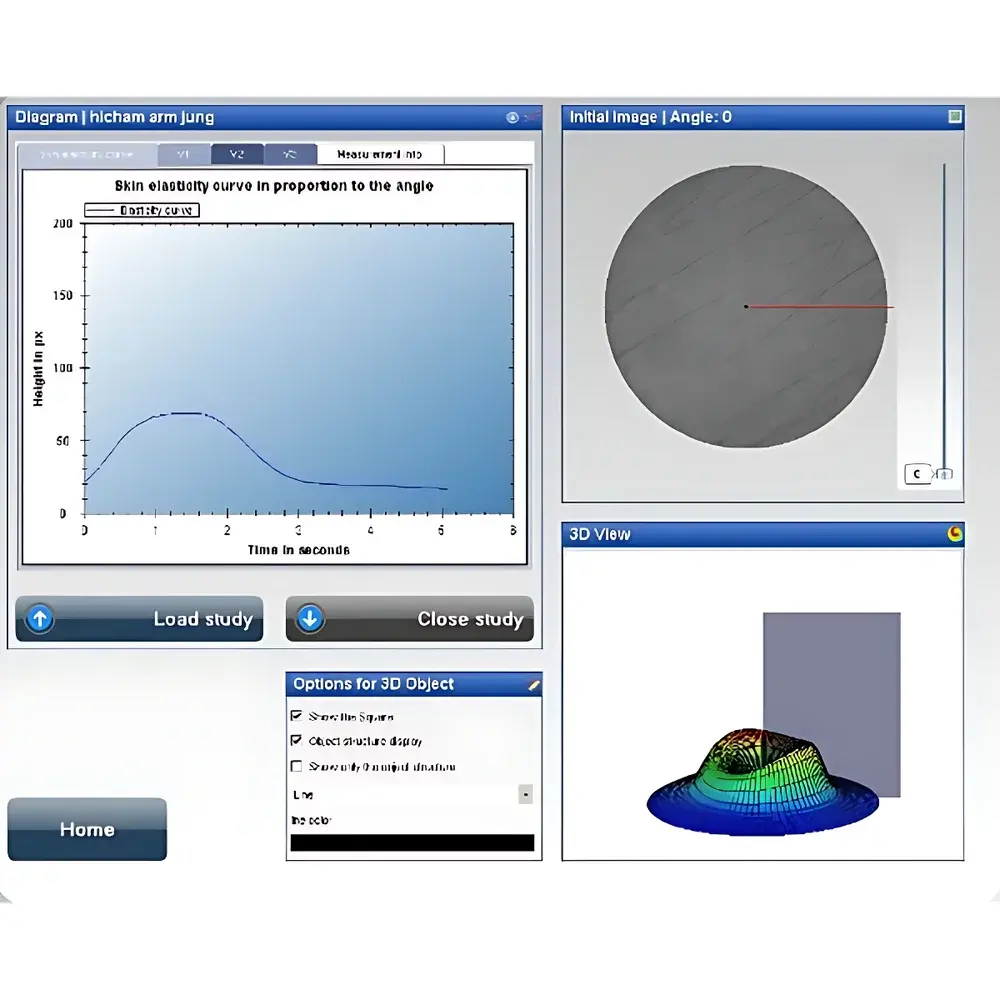
- Real-time visualization of deformation kinetics with synchronized pressure trace overlay for immediate quality control
- Rugged aluminum-alloy housing with medical-grade surface finish; CE-marked per MDR 2017/745 and RoHS-compliant
Sample Compatibility & Compliance
The CS100 is validated for use on human volar forearm, cheek, and dorsal hand skin—sites representing distinct biomechanical environments (thin vs. thick epidermis, varying collagen density). It accommodates skin types I–VI (Fitzpatrick scale) and requires no coupling gels or adhesives. All measurement protocols align with internationally recognized dermatological testing frameworks, including COLIPA (now Cosmetics Europe) guidelines for efficacy evaluation of anti-aging actives and ISO/IEC 17025–accredited laboratory validation requirements. Data acquisition supports audit trails compliant with GLP principles, and raw video sequences are stored in lossless AVI format with embedded metadata (timestamp, pressure setpoint, ambient temperature/humidity).
Software & Data Management
The proprietary CutiScan Analysis Suite (v5.2, Windows 10/11 compatible) provides full control over test parameters, automated landmark tracking via adaptive template matching, and export of standardized biomechanical indices—including Elasticity Index (R2/R5), Viscosity Ratio (R7/R2), Recovery Half-Time (t1/2), and Anisotropy Quotient (AQ = ΔX/ΔY). Software modules support batch processing, statistical comparison across cohorts (ANOVA, paired t-test), and generation of publication-ready graphs with error bars. Raw data files are structured in HDF5 format for long-term archival integrity and interoperability with MATLAB or Python-based custom analysis pipelines. The system supports 21 CFR Part 11–compliant user authentication, electronic signatures, and immutable audit logs for regulated cosmetic R&D environments.
Applications
- Evaluation of topical formulations targeting skin elasticity, firmness, and resilience—particularly retinoids, peptides, and cross-linking inhibitors
- Longitudinal monitoring of intrinsic and extrinsic aging biomarkers in clinical trials (e.g., changes in t1/2 over 12-week intervention)
- Characterization of post-procedural skin recovery following laser resurfacing, microneedling, or radiofrequency treatments
- Comparative analysis of ethnic skin biomechanics to inform inclusive product development
- Preclinical correlation studies linking histological collagen/elastin architecture (via SHG/THG microscopy) with macroscopic viscoelastic output
FAQ
What skin sites are validated for CS100 measurements?
The device is validated for volar forearm (primary reference site), cheek, and dorsal hand. Protocol adjustments (e.g., suction duration, pressure amplitude) are recommended for highly pigmented or scarred regions.
Does the CS100 require calibration before each use?
A daily verification check using the supplied reference grid slide is required; full factory calibration is recommended annually or after impact events.
Can the CS100 distinguish between epidermal and dermal contributions to elasticity?
While not depth-resolved like OCT or ultrasound elastography, its short-duration suction (<1 s) primarily engages the papillary dermis and DEJ—making it sensitive to early-stage ECM remodeling rather than deep reticular dermis changes.
Is the system compatible with Good Clinical Practice (GCP) documentation workflows?
Yes—audit logs, user roles, and raw video archiving meet GCP Annex 11 and ICH E6(R3) data integrity expectations for investigator-initiated trials.
How is inter-operator variability minimized?
Standardized probe placement templates, auto-focus lock, and pressure-triggered acquisition eliminate manual timing dependencies; intra-class correlation coefficients (ICC >0.92) have been reported across three operators in multi-center studies.





