
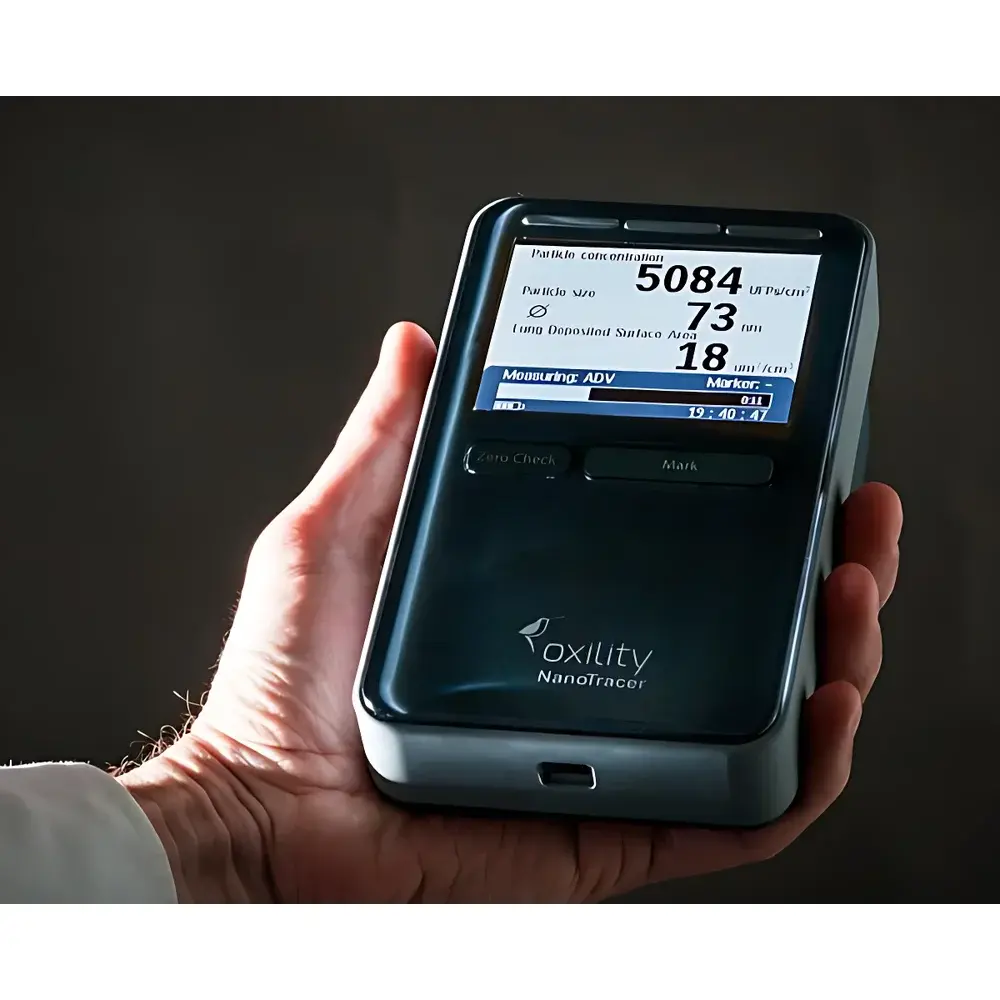
Nano Tracer XP Portable Nanoparticle Monitor
| Brand | Oxility |
|---|---|
| Origin | Netherlands |
| Model | Nano Tracer XP |
| Instrument Type | Aerosol Detector |
| Measurement Range | 10–300 nm |
| Output Parameters | Total Particle Number Concentration, Mean Particle Diameter, Lung Deposited Surface Area (LDSA) |
| Detection Principle | Diffusion Charging + Electrometer-based Quantification (Aerasense Technology) |
| Noise Level | <35 dB(A) |
| Pump Lifetime | 40,000 hours |
| Compliance | Validated per IGF (Institut für Gefahrstoffe) independent testing protocol |
| Software | NanoReporter (real-time multi-unit dashboard, audit-ready data export, report generation) |
Overview
The Nano Tracer XP is a handheld, field-deployable nanoparticle monitor engineered for real-time quantification of airborne ultrafine particles (UFPs) and engineered or incidental nanoscale aerosols in occupational, urban, and indoor environments. It operates on the diffusion charging principle—originally developed and industrially validated by Philips Research—and implemented as the Aerasense sensing platform. Charged particles are collected on an electrometer, enabling direct, calibration-free measurement of total particle number concentration (particles/cm³) and calculation of mean aerodynamic diameter and lung-deposited surface area (LDSA). Unlike optical counters limited by refractive index dependence or lower detection thresholds, the Nano Tracer XP delivers robust, size-resolved surrogate metrics across the critical 10–300 nm range—where particles exhibit maximal pulmonary penetration and alveolar deposition. Its design targets compliance with international exposure assessment frameworks, including ISO 9001-aligned quality management and alignment with EU-OSHA guidance on nanomaterial risk assessment.
Key Features
- True portable form factor: weighs under 650 g with integrated rechargeable Li-ion battery supporting >8 hours continuous operation
- No consumables, no solvents, no sheath gas—eliminates recurring operational costs and calibration drift associated with condensation particle counters (CPCs)
- High-fidelity electrometer with sub-femtoamp resolution ensures stable baseline and low detection limit (<100 particles/cm³ at 10 nm)
- Integrated silent diaphragm pump (noise level <35 dB(A)) rated for 40,000 hours MTBF—suitable for long-term unattended monitoring in sensitive settings (e.g., hospitals, cleanrooms, offices)
- Backlit 4.3-inch capacitive touchscreen with intuitive icon-driven interface; no external PC required for basic operation or data review
- On-device storage for up to 30 days of second-resolution time-series data (particle count, LDSA, mean diameter), timestamped and GPS-tagged when paired with optional Bluetooth GNSS module
Sample Compatibility & Compliance
The Nano Tracer XP is optimized for ambient and workplace air sampling of solid and liquid-phase aerosols—including combustion-derived nanoparticles (e.g., diesel exhaust, welding fume), process-generated nanomaterials (e.g., TiO₂, SiO₂, carbon black), and secondary organic aerosols (SOA). It does not require particle classification by mobility or optical scattering, making it insensitive to particle composition, shape, or volatility—critical for heterogeneous real-world aerosols. The instrument’s performance has been independently verified by the Institut für Gefahrstoffe (IGF), Germany’s leading occupational health research institute, confirming linearity (R² > 0.995), repeatability (<5% CV), and agreement with reference scanning mobility particle sizers (SMPS) across multiple test aerosols. Data output meets GLP/GMP documentation standards, with full traceability of firmware version, sensor ID, and environmental metadata (temperature, pressure, RH) embedded in each exported CSV or PDF report.
Software & Data Management
NanoReporter software (Windows/macOS) provides centralized configuration, live visualization, and regulatory-grade data handling. Users can simultaneously monitor up to four Nano Tracer XP units on a single dashboard, with synchronized time-stamping and color-coded trend overlays. All raw and derived parameters—including second-by-second particle counts, moving-average diameter, and cumulative LDSA dose—are stored with SHA-256 hash integrity checks. Export options include ISO/IEC 17025-compliant PDF reports (with digital signature support), CSV for statistical analysis in R or Python, and XML formatted for LIMS integration. Audit trails log all user actions (e.g., calibration reset, parameter change), satisfying FDA 21 CFR Part 11 requirements for electronic records and signatures when deployed in pharmaceutical or medical device manufacturing facilities.
Applications
- Occupational hygiene surveys: real-time hotspot identification during nanomaterial handling, 3D printing, laser ablation, or thermal spraying
- Indoor air quality (IAQ) benchmarking: evaluating HVAC filtration efficiency, cooking emissions, or printer/copy machine release profiles
- Urban microenvironment studies: roadside UFP mapping, tunnel ventilation validation, and near-airport emission dispersion modeling
- Product safety testing: quantifying nanoparticle release from consumer goods (e.g., spray coatings, textiles, cosmetics) under standardized use conditions per ISO/TR 13121
- Epidemiological fieldwork: longitudinal personal exposure monitoring using belt-mounted deployment with Bluetooth telemetry
FAQ
Does the Nano Tracer XP require periodic calibration?
No—its diffusion charging + electrometer architecture is inherently stable and does not rely on radioactive sources or optical alignment. Annual verification against a traceable reference aerosol generator (e.g., PSL or DEHS) is recommended per ISO 29463-4 for quality assurance.
Can it distinguish between different nanoparticle chemistries?
No—it measures physical surrogates (number, size, surface area), not chemical identity. For compositional analysis, coupling with offline TEM/EDS or online SP-ICP-MS is advised.
Is the device suitable for outdoor use in rain or extreme temperatures?
It is IP54-rated for dust and splash resistance, and operates continuously from 5 °C to 40 °C. Extended outdoor deployment requires optional weatherproof enclosure and thermal stabilization kit.
How is lung-deposited surface area (LDSA) calculated?
Using the internationally accepted MPPD (Multiple-Path Particle Dosimetry) model v3.04, with default default breathing parameters (20 L/min, nasal inhalation) and particle density assumptions consistent with ISO/TR 13121 Annex C.
What data security protocols are supported?
NanoReporter supports AES-256 encryption for stored data, TLS 1.3 for cloud sync (optional Oxility Cloud subscription), and role-based access control (RBAC) for multi-user laboratory deployments.
Related Products







