
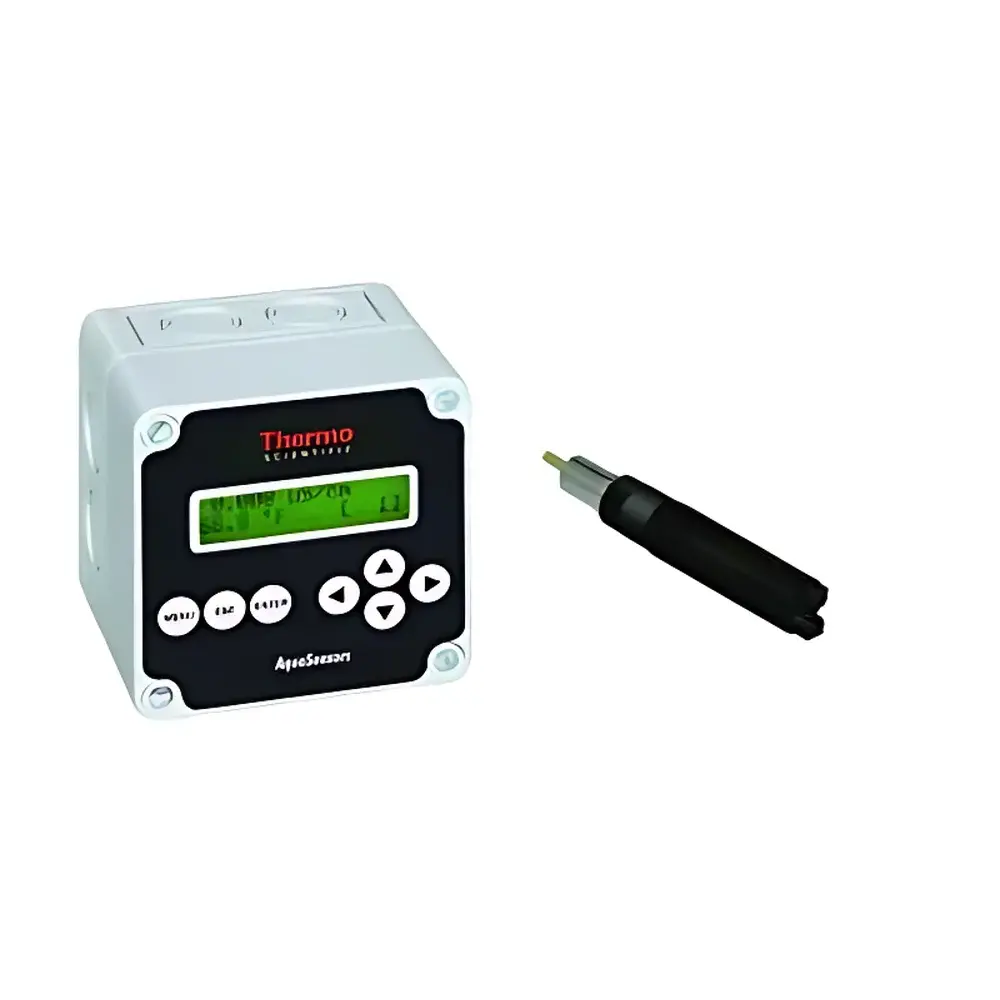
Thermo Fisher AquaSensors SST Suspended Solids & Turbidity Analyzer
| Brand | Thermo Fisher |
|---|---|
| Origin | USA |
| Manufacturer | Thermo Fisher Scientific |
| Product Type | Imported Instrument |
| Model | AquaSensors SST |
| Price | Upon Request |
Overview
The Thermo Fisher AquaSensors SST is a dual-mode, in-line optical analyzer engineered for continuous, real-time measurement of turbidity and suspended solids (SS) in water and wastewater streams. It operates on the principle of multi-angle infrared (IR) light scattering—compliant with ISO 7027:2016—utilizing both 90° and 180° detection geometries to minimize bias from particle size distribution, shape anisotropy, and color interference. Unlike visible-light-based systems, its IR light source (typically 850–880 nm) eliminates spectral absorption artifacts caused by natural organic matter, humic substances, or dye contaminants—critical for reliable performance in colored or tannin-rich waters. The instrument integrates a 1 cm optical path length with fused quartz optical windows, enabling high signal-to-noise ratio detection across broad concentration ranges while maintaining long-term stability under fouling-prone conditions.
Key Features
- Dual-mode operation: Simultaneous or independent measurement of turbidity (NTU) and suspended solids concentration (mg/L, ppm, %)
- ISO 7027-compliant optical architecture with orthogonal (90°) and backscatter (180°) photodetectors for enhanced particle-size independence
- Infrared LED source (850 nm) paired with spectral scanning capability across blue-to-IR range for adaptive compensation in variable water matrices
- Robust mechanical design featuring polycarbonate housing and chemically inert quartz optical windows rated for continuous immersion
- High-pressure tolerance: up to 10.3 bar (150 PSIG) at 95°C in SS mode; 4.5 bar (65 PSIG) at 95°C in turbidity mode
- Maximum flow velocity rating of 300 cm/s—suitable for high-velocity pipelines, open-channel applications, and effluent monitoring
- Integrated temperature sensor (±0.2°C accuracy) with automatic thermal compensation of optical readings
- Optional ultrasonic or mechanical self-cleaning module for extended maintenance-free operation in high-fouling environments
Sample Compatibility & Compliance
The AquaSensors SST is validated for use in raw water, clarified effluent, activated sludge return lines, membrane bioreactor (MBR) filtrate, and industrial process streams. Its optical topology meets the metrological requirements of ISO 7027 for turbidity and supports method validation per EPA Method 180.1 and ASTM D6415. The device is CE-marked and designed to support GLP/GMP data integrity workflows, including configurable audit trails and user-access controls. While not intrinsically certified for hazardous areas, it may be deployed in Zone 2/Class I, Div 2 environments when installed with appropriate conduit and barrier systems.
Software & Data Management
The analyzer communicates via 4–20 mA analog output, Modbus RTU over RS-485, and optional Ethernet/IP or HART 7 interfaces. Configuration, calibration, diagnostics, and firmware updates are performed using Thermo Fisher’s AquaView™ PC software or compatible SCADA/HMI platforms. All measurement data—including timestamped turbidity, SS, temperature, and diagnostic flags—are logged with traceable metadata. The system supports 21 CFR Part 11-compliant electronic signatures when integrated with validated LIMS or asset management systems, ensuring regulatory readiness for drinking water utilities and pharmaceutical manufacturing facilities.
Applications
- Real-time monitoring of coagulation/flocculation efficiency in potable water treatment plants
- Sludge blanket level estimation and return activated sludge (RAS) control in secondary clarifiers
- MBR and ultrafiltration (UF) permeate quality assurance
- Industrial pretreatment compliance verification (e.g., textile, food & beverage, pulp & paper)
- Environmental discharge monitoring per NPDES permit requirements
- Research-grade particulate dynamics studies in limnological and estuarine systems
FAQ
Does the AquaSensors SST require periodic recalibration?
Yes—recommended calibration intervals are every 3–6 months depending on application severity and regulatory requirements. Calibration uses NIST-traceable formazin or polymer-based standards (e.g., AMCO AEPA-1) for turbidity, and gravimetrically prepared kaolin or silica suspensions for suspended solids.
Can the instrument operate submersed in open channels?
It is rated for continuous submersion up to 10 m depth (IP68), provided pressure and flow constraints are observed. Mounting brackets and flow straighteners are available for open-channel installations.
Is the IR light source stable over time?
The IR LED exhibits <0.5% intensity drift over 12 months under continuous operation, verified per IEC 62471 photobiological safety standards.
How does the 90°/180° dual detection improve accuracy?
Scattering at 90° is sensitive to small particles (10 µm). Ratio-based algorithms reduce dependence on Mie theory assumptions and enhance reproducibility across heterogeneous suspensions.
What cleaning options are supported?
Factory-installed ultrasonic transducers (25 kHz) or motor-driven wiper blades can be specified. Both options integrate with programmable cleaning cycles triggered by signal drift or time-based schedules.







