
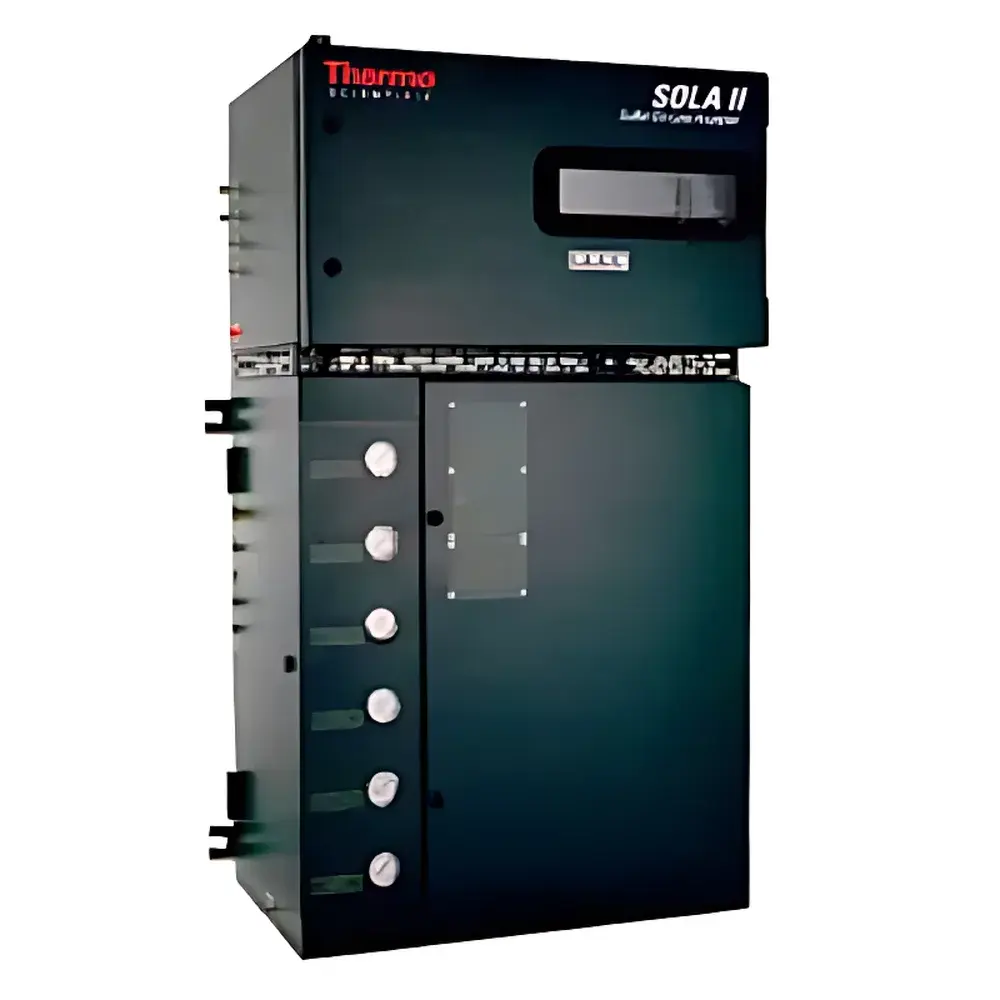
Thermo Scientific SOLA II Online Total Sulfur Analyzer
| Brand | Thermo Fisher |
|---|---|
| Origin | USA |
| Manufacturer | Thermo Fisher Scientific |
| Type | SOLA II |
| Measurement Principle | Pulsed Ultraviolet Fluorescence (PUVF) |
| Detection Range | SOLA II: 0–5 ppmS to 0–5000 ppmS |
| SOLA Trace | 0–2 ppmS to 0–5 ppmS |
| SOLA Flare DI | 10 ppmS to 95% S |
| Repeatability | ±2% FS (1 injection/min), ±1% FS (2 injections/min) |
| Response Time (T90) | 3–5 min |
| Communication | 4–20 mA, Modbus RTU/ASCII/TCP, RS-232/RS-485, Ethernet (TCP/IP) |
| Certifications | ATEX Zone 1/2, IECEx, CSA Class I Div 1/2, NEC Class I Div 1/2, CE Mark |
| Environmental Operating Range | 12–40 °C |
| Power | 110/220 VAC, 50/60 Hz, 2000 W |
| Sample Requirements | Liquid or gas (ASTM D5453/D6667 compliant) |
| Auto-Diagnostics | Valve leak detection, flow monitoring, lamp/PMT health tracking, density compensation interface |
Overview
The Thermo Scientific SOLA II Online Total Sulfur Analyzer is an industrial-grade process analytical instrument engineered for continuous, real-time quantification of total sulfur content in liquid and gaseous hydrocarbon streams. It employs Pulsed Ultraviolet Fluorescence (PUVF) spectroscopy — a reference-grade measurement principle standardized under ASTM D5453 (for liquids) and ASTM D6667 (for LPG and gases). In this method, sulfur-containing compounds are thermally cracked at 1100 °C in an oxygen-rich environment to produce SO2. The resulting SO2 is exposed to pulsed UV radiation (hν1), exciting molecules to a short-lived electronic state. Upon relaxation, they emit characteristic fluorescence (hν2) at a distinct wavelength, the intensity of which is linearly proportional to sulfur concentration. A photomultiplier tube (PMT) detects this signal, while a feedback-controlled photodiode maintains stable UV lamp output — a proprietary feature ensuring long-term calibration stability without manual intervention. Unlike combustion-based analyzers requiring pure oxygen, SOLA II operates safely with zero-oxygen combustion air, eliminating explosion hazards associated with high-purity O2 delivery systems.
Key Features
- Robust PUVF detection architecture delivering sub-ppb detection limits (25 ppb for SOLA Trace variant) and full-scale repeatability of ±1% FS at dual-injection frequency
- Patented UV intensity stabilization loop enabling >99% online uptime and minimizing drift-related recalibration needs
- Integrated valve leak detection system that triggers automatic sample path isolation and detector purge upon detecting inlet valve leakage — preventing carbonaceous fouling and extending maintenance intervals
- Dual-stream capability (optional) supporting independent calibration and measurement of two distinct sulfur concentration ranges (e.g., feed vs. product streams) within a single analyzer housing
- Density compensation interface compatible with third-party densitometers (e.g., Thermo Scientific Sarasota FD910), enabling accurate wt/wt (ppmS) reporting for liquid fuels without manual correction
- Auto-calibration functionality with programmable schedule, reducing dependency on manual intervention and supporting GLP/GMP-aligned operational discipline
Sample Compatibility & Compliance
SOLA II is validated for use across refinery, petrochemical, and fuel blending applications involving gasoline, diesel, jet fuel, naphtha, LPG, natural gas, and flare gas. Its measurement performance aligns with globally recognized standards including ASTM D5453, ASTM D6667, ISO 20846, and ASTM D6313. For regulatory compliance, the analyzer supports audit-ready data logging and secure user access control when integrated with Thermo Scientific SOLAWeb software. All firmware and communication protocols adhere to FDA 21 CFR Part 11 requirements for electronic records and signatures where enabled via optional configuration. Electrical safety and hazardous area certifications include ATEX Zone 1/2 (EEx p IIC T2–T4), IECEx, CSA Class I Division 1/2 (Groups B, C, D), and NEC Class I Division 1/2 — permitting installation in classified locations without additional barrier systems.
Software & Data Management
Thermo Scientific SOLAWeb is a browser-based HMI platform accessible via standard Ethernet (TCP/IP) without client-side software installation. Operators can monitor live analyzer status, view real-time chromatograms (raw PMT signal, lamp voltage, detector temperature, airflow), and download 24-hour historical datasets — including calibrated sulfur values, diagnostic flags, and hardware telemetry. Remote support is facilitated through modem or LAN connectivity, allowing field engineers to perform root-cause analysis using embedded fault trees and event logs. Modbus TCP/RTU integration enables bidirectional communication with DCS/SCADA systems for automated alarm routing, setpoint updates, and trend archiving. All digital outputs include timestamped metadata compliant with ISA-88/ISA-95 data models, facilitating traceability in quality management systems.
Applications
- Fuel sulfur compliance monitoring: Real-time verification of ultra-low-sulfur diesel (ULSD) and gasoline against Tier 3, Euro 5/6, and IMO 2020 marine fuel specifications (≤10 ppm)
- Catalyst protection: Trace-level sulfur monitoring (SOLA Trace) of hydrotreater feedstocks to prevent premature catalyst deactivation and unplanned shutdowns
- Flare gas emission assurance: Dynamic quantification of total sulfur in flare streams (SOLA Flare DI) across wide dynamic range (10 ppm to 95% S) for environmental reporting and combustion efficiency optimization
- Process optimization: Closed-loop control of amine treating units, sulfur recovery units (SRUs), and hydrotreating reactors using high-frequency sulfur trends (update interval: 10–30 seconds)
- Blending accountability: Automated density-compensated sulfur reporting for custody transfer and batch reconciliation in terminal operations
FAQ
What measurement principle does SOLA II use, and how is it standardized?
SOLA II implements Pulsed Ultraviolet Fluorescence (PUVF), fully aligned with ASTM D5453 for liquid fuels and ASTM D6667 for gaseous samples. This method is recognized by global regulatory bodies as a primary reference technique for total sulfur determination.
Does SOLA II require pure oxygen for operation?
No. It uses compressed air (80 psig, 200–300 mL/min) for combustion, eliminating risks associated with high-pressure oxygen handling and simplifying site utility requirements.
How does SOLA II handle sample matrix variability, especially in dense hydrocarbons?
It accepts analog density input from certified densitometers to automatically correct reported sulfur values from vol/vol to wt/wt basis — critical for accurate specification compliance in diesel and jet fuel applications.
Can SOLA II be integrated into existing DCS environments?
Yes. It provides native 4–20 mA analog outputs, discrete alarm contacts, and dual-channel Modbus (RTU/ASCII/TCP) or RS-485 interfaces, supporting seamless integration with Emerson DeltaV, Honeywell Experion, Yokogawa CENTUM VP, and Siemens PCS7 systems.
What diagnostic capabilities support predictive maintenance?
Real-time monitoring includes inlet valve integrity checks, PMT gain drift tracking, UV lamp spectral output verification, carrier gas flow validation, and thermal zone temperature profiling — all accessible via SOLAWeb or local MMI.






