
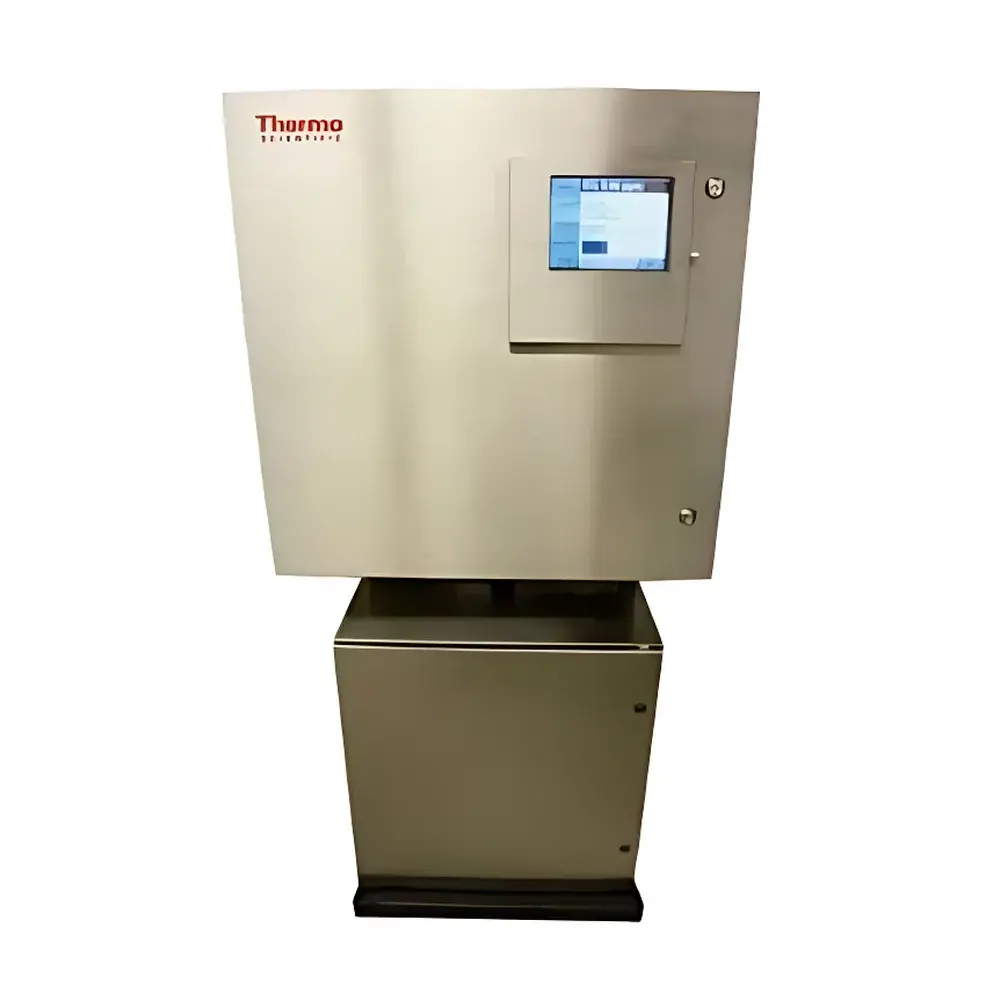
Thermo Fisher Aeke SO3 Continuous Emission Monitoring System (CEMS) for Sulfur Trioxide
| Brand | Thermo Fisher |
|---|---|
| Origin | USA |
| Manufacturer | Thermo Fisher Scientific |
| Product Type | Flue Gas Continuous Emission Monitoring System (CEMS) |
| Model | Aeke SO3 |
| Measurement Principle | Quantum Cascade Laser Absorption Spectroscopy (QCLAS) |
| Calibration Method | On-site SO₂-to-SO₃ conversion via integrated catalytic converter |
| Sampling Configuration | Dilution extractive probe with inertial filter |
| Installation Flexibility | Hot/wet sampling capable |
| Data Integration | Native compatibility with DAS and DCS platforms |
| Regulatory Alignment | Designed to support EPA Method 8/204 compliance, ISO 12039, and EU EN 15267-3 requirements |
| Software Compliance | Audit-trail enabled, 21 CFR Part 11–ready data logging |
Overview
The Thermo Fisher Aeke SO₃ Continuous Emission Monitoring System (CEMS) is an engineered solution for real-time, in-situ quantification of sulfur trioxide (SO₃) in flue gas streams from coal-fired, biomass, and waste-to-energy power plants. Unlike conventional wet-chemical or indirect estimation methods, the Aeke SO₃ system employs quantum cascade laser absorption spectroscopy (QCLAS) — a tunable diode-based optical technique operating in the mid-infrared region (typically 10–12 µm) — to achieve direct, molecule-specific detection of SO₃ at sub-parts-per-trillion (pptv) levels. This physical measurement principle eliminates reliance on stoichiometric assumptions or empirical correlations between SO₂ and SO₃, thereby delivering trace-level accuracy under dynamic combustion conditions. The system is explicitly designed to address operational challenges arising from SO₃’s role in acid dew point formation, air heater fouling, electrostatic precipitator (ESP) rapping inefficiency, and mercury re-emission downstream of activated carbon injection (ACI). Its deployment supports proactive mitigation strategies aligned with EPA guidance on SO₃ management and EU Industrial Emissions Directive (IED) monitoring expectations.
Key Features
- Quantum cascade laser (QCL) source with wavelength stability < ±0.005 cm⁻¹ over 30 days, ensuring long-term spectral fidelity for SO₃ band isolation at 1135.5 cm⁻¹.
- Dilution extractive sampling architecture with heated sample line (maintained at >180 °C) and integrated inertial particulate filter — validated for operation upstream of ESPs and fabric filters (dust loadings up to 50 g/Nm³).
- On-board catalytic SO₂-to-SO₃ converter (Pt/V₂O₅ catalyst, 400–450 °C), enabling zero-span calibration without external gas cylinders and verifying system response across 0–50 ppmv SO₃ range.
- Optical path design minimizes residence time between probe tip and detector (< 2 s), suppressing SO₃ wall adsorption artifacts and preserving true transient concentration profiles.
- Ruggedized field enclosure rated IP65, with NEMA 4X-compliant electronics housing and redundant power supply options for uninterrupted CEMS operation.
- Embedded real-time compensation algorithms for H₂O vapor pressure, CO₂ partial pressure, and temperature-induced spectral broadening — all derived from co-located parametric sensors.
Sample Compatibility & Compliance
The Aeke SO₃ system accommodates flue gas matrices containing up to 15% O₂, 12% CO₂, 10% H₂O (v/v), and particulate concentrations exceeding 30 g/Nm³ — typical of post-combustion ducts in pulverized coal units. Its inertial filtration stage operates without consumables or scheduled maintenance intervals, making it suitable for installation at critical points including economizer exit, air preheater inlet, and scrubber bypass ducts. From a regulatory standpoint, the system’s measurement uncertainty profile (±2% of reading above 1 ppmv, per ISO 12039 Annex B) satisfies performance criteria for Reference Method equivalency under U.S. EPA PS-18 and EU EN 15267-3 certification frameworks. All firmware and configuration logs are timestamped and digitally signed to meet GLP/GMP audit trail requirements.
Software & Data Management
The embedded Thermo Fisher CEMS Manager software provides ISO/IEC 17025-aligned instrument control, diagnostics, and report generation. It supports automated daily zero/span verification, drift tracking, and failure mode logging with configurable alarm thresholds (e.g., optical density drop >5%, flow deviation >10%). Data export conforms to EPA 40 CFR Part 75 ASCII format and IEC 62443-3-3 security protocols. Integration with third-party DCS platforms (e.g., Emerson DeltaV, Honeywell Experion) occurs via OPC UA 1.04 or Modbus TCP, with bi-directional setpoint control for sorbent injection systems. Full 21 CFR Part 11 compliance is achieved through electronic signature workflows, role-based access controls, and immutable audit trails covering all calibration, configuration, and data export events.
Applications
- Optimization of calcium oxide (CaO) or magnesium oxide (MgO) sorbent dosing in dry scrubbers by correlating real-time SO₃ concentration with acid gas saturation limits.
- Diagnosis of selective catalytic reduction (SCR) catalyst degradation via SO₃/SO₂ ratio trends during ammonia slip testing.
- Validation of low-NOₓ burner modifications by monitoring SO₃ formation kinetics under varying excess air and flame temperature conditions.
- Supporting mercury control strategy refinement — quantifying SO₃-driven oxidation of Hg⁰ to Hg²⁺ upstream of wet FGD, thereby improving capture efficiency in ACI trains.
- Long-term corrosion risk assessment for air preheaters and ID fans using time-weighted SO₃ exposure indices derived from 1-second resolution data archives.
FAQ
Does the Aeke SO₃ system require periodic calibration with certified SO₃ gas standards?
No — the integrated catalytic converter enables in-situ SO₂-to-SO₃ generation for full-system zero-and-span validation without external calibration gases.
Can the system operate reliably in high-moisture, low-temperature duct sections?
Yes — the heated dilution probe and thermal management subsystem maintain all wetted components above the SO₃ condensation threshold (typically >150 °C), preventing liquid-phase deposition.
Is the optical path susceptible to fouling in high-dust environments?
No — the QCL beam path is fully isolated from the sample stream; only the extractive probe tip contacts flue gas, and its inertial filter prevents particulate ingress into the analyzer chamber.
How does the system handle interference from SO₂ at high concentrations (e.g., >2,000 ppmv)?
The QCL’s narrow linewidth (<0.001 cm⁻¹) and spectral fitting algorithm selectively resolve the SO₃ rotational-vibrational transition while rejecting overlapping SO₂ features through multi-component least-squares regression.
What cybersecurity measures are implemented for remote access and data transmission?
All network interfaces enforce TLS 1.2+ encryption, device authentication via X.509 certificates, and session timeouts aligned with NIST SP 800-53 Rev. 5 IA-2 and IA-5 controls.







