
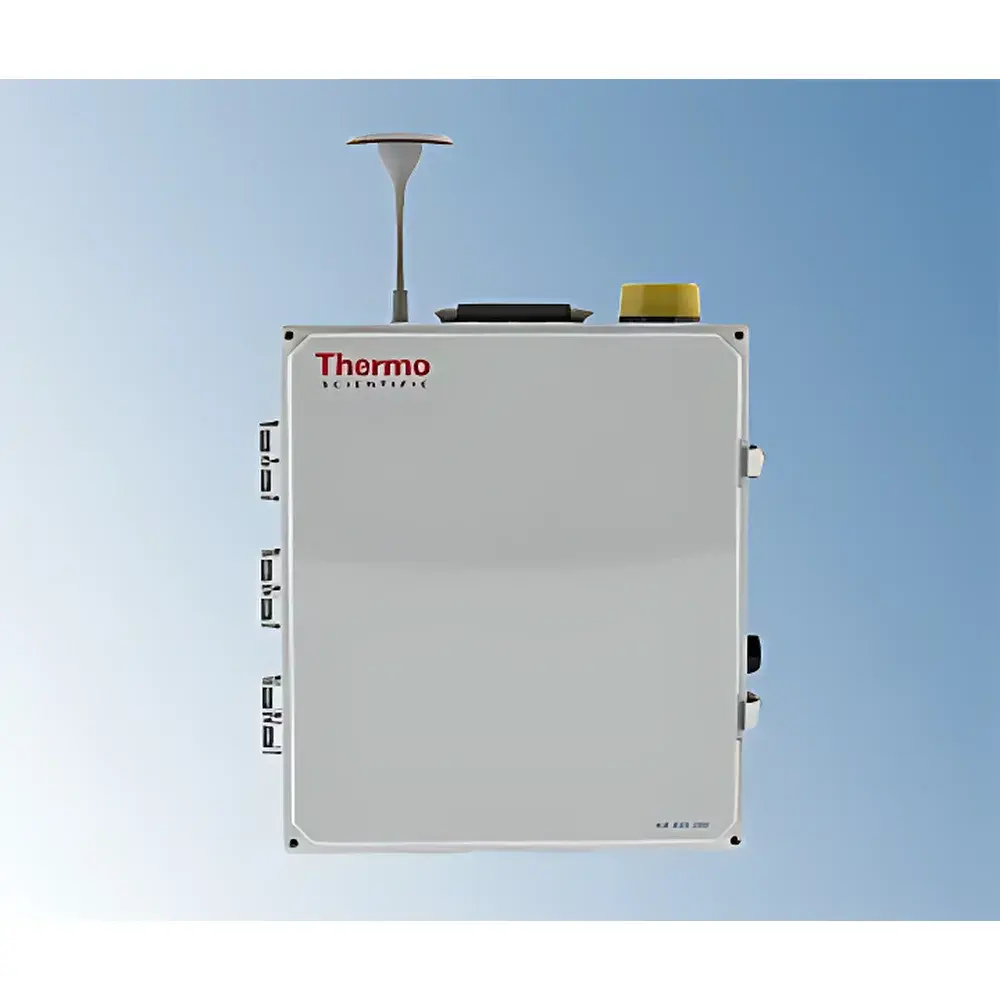
Thermo Scientific ADR-1500 Area Dust Monitor
| Brand | Thermo Fisher |
|---|---|
| Origin | USA |
| Manufacturer Type | Manufacturer |
| Origin Category | Imported |
| Model | ADR-1500 |
| Pricing | Upon Request |
| Measurement Principle | Optical Light Scattering (Nephelometry) |
| Measured Parameters | PM₁₀, PM₂.₅ |
| Enclosure Rating | IP65 |
| Power Options | AC, External DC, Internal Rechargeable Battery |
| Communication Interfaces | USB, RS-232, 0–5 V / 4–20 mA Analog Output, Optional Wireless Module |
| Environmental Compensation | Integrated Temperature, Relative Humidity, and Barometric Pressure Sensors with Active Heating |
| Flow Control | True Volumetric Flow Control via Digital Feedback Loop Using Calibrated Critical Orifice and Differential Pressure Sensor |
Overview
The Thermo Scientific ADR-1500 Area Dust Monitor is a field-deployable, real-time optical nephelometer engineered for continuous ambient particulate matter monitoring in regulatory, occupational health, and environmental research applications. It operates on the principle of light scattering—specifically, forward-angle nephelometry—where airborne particles passing through a precisely defined optical sensing chamber scatter incident light in proportion to their mass concentration and effective cross-sectional area. This linear relationship between scattered light intensity and particle concentration enables quantitative, traceable measurement of respirable and inhalable fractions without reliance on gravimetric reference methods during operation. Unlike passive samplers or filter-based systems, the ADR-1500 delivers second-by-second concentration data for PM₂.₅ and PM₁₀, with its aerodynamic particle size cutoffs validated against ISO 7708 and EPA reference methodologies. Its design integrates active environmental compensation—including heated relative humidity sensing and real-time temperature/pressure correction—to mitigate hygroscopic bias commonly observed in high-humidity conditions, ensuring metrological integrity across diverse climatic zones.
Key Features
- True volumetric flow control architecture: Utilizes a digitally regulated critical orifice system with differential pressure feedback, referenced to integrated barometric pressure and temperature sensors, to maintain constant sample volume regardless of ambient atmospheric fluctuations.
- High-sensitivity nephelometric detection: Optimized optical path geometry and stable LED light source deliver low detection limits and high signal-to-noise ratio across the full dynamic range.
- Integrated environmental compensation: Onboard heated RH sensor, thermistor, and barometer enable automatic correction of humidity-induced positive bias and thermal expansion effects on flow and scattering response.
- Robust IP65-rated enclosure: Sealed, corrosion-resistant aluminum housing rated for continuous outdoor exposure—including rain, dust, and temperature extremes from –20 °C to +50 °C.
- Flexible power architecture: Supports simultaneous operation via AC mains, external 12–24 V DC supply, or internal rechargeable battery pack—enabling deployment in grid-constrained or mobile monitoring scenarios.
- Multi-protocol communication suite: Native support for USB virtual COM port, RS-232 serial, analog voltage/current outputs (0–5 V / 4–20 mA), and optional cellular or LoRaWAN wireless telemetry modules for remote data acquisition.
Sample Compatibility & Compliance
The ADR-1500 is designed for continuous sampling of ambient air, stack effluents (with appropriate inlet conditioning), and indoor workplace environments. Its inlet configuration complies with ISO 10112 and EN 12341 for PM₁₀ measurement, and incorporates a pre-aligned impactor stage optimized for PM₂.₅ cutpoint performance per ISO/CEN TS 15998. All internal wetted surfaces are inert (stainless steel, anodized aluminum, fluoropolymer gaskets) to prevent adsorption or catalytic interference. The instrument meets IEC 61326-1 (EMC), IEC 61000-4 series immunity standards, and carries CE marking for EMC and RoHS compliance. Data logging and configuration parameters adhere to GLP principles; audit trails, user access levels, and timestamped calibration logs support 21 CFR Part 11 readiness when paired with compliant data management software.
Software & Data Management
The ADR-1500 communicates natively with Thermo Scientific AirWatch™ Desktop Software for configuration, real-time visualization, and raw data export in CSV and XML formats. Firmware supports configurable averaging intervals (1 s to 1 hr), alarm thresholds, and event-triggered logging. All operational metadata—including flow rate, temperature, RH, pressure, battery status, and diagnostic flags—are time-stamped and stored internally (up to 30 days at 1-minute resolution). Exported datasets include NIST-traceable calibration coefficients and sensor-specific compensation parameters. For enterprise integration, the device supports Modbus RTU over RS-232 and TCP/IP protocols via optional gateway firmware, enabling ingestion into SCADA, LIMS, or cloud-based environmental dashboards (e.g., AWS IoT Core, Azure IoT Hub).
Applications
- Ambient air quality monitoring networks (AQN) requiring EPA-equivalent PM₂.₅/PM₁₀ reporting under 40 CFR Part 53 Tier 2 equivalency frameworks.
- Construction site perimeter monitoring and fugitive dust compliance verification per local ordinances and ISO 17332.
- Industrial hygiene assessments in mining, cement production, pharmaceutical manufacturing, and waste handling facilities.
- Long-term epidemiological exposure studies where spatially resolved, temporally dense PM data is required for dose–response modeling.
- Calibration transfer and collocation validation for reference-grade beta attenuation monitors (BAM) and tapered element oscillating microbalances (TEOM).
FAQ
Does the ADR-1500 meet U.S. EPA Federal Reference Method (FRM) or Federal Equivalent Method (FEM) requirements?
No—the ADR-1500 is classified as a non-reference, indicative monitor. It is widely used for trend analysis, source attribution, and compliance screening but is not certified as an FRM/FEM device under 40 CFR Part 53.
What maintenance intervals are recommended for routine field operation?
Optical window cleaning every 7–14 days in high-dust environments; HEPA filter replacement every 6 months or after 2,000 operating hours; annual factory recalibration recommended for metrological continuity.
Can the ADR-1500 be deployed in unattended mode for extended periods?
Yes—its IP65 enclosure, wide-temperature battery operation, and internal data logging support autonomous deployments exceeding 30 days without intervention, provided power and communication infrastructure are maintained.
Is the instrument capable of distinguishing between PM₂.₅ and PM₁₀ simultaneously?
Yes—dual-channel nephelometric processing with independent, hardware-defined size-selective inlets enables concurrent, time-synchronized measurement of both fractions without sequential switching or algorithmic deconvolution.
How is traceability ensured for calibration and measurement uncertainty?
Each unit ships with a NIST-traceable calibration certificate referencing SRM 1691 (Arizona Road Dust) and polydisperse PSL aerosol standards; uncertainty budgets are documented per ISO/IEC 17025 and include contributions from flow control, optical stability, and environmental compensation residuals.







