
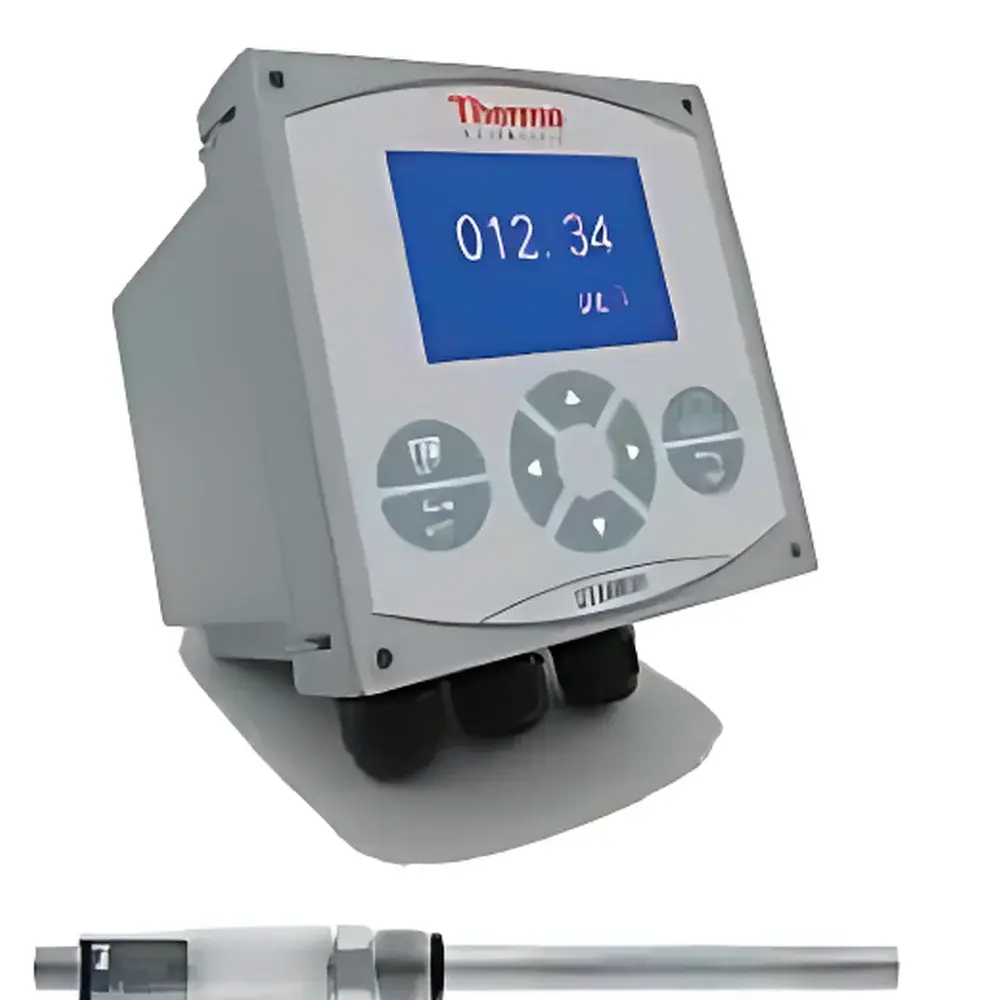
Thermo Scientific 2116RDO ppb-Level Dissolved Oxygen Analyzer
| Brand | Thermo Fisher |
|---|---|
| Origin | USA |
| Manufacturer | Thermo Fisher Scientific |
| Product Type | Imported Instrument |
| Model | Thermo Scientific 2116RDO |
| Pricing | Upon Request |
Overview
The Thermo Scientific 2116RDO is a high-precision, fluorescence-based dissolved oxygen (DO) analyzer engineered for continuous, ultra-trace-level measurement in ultrapure water (UPW) and critical process streams. Unlike traditional amperometric or galvanic sensors, the 2116RDO employs phase-fluorescence quenching technology—where molecular oxygen modulates the decay time of a ruthenium-based luminophore immobilized on a replaceable optical cap. This principle eliminates electrochemical drift, polarization delays, and membrane-related artifacts, delivering stable, calibration-free operation with trace-level resolution down to 0.05 ppb (parts per trillion by weight) or ±2% of reading—whichever is greater—across its full 0–200 ppb measurement range. Designed specifically for environments where oxygen contamination compromises product integrity—such as power plant boiler feedwater, semiconductor rinse loops, pharmaceutical WFI systems, and steam condensate networks—the 2116RDO integrates seamlessly into online monitoring architectures with minimal maintenance overhead and no consumable electrolytes or gas-permeable membranes.
Key Features
- Fluorescence lifetime detection enables true zero-drift performance without electrode polarization or warm-up delay—measurement stabilization occurs within seconds of installation.
- Optical sensing architecture eliminates interference from flow velocity, hydrogen sulfide, chlorine, heavy metals, and redox-active species that commonly affect electrochemical DO sensors.
- Replaceable fluorescent sensor cap with nominal two-year service life; no routine recalibration required under stable operating conditions per ASTM D888-22 Annex A3 guidance for optical DO methods.
- Rugged, IP66-rated stainless steel transmitter housing with NEMA 4X compatibility; supports 4–20 mA analog output, Modbus RTU over RS-485, and optional HART 7 communication.
- Temperature compensation integrated via Pt1000 RTD embedded in the sensor body; accuracy maintained across 0–50 °C operating range.
- Self-diagnostics include cap degradation monitoring, signal-to-noise ratio tracking, and optical path integrity verification—all logged with timestamps for audit-ready traceability.
Sample Compatibility & Compliance
The 2116RDO is validated for use in non-aerated, low-conductivity aqueous matrices including deionized water (≥18.2 MΩ·cm), reverse osmosis permeate, mixed-bed effluent, turbine condensate, and steam cycle return lines. It complies with key industry standards governing purity-critical water analysis: ASTM D5119 (Standard Guide for Online Monitoring of Ultrapure Water), USP (Total Organic Carbon) and (Water for Pharmaceutical Purposes) contextual requirements for DO control, and ISO 8502-9 (corrosion testing—oxygen content in test solutions). Its design supports GLP/GMP-aligned data integrity practices, including configurable audit trails, user access levels, and electronic signature readiness per FDA 21 CFR Part 11 when deployed with compatible SCADA or DCS historian systems.
Software & Data Management
The 2116RDO operates autonomously but interfaces with Thermo Scientific’s optional Orion Star™ Connect software suite for configuration, trend visualization, alarm management, and export of time-stamped measurement logs in CSV or PDF format. All configuration changes, sensor cap replacement events, and diagnostic alerts are timestamped and stored locally in non-volatile memory for ≥30 days. When integrated into enterprise-level asset management platforms (e.g., Emerson DeltaV, Siemens Desigo, or Honeywell Experion), the device supports OPC UA connectivity for real-time KPI dashboards and predictive maintenance workflows based on optical signal decay trends.
Applications
- Power generation: Continuous monitoring of boiler feedwater and condensate return to prevent oxidative corrosion in supercritical steam cycles.
- Semiconductor manufacturing: In-line DO verification in CMP slurry delivery, photolithography rinse stations, and UPW distribution loops where sub-ppb excursions trigger batch rejection.
- Pharmaceutical and biotech: Monitoring of water-for-injection (WFI) storage and distribution systems per EU GMP Annex 1 and PIC/S guidance on microbial risk mitigation.
- Pulp and paper: Control of oxygen ingress in closed-loop white water systems to minimize cellulose oxidation and improve fiber strength retention.
- Microelectronics and specialty chemicals: Process validation during high-purity acid/base blending where dissolved oxygen catalyzes metal ion leaching from wet benches.
FAQ
Does the 2116RDO require daily calibration?
No. The sensor operates without routine calibration due to inherent stability of the fluorescence lifetime measurement principle. Initial factory calibration is traceable to NIST SRM 2193a; field verification is recommended annually or after cap replacement.
Can it be installed in pressurized sample lines?
Yes—rated for continuous operation at up to 10 bar (145 psi) with appropriate flow cell or insertion-style mounting kits (e.g., Thermo Scientific 2116-FC10 flow cell or 2116-IS15 insertion probe).
What maintenance is required beyond cap replacement?
None. There are no electrolytes to replenish, no membranes to clean or replace, and no anode/cathode surfaces to polish. Routine inspection of optical window cleanliness is advised every 6 months in high-particulate applications.
Is the transmitter compatible with third-party PLCs?
Yes—4–20 mA output with HART 7 or Modbus RTU protocol ensures interoperability with major industrial automation platforms without proprietary gateways.
How is sensor cap replacement documented for compliance purposes?
Cap replacement triggers an automatic event log entry with date/time stamp, operator ID (if configured), and pre-/post-replacement baseline verification data—exportable for internal QA review or regulatory submission.
Related Products







