
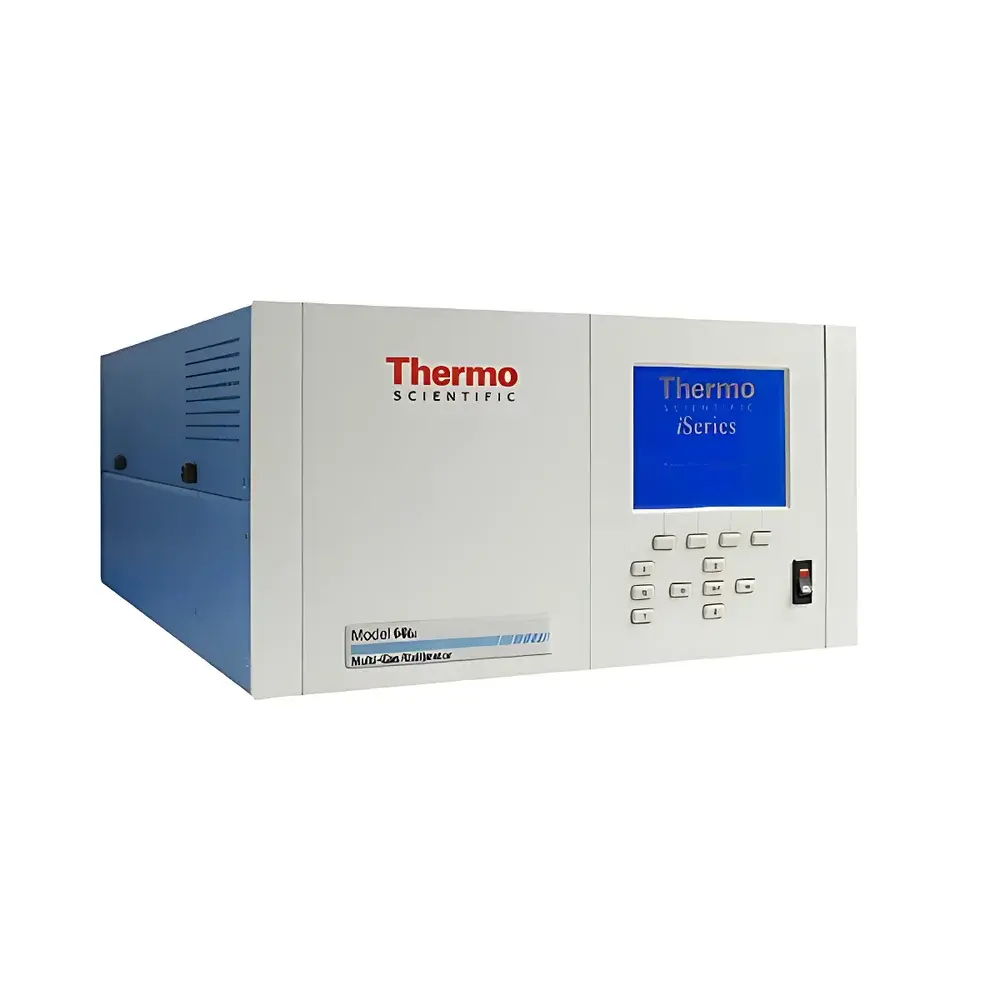
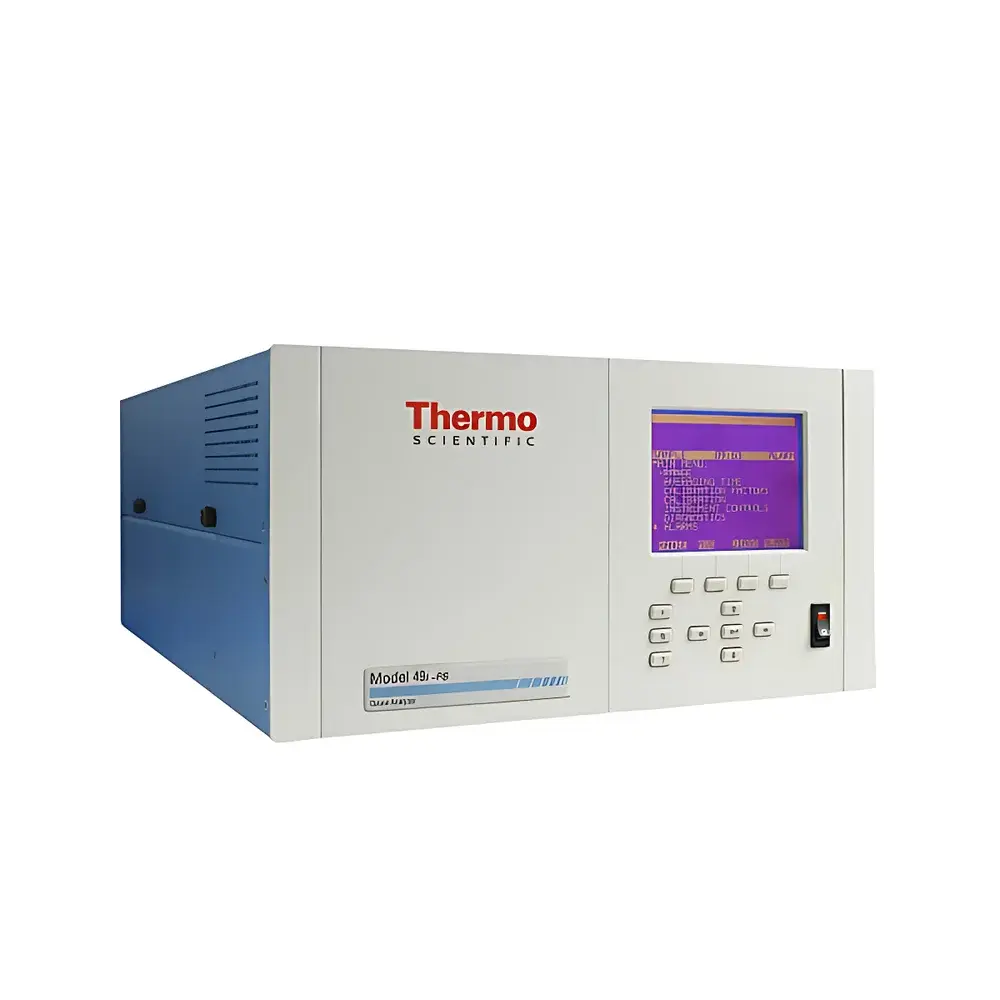
Thermo Scientific 146i Multi-Gas Calibration System & 49i-PS Ozone Primary Standard
| Brand | Thermo Fisher |
|---|---|
| Origin | USA |
| Manufacturer | Thermo Fisher Scientific |
| Product Type | Imported |
| Models | 146i, 49i-PS |
| Pricing | Upon Request |
Overview
The Thermo Scientific 146i Multi-Gas Calibration System and 49i-PS Ozone Primary Standard are precision-engineered instruments designed to meet stringent regulatory requirements for ambient air quality monitoring networks. The 49i-PS operates on the principle of ultraviolet (UV) photometry at 254 nm — a NIST-traceable reference method adopted by the U.S. Environmental Protection Agency (EPA) as the definitive standard for ozone calibration. It generates certified ozone concentrations up to 5000 ppb via a mercury vapor lamp-based photolytic source, with dual-beam optical detection enabling real-time compensation for lamp drift and optical path variations. The 146i integrates mass flow-controlled dilution, gas-phase titration (GPT), permeation tube technology, and UV photometric verification into a single microprocessor-driven platform. Its architecture supports traceable, multi-point calibration of ozone (O₃), nitrogen dioxide (NO₂), sulfur dioxide (SO₂), carbon monoxide (CO), nitric oxide (NO), non-methane hydrocarbons (NMHC), and other target analytes across EPA-defined concentration ranges.
Key Features
- Dual-beam UV photometric detection system (49i-PS) with automatic temperature and pressure compensation — compliant with EPA Method EQOA-0103 and ISO 13964
- Integrated gas-phase titration module (146i) for dynamic generation of O₃ and NO₂ with stoichiometric accuracy and sub-ppb reproducibility
- High-precision thermal mass flow controllers (MFCs) calibrated per ISO 17025-accredited procedures; accuracy ±2% of reading or ±1% FS (20–100% FS range)
- Expandable flash memory with network-enabled data logging (Ethernet/RS-232); supports remote firmware updates and configuration management
- User-definable soft keys and a high-resolution LCD interface enabling direct navigation to frequently used calibration routines and diagnostic menus
- Modular design with field-replaceable components including UV photometer cells, MFC modules, ozone generators, and permeation ovens — minimizing downtime during GLP/GMP audits
- Built-in self-diagnostic routines with configurable alarm thresholds for zero drift, span deviation, flow instability, and lamp intensity decay
Sample Compatibility & Compliance
The 146i and 49i-PS are validated for use in EPA-approved ambient air monitoring programs under 40 CFR Part 58 Appendix A and Appendix E. Both instruments satisfy performance criteria for zero air generation (≤0.5 ppb hydrocarbon equivalent), span gas delivery accuracy (±1% FS), and response time (≤20 s for 49i-PS; ≤180 s for UV photometric verification in 146i). The system complies with ASTM D5012 (ozone calibration), ISO 13964 (UV photometry), and EN 14625 (NO₂ GPT). All internal pressure, temperature, and flow sensors are NIST-traceable and documented per ISO/IEC 17025 calibration records. The instruments support 21 CFR Part 11-compliant audit trails when operated with Thermo’s optional IQ/OQ validation packages and secure user authentication protocols.
Software & Data Management
Embedded firmware provides menu-driven calibration workflows including zero/span checks, multi-point linearity verification, precision audits, and performance evaluation reports aligned with EPA QA Handbook Volume II. Data export is supported in CSV and XML formats with timestamped metadata (UTC/GMT), instrument ID, operator credentials, and environmental correction factors. Remote access is enabled via HTTP/HTTPS, Modbus TCP, or OPC UA — allowing integration into SCADA systems and centralized data acquisition platforms (e.g., EPA AirNow, AQS). Firmware supports configurable data retention policies, cyclic buffer overwrites, and encrypted remote downloads. Optional Thermo Trace™ software enables automated report generation compliant with EPA Form QA-1 and QA-2 templates.
Applications
- Primary standard calibration of ambient ozone analyzers in national reference laboratories and regional air quality monitoring stations
- Multi-gas calibration of continuous emission monitoring systems (CEMS) and portable gas analyzers used in regulatory compliance testing
- Performance audits of federal equivalent methods (FEM) and federal reference methods (FRM) under 40 CFR Part 53
- Validation of zero air generators and synthetic air standards in ISO 17025-accredited testing laboratories
- Traceability chain establishment from NIST SRMs to field-deployed analyzers through documented uncertainty budgets
- Research applications requiring stable, dynamically generated reactive gases (e.g., O₃/NO₂ reaction kinetics, sensor cross-sensitivity studies)
FAQ
What regulatory standards does the 49i-PS comply with as an ozone primary standard?
It meets EPA Method EQOA-0103, ISO 13964, and serves as the U.S. national reference standard per NIST Special Publication 260-179.
Can the 146i generate both ozone and nitrogen dioxide simultaneously?
No — it performs sequential GPT-based generation using dedicated reaction chambers; simultaneous output requires external manifold integration.
Is the 146i compatible with third-party data acquisition systems?
Yes — via Modbus TCP, OPC UA, or ASCII protocol over Ethernet/RS-232 with full register mapping documentation provided.
What is the minimum detectable ozone concentration for the 49i-PS?
0.50 ppb (with 60-second averaging), achieving RMS noise of 0.25 ppb.
Does the system support GLP/GMP audit requirements?
Yes — with optional IQ/OQ documentation, electronic signature capability, and 21 CFR Part 11-compliant audit trail logging.
How often does the UV lamp require recalibration or replacement?
Lamp intensity is monitored continuously; typical service interval is 12 months or 8,000 operating hours — verified against NIST-traceable reference cells.
Related Products







