
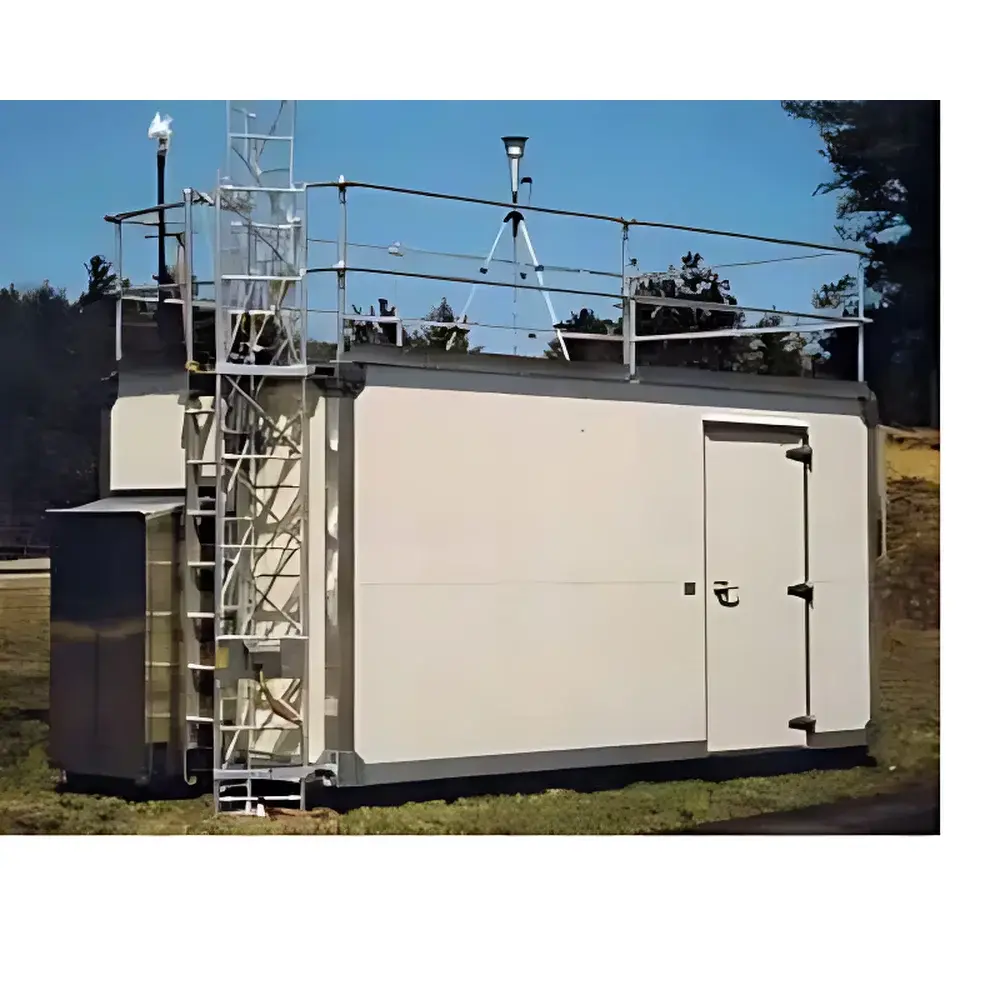
Thermo Scientific Environmental Air Quality Automatic Monitoring System
| Brand | Thermo Fisher |
|---|---|
| Origin | USA |
| Manufacturer Type | Original Equipment Manufacturer (OEM) |
| Origin Category | Imported |
| Model | Thermo Scientific |
| Pricing | Available Upon Request |
Overview
The Thermo Scientific Environmental Air Quality Automatic Monitoring System is a fully integrated, regulatory-grade ambient air monitoring platform engineered for continuous, unattended measurement of gaseous pollutants and particulate matter in accordance with U.S. EPA reference and equivalent methods. Based on standardized physical and electrochemical detection principles—including pulsed ultraviolet fluorescence (SO₂), chemiluminescence (NO/NO₂/NOₓ), gas filter correlation infrared absorption (CO), UV photometry (O₃), beta attenuation (PM₁₀), and tapered element oscillating microbalance (TEOM™) technology—the system delivers metrologically traceable, high-reproducibility data suitable for compliance reporting, trend analysis, and public health assessment. Designed around a distributed architecture comprising central data management stations, field-deployed monitoring sub-stations, and dedicated quality assurance laboratories, the system operates 24/7 with automated calibration, diagnostic self-checks, and real-time telemetry—ensuring >90% effective data capture rate and ≤1% deviation between raw sensor output and final reported standard-state concentration values.
Key Features
- Fully automated, multi-parameter monitoring with simultaneous quantification of SO₂, NO, NO₂, NOₓ, CO, O₃, and PM₁₀
- Regulatory-compliant analyzers validated to U.S. EPA Reference Method (RM) and Equivalent Method (EM) specifications
- Integrated meteorological sensor suite measuring wind direction, wind speed, ambient temperature, relative humidity, and barometric pressure
- Onboard calibration subsystem including multi-gas calibrators, zero-air generators, and certified standard gas cylinders
- Robust data acquisition architecture featuring industrial-grade embedded controllers with dual RS-232/RS-485 serial interfaces and analog outputs (0–1 V, 0–5 V, 0–10 V, 0–100 mV)
- Automated daily span/zero checks with configurable frequency, remote firmware updates, and event-triggered diagnostics
- Comprehensive audit trail generation supporting GLP/GMP-aligned data integrity requirements
Sample Compatibility & Compliance
The system is designed for ambient outdoor air sampling under ISO 12039, ISO 12049, ISO 13964, and EN 14625 standards. All gas analyzers meet U.S. EPA Designated Reference Method criteria, while particulate monitors satisfy EPA PM₁₀ Federal Reference Method (FRM) equivalency. The platform supports full compliance with China’s HJ 653–2013 and HJ 654–2013 technical specifications for ambient air monitoring equipment. Data handling protocols align with FDA 21 CFR Part 11 for electronic records and signatures where applicable. Instrument-level certifications include CE marking, RoHS compliance, and national type-approval documentation issued by China’s State Administration for Market Regulation (SAMR).
Software & Data Management
The system utilizes ENVIDATA™—a modular, Windows-based data acquisition and processing software suite developed by Thermo Fisher Scientific. ENVIDATA provides real-time visualization, automatic unit conversion to standard temperature and pressure (STP: 25°C, 101.325 kPa), QA/QC flagging, calibration log management, and customizable report generation (daily, monthly, annual summaries). It supports secure role-based access control, encrypted database storage, and export formats compliant with national environmental information platforms (e.g., China’s National Environmental Monitoring Network—NEMN). Audit logs record all user actions, parameter changes, and instrument events with timestamp and operator ID, satisfying GLP audit readiness requirements.
Applications
- Regulatory ambient air quality monitoring networks operated by national and municipal environmental protection agencies
- Long-term trend analysis for urban, suburban, and background sites under national air quality index (AQI) frameworks
- Source attribution studies and receptor modeling requiring high-temporal-resolution, multi-pollutant datasets
- Industrial fence-line monitoring and environmental impact assessment (EIA) programs
- Research applications in atmospheric chemistry, aerosol science, and exposure epidemiology
- Integration into smart city infrastructure for real-time public air quality dashboards
FAQ
What regulatory standards does this system comply with?
It meets U.S. EPA Reference Method requirements for all measured parameters and complies with Chinese national standards HJ 653–2013 and HJ 654–2013.
Is remote diagnostics and software update capability supported?
Yes—ENVIDATA enables secure remote access for configuration, troubleshooting, and over-the-air firmware updates via authenticated network connections.
How is data integrity ensured during transmission and storage?
All measurements undergo time-synchronized logging with cryptographic hashing; audit trails are immutable and exportable for third-party verification.
Can the system operate without on-site personnel?
Yes—the substation is fully autonomous with automatic calibration, fault detection, and alarm notification via SMS/email or SCADA integration.
Does the system support integration with national environmental data platforms?
Yes—ENVIDATA includes configurable API endpoints and flat-file exporters compatible with China’s NEMN and similar national telemetry protocols.
Related Products







