
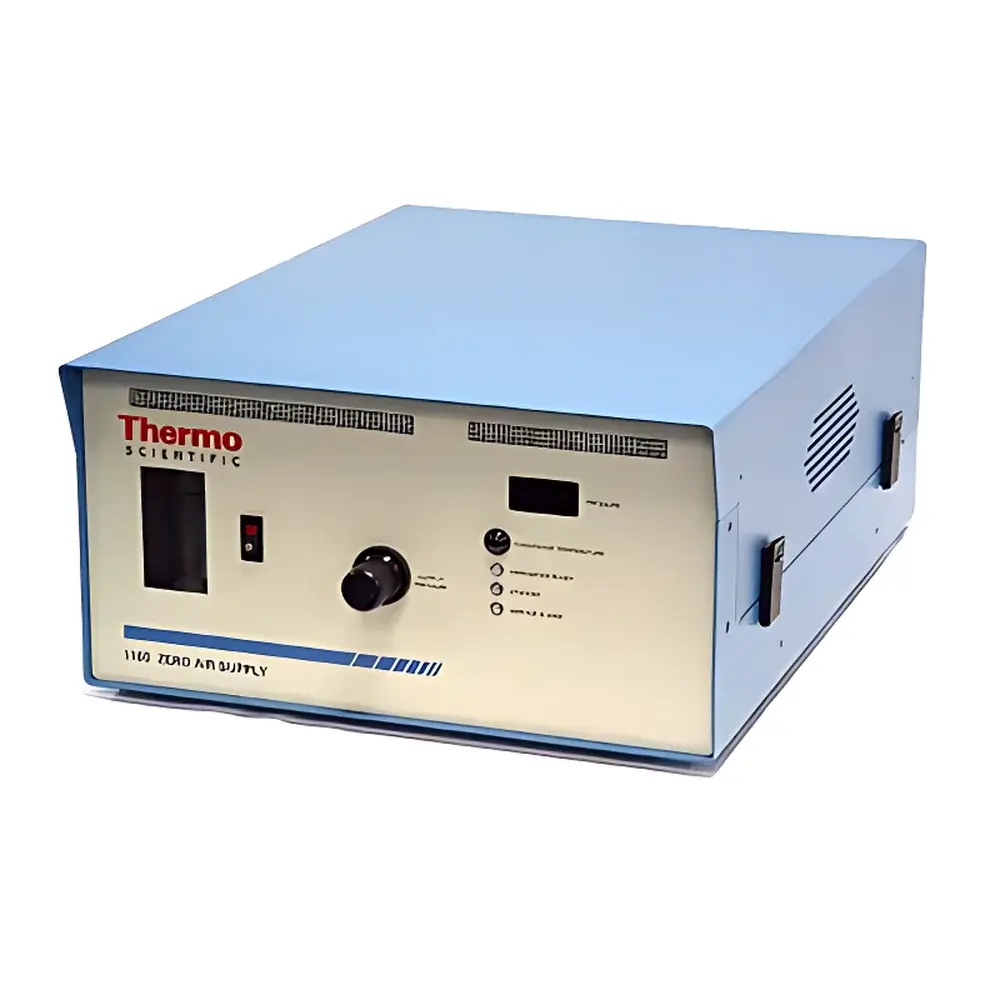
Thermo Scientific 1160 Zero Air Generator
| Brand | Thermo Fisher |
|---|---|
| Origin | USA |
| Manufacturer Type | Original Equipment Manufacturer (OEM) |
| Import Status | Imported |
| Model | Thermo Scientific 1160 |
| Pricing | Upon Request |
| Flow Rate | 1–20 L/min |
| Output Pressure | 10–60 PSI |
| Dew Point | −10 °C (membrane dryer) / −40 °C (heatless desiccant dryer) |
| Purity | SO₂ < 0.1 ppb |
Overview
The Thermo Scientific™ 1160 Zero Air Generator is an engineered solution for laboratories and ambient air monitoring stations requiring ultra-low-background, contaminant-free air as a calibration and purge gas source. It operates on compressed instrument-grade air (typically 80–120 PSI), which is sequentially purified through a multi-stage filtration architecture to remove reactive gaseous species, moisture, and hydrocarbon vapors. The system leverages catalytic oxidation, high-efficiency particulate adsorption, and selective chemical scrubbing—combined with either membrane-based or heatless desiccant drying—to achieve trace-level purity specifications mandated by regulatory-grade environmental analyzers, including chemiluminescence NOx analyzers, UV photometric O3 monitors, and pulsed fluorescence SO2 detectors. Designed explicitly for integration into continuous emission monitoring systems (CEMS) and reference-grade ambient air quality networks, the 1160 meets the stringent zero-air criteria defined in U.S. EPA Method TO-15, ISO 8573-1 Class 1 for particulates and oil aerosols, and ASTM D6167 for calibration gas preparation.
Key Features
- Triple-stage modular filtration architecture: includes coalescing pre-filter, catalytic CO-to-CO2 converter (for optional CO removal), and dual-bed chemical scrubber for NOx, SO2, O3, H2S, and NH3
- Selectable drying configuration: integrated membrane dryer (−10 °C dew point) or heatless desiccant dryer (−40 °C dew point), both compliant with ISO 8573-3 Class 2 moisture specifications
- Real-time temperature monitoring with audible/visual alarm for thermal anomaly detection during catalytic oxidation—critical for maintaining reaction efficiency and preventing breakthrough
- Adjustable flow control (1–20 L/min) with integrated pressure regulation (10–60 PSI output), enabling stable delivery across variable downstream impedance
- Modular filter cartridge design with individual service life indicators; each stage (particulate, catalyst, chemical adsorbent) is independently replaceable per maintenance schedule
- Front-panel digital display showing operational status, flow rate, outlet pressure, and active filter stage health indicators
Sample Compatibility & Compliance
The 1160 is validated for use with EPA-certified ambient air analyzers (e.g., Thermo Scientific 42i, 43i, 48i series) and reference-grade laboratory instruments requiring certified zero air per 40 CFR Part 53 and EN 14625. Its verified purity profile supports method-defined blank requirements for EPA Methods 205, 211, and 212 (trace VOC analysis), where hydrocarbon interference must remain below 0.005 ppm C1–C12. All wetted materials—including stainless-steel 316L manifolds, fluoropolymer-sealed valves, and carbon molecular sieve beds—are selected for inertness and low outgassing. The unit complies with IEC 61000-6-2 (electromagnetic immunity) and UL 61010-1 safety standards. Optional factory-installed CO removal module satisfies ASTM D5502 requirements for zero air used in combustion efficiency testing and stack gas dilution calibrations.
Software & Data Management
While the 1160 operates as a standalone hardware system without embedded firmware or network connectivity, it is fully compatible with Thermo Scientific’s Instrument Manager™ software suite when deployed alongside compatible gas analyzers. This enables synchronized logging of zero-air delivery parameters (flow, pressure, temperature) alongside analyzer response data for audit-ready GLP/GMP traceability. Filter replacement timestamps and operational uptime are manually recorded in lab notebooks or electronic lab notebooks (ELN) per ISO/IEC 17025 documentation requirements. For regulated environments, the unit supports 21 CFR Part 11-compliant audit trails when integrated via analog/digital I/O into validated SCADA or LIMS platforms using third-party interface modules.
Applications
- Ambient air quality monitoring networks (AQS) requiring EPA-equivalent zero air for daily span/zero checks and drift verification
- Calibration laboratories performing ISO/IEC 17025-accredited gas analyzer validation and uncertainty budgeting
- Research facilities conducting atmospheric chemistry studies where background interference must be minimized to sub-ppt levels
- Industrial hygiene programs supporting NIOSH Method 0600 and OSHA ID-254 for hydrocarbon exposure assessment
- Reference method comparison studies under EU Directive 2008/50/EC and U.S. NAAQS compliance frameworks
FAQ
What is the recommended inlet air quality for optimal 1160 performance?
Instrument-grade compressed air with ≤ 0.01 mg/m³ oil content, ≤ 0.1 µm particulate filtration, and initial dew point ≤ 3 °C is required to prevent premature filter saturation and ensure specified lifetime.
Can the 1160 be used with ozone generators for photolysis experiments?
Yes—the unit’s verified O3 < 0.4 ppb output ensures minimal baseline interference in controlled photochemical reaction chambers when used as carrier or diluent gas.
Is routine calibration required for the 1160 itself?
No. As a purification device—not a measurement instrument—it does not require calibration; however, periodic verification using certified gas standards (e.g., NIST-traceable zero air cylinders) is recommended per ISO/IEC 17025 Clause 6.6.
How often must filter cartridges be replaced?
Typical service intervals: coalescing pre-filter every 6 months, catalytic converter every 12–18 months (dependent on inlet CO load), chemical scrubber every 12 months at 10 L/min continuous operation.
Does the 1160 support remote monitoring or alarm relay outputs?
Standard configuration includes dry-contact alarm relays for temperature fault and optional flow loss; RS-485 Modbus RTU interface is available via factory-orderable communication module (Part No. 1160-COM).







