
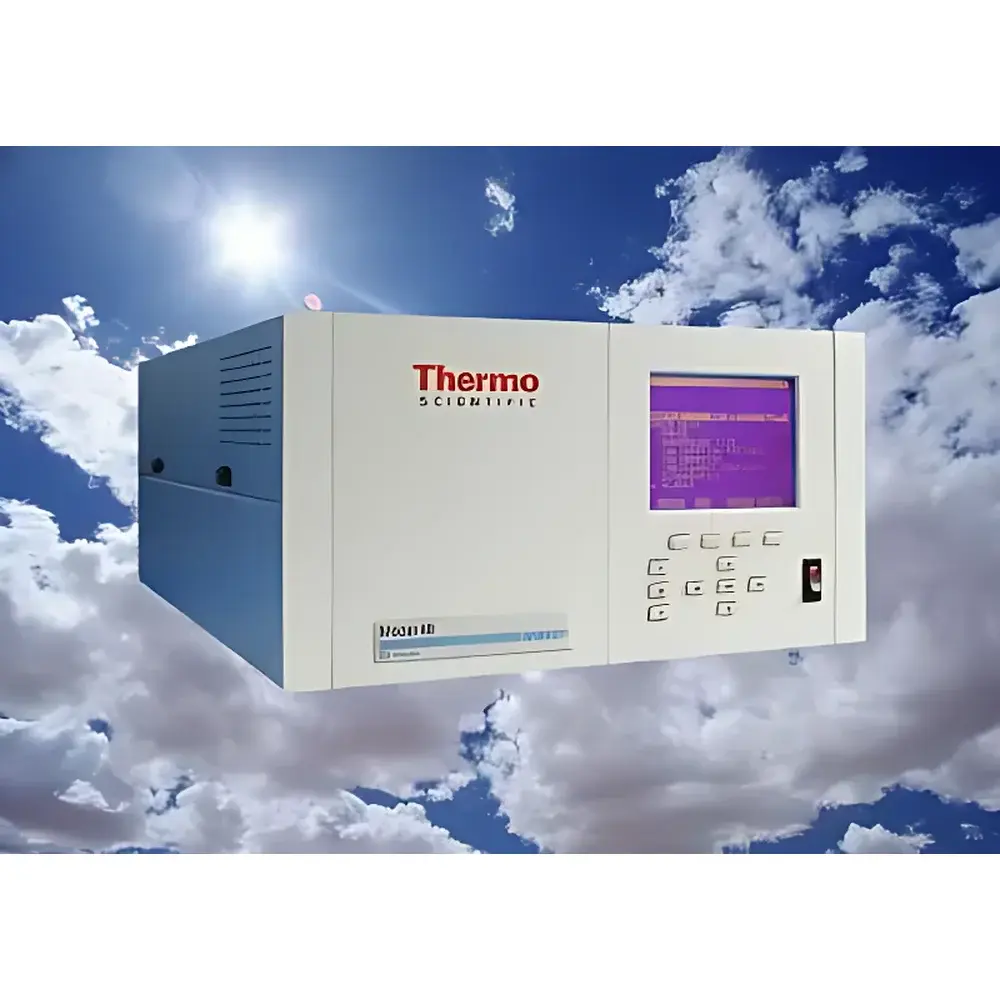
Thermo Fisher Scientific 48i Carbon Monoxide (CO) Analyzer
| Brand | Thermo Fisher Scientific |
|---|---|
| Origin | USA |
| Manufacturer | Thermo Fisher Scientific |
| Type | Imported |
| Model | 48i |
| Configuration | Online Gas Analyzer |
| Target Analyte | Carbon Monoxide (CO), Single-Component |
| Measurement Range | 0–1 to 0–10,000 ppm (also available in mg/m³ equivalents) |
| Response Time (T90) | 60 s (with 30-s averaging) |
| Zero Drift (24 h) | < 0.1 ppm |
| Span Drift (24 h) | ±1% of full scale |
| Zero Noise | 0.02 ppm RMS (30-s average) |
| Limit of Detection | 0.04 ppm |
| Linearity Error | < ±1% of reading across full range |
| Data Storage | Flash memory with expanded capacity |
| Connectivity | Ethernet-enabled for remote access and control |
| Display | High-resolution backlit LCD with multi-tier menu interface |
| Soft-key Customization | User-definable function keys for rapid navigation |
| Compliance | Designed to meet EPA Performance Specification PS-1 (for ambient CO monitoring), ISO 9001-certified manufacturing, supports GLP/GMP data integrity requirements (audit trail, user authentication, electronic signature readiness per 21 CFR Part 11) |
Overview
The Thermo Fisher Scientific 48i Carbon Monoxide (CO) Analyzer is a high-performance, continuous-emission and ambient-air monitoring instrument engineered for regulatory-grade accuracy, long-term stability, and operational simplicity. It employs the gas filter correlation (GFC) infrared absorption technique—a highly selective, interference-resistant method optimized for CO detection at trace to high-concentration levels. The analyzer operates on the principle that carbon monoxide exhibits strong, characteristic absorption at 4.6 µm in the mid-infrared spectrum. Unlike conventional non-dispersive infrared (NDIR) systems, GFC technology uses a mechanically modulated reference cell filled with pure CO to dynamically match and cancel out background spectral interferences—significantly enhancing specificity and minimizing cross-sensitivity to water vapor, CO₂, and hydrocarbons. This optical architecture delivers exceptional signal-to-noise ratio and enables reliable quantification across an ultra-wide dynamic range—from 0–1 ppm (ideal for ambient air compliance) up to 0–10,000 ppm (suitable for stack or industrial process monitoring). The 48i’s embedded linearization algorithm applies a precision-calibrated correction curve to raw detector output, ensuring traceable linearity over its entire span without reliance on external calibration gases during routine operation.
Key Features
- Gas Filter Correlation (GFC) optical design for superior CO selectivity and minimal cross-interference
- Multi-range programmability: 13 selectable full-scale ranges from 0–1 ppm to 0–10,000 ppm (and equivalent mg/m³ scales)
- High-stability thermal management system enabling < 0.1 ppm zero drift over 24 hours
- Ethernet interface (RJ-45) supporting Modbus TCP, HTTP, and SNMP protocols for seamless integration into SCADA and EMS platforms
- User-customizable soft keys for one-touch access to frequently used functions—calibration, span check, data export, or alarm configuration
- Backlit high-resolution LCD display showing real-time concentration, status flags, diagnostic codes, and live menu navigation simultaneously
- Onboard flash memory with extended logging capacity (≥30 days of 1-minute averaged data at default settings)
- Modular internal layout with tool-less access to optical bench, pump, and filter assemblies—reducing mean time to repair (MTTR)
- Firmware-upgradable architecture supporting future protocol enhancements and regulatory updates
Sample Compatibility & Compliance
The 48i is validated for continuous analysis of CO in ambient air, flue gas, landfill emissions, and indoor air quality applications. Sample conditioning is compatible with standard heated sample lines (optional) and particulate filtration (e.g., Teflon membrane filters ≤ 2.5 µm). It meets U.S. Environmental Protection Agency (EPA) Performance Specification PS-1 for ambient CO analyzers and conforms to ISO/IEC 17025 general requirements for competence of testing and calibration laboratories. Its hardware and firmware architecture support audit-trail generation, role-based user access control, and electronic signature functionality—enabling deployment in environments governed by FDA 21 CFR Part 11, EU Annex 11, and GLP/GMP frameworks. Calibration verification can be performed using NIST-traceable CO standards; optional integrated zero/span valves support automated daily checks.
Software & Data Management
The 48i operates with Thermo Fisher’s Instrument Manager™ software suite (Windows-based), providing centralized configuration, real-time telemetry visualization, historical trend analysis, and automated report generation (PDF/CSV). All data—including raw analog outputs, digital diagnostics, and event logs—are timestamped with microsecond precision and stored with immutable metadata (operator ID, calibration history, environmental conditions). Remote firmware updates and parameter reconfiguration are supported via secure HTTPS session. The analyzer complies with IEC 62443-3-3 cybersecurity standards for industrial automation systems, featuring TLS 1.2 encryption, configurable password policies, and disabled legacy protocols (e.g., Telnet, FTP) by default.
Applications
- Ambient air quality monitoring networks (AQS) compliant with EPA and EEA regulatory mandates
- Continuous emission monitoring systems (CEMS) for combustion sources including power plants, incinerators, and cement kilns
- Indoor air quality (IAQ) assessment in transportation hubs, parking garages, and industrial facilities
- Research-grade CO flux studies in atmospheric chemistry and urban pollution modeling
- Process safety monitoring in hydrogen production, syngas handling, and metal annealing operations
- Calibration laboratory reference standard for secondary CO analyzers
FAQ
What measurement principle does the 48i employ?
It utilizes gas filter correlation (GFC) infrared absorption at 4.6 µm, offering high specificity and low interference susceptibility.
Is the 48i suitable for unattended long-term deployment?
Yes—it is designed for continuous operation with < 0.1 ppm zero drift over 24 hours and robust thermal stabilization for field environments.
Can the 48i be integrated into existing facility SCADA systems?
Yes—via standard Ethernet with Modbus TCP, HTTP API, and SNMP support for bidirectional communication.
Does the 48i support regulatory-compliant data integrity requirements?
Yes—it provides electronic signatures, user authentication, audit trails, and tamper-evident logging aligned with 21 CFR Part 11 and Annex 11.
What are the key differences between the 48i, 48i-HL, and 48i-TLE models?
The 48i-HL offers high-linearity performance for industrial stack applications; the 48i-TLE features enhanced sensitivity (sub-ppb LOD) and ultra-low noise electronics for background atmospheric research.







