
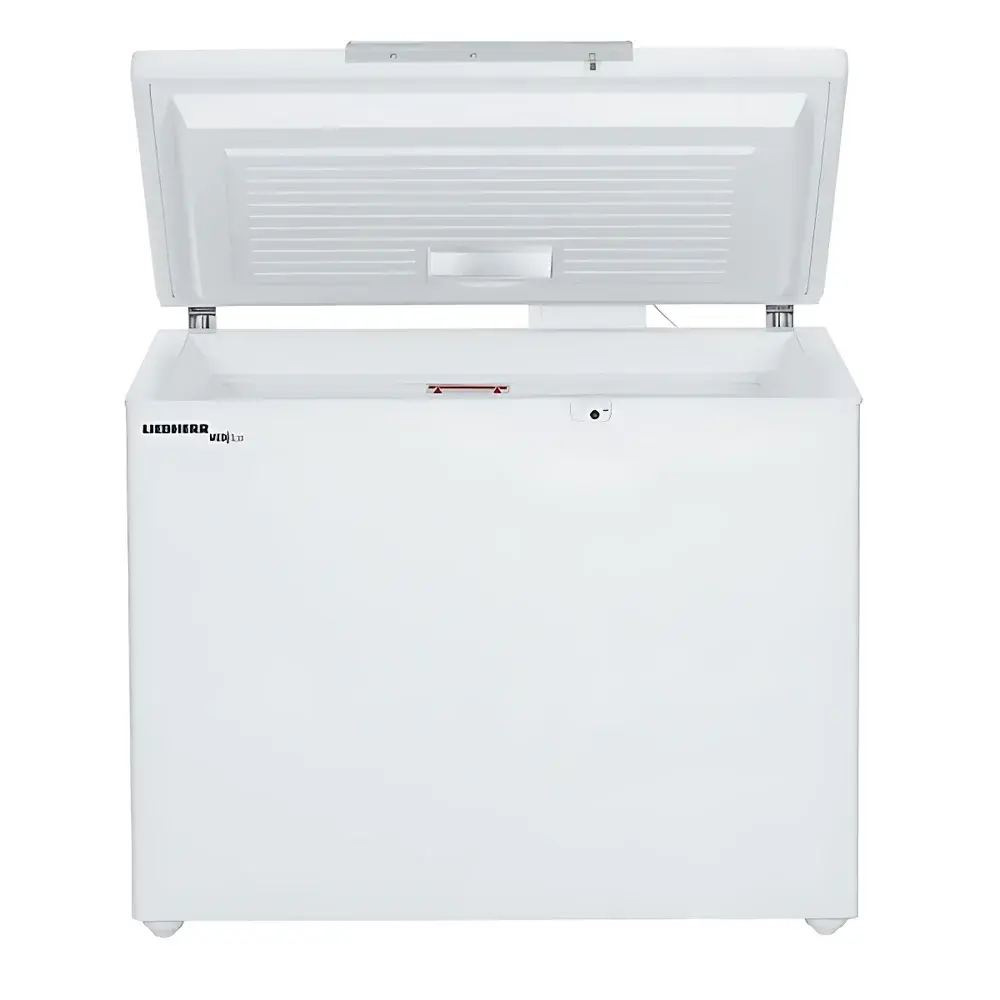
Liebherr LGT 2325 Ultra-Low Temperature Horizontal Freezer
| Brand | Liebherr |
|---|---|
| Origin | Austria |
| Model | LGT 2325 |
| Type | Horizontal ULT Freezer |
| Effective Volume | 215 L |
| Interior Dimensions (W×D×H) | 1132 × 760 × 919 mm |
| External Dimensions (W×D×H) | 1132 × 760 × 919 mm |
| Power Supply | 220 V / 50 Hz |
| 24-h Energy Consumption | 2.256 kWh |
| Temperature Range | –10 °C to –45 °C |
| Temperature Uniformity | ±5 °C |
| Control Resolution | 0.1 °C (–10 to –19.9 °C), 1 °C (below –20 °C) |
| Door Hinge Cycle Life | ≥300,000 cycles |
| Construction | Stainless steel cabinet & lid |
| Lighting | Integrated LED interior lamp |
| Frost Management | StopFrost system |
| Connectivity | RS485 interface for NTC sensor data output |
| Control System | Comfort-type electronic controller (top-mounted, 5° forward tilt display) |
Overview
The Liebherr LGT 2325 is a horizontally configured ultra-low temperature freezer engineered for reliable, long-term storage of temperature-sensitive biological and chemical specimens in regulated laboratory environments. Operating within a precisely controlled range of –10 °C to –45 °C, the unit employs a high-efficiency dual-stage cascade refrigeration system optimized for thermal stability and energy conservation. Unlike conventional low-temperature freezers, the LGT 2325 integrates advanced thermal management—including the proprietary StopFrost technology—to minimize internal frost accumulation, reduce manual defrost frequency, and maintain rapid pressure equilibration upon lid cycling. Its uniform temperature distribution (±5 °C across the entire chamber volume) ensures sample integrity during extended storage, while the 0.1 °C resolution control in the –10 °C to –19.9 °C sub-range supports applications requiring fine-grained thermal setpoint optimization—such as controlled freezing of primary cell isolates or antibody formulations.
Key Features
- Stainless steel outer cabinet and lid with reinforced hinge mechanism rated for ≥300,000 open/close cycles—designed for high-traffic core facilities and shared lab infrastructure.
- White-coated aluminum interior liner: non-porous, corrosion-resistant, and compatible with common laboratory disinfectants (e.g., 70% ethanol, quaternary ammonium solutions).
- Integrated LED lighting embedded in the lid—provides uniform illumination without generating localized heat or compromising thermal stability.
- StopFrost system: dynamically manages internal humidity and pressure differentials to suppress ice formation on evaporator surfaces and accelerate lid resealing after access.
- Top-mounted Comfort electronic controller with 5° forward-tilt display panel—enables ergonomic parameter viewing and adjustment without bending or obstructing chamber access.
- Rear-panel external temperature sensor port: accommodates calibrated, traceable NIST-traceable probes for independent validation and GLP-compliant temperature mapping studies.
- RS485 serial interface: enables real-time transmission of NTC sensor readings (chamber air and optional product probe) to centralized LTM monitoring software—supporting up to 20 units per network node.
Sample Compatibility & Compliance
The LGT 2325 is validated for storage of a broad spectrum of biospecimens under ISO 13485–aligned manufacturing conditions and conforms to IEC 61010-1 (Safety Requirements for Electrical Equipment for Measurement, Control, and Laboratory Use). Its stable thermal profile meets critical requirements for preserving viability of primary human cells, cryopreserved stem cell lines, monoclonal antibodies, viral vectors (AAV, lentivirus), tissue sections, serum pools, and diagnostic reagents. The unit’s design supports compliance with FDA 21 CFR Part 11 when integrated with validated LTM software—enabling electronic audit trails, user-access controls, and alarm event logging. It is routinely deployed in GLP/GMP-aligned settings including biobanks (ISO 20387), clinical trial material storage, QC laboratories in pharmaceutical development, and academic core facilities adhering to NIH Biospecimen Resource Guidelines.
Software & Data Management
Data acquisition and remote oversight are facilitated via Liebherr’s LTM (Laboratory Temperature Monitoring) platform—a Windows-based application supporting multi-unit surveillance, configurable alarm thresholds (high/low, deviation, communication loss), and automated report generation (PDF/CSV). All temperature logs include timestamps with millisecond precision, user ID tagging, and cryptographic hash integrity verification. When deployed with optional external NTC sensors and calibrated reference thermistors, the system satisfies calibration traceability requirements per ISO/IEC 17025. Alarm notifications can be routed via SMTP email or SNMP traps to existing facility-wide building management systems (BMS), ensuring alignment with institutional cold chain incident response protocols.
Applications
- Long-term archival storage of human and animal-derived biospecimens (serum, plasma, PBMCs, tissue blocks) in biorepositories and biobanks.
- Stabilization of thermolabile reagents including restriction enzymes, polymerases, and ELISA kits prior to assay deployment.
- Controlled cryopreservation of microbial cultures (bacteria, yeast, fungi) and viral stocks for strain maintenance and challenge studies.
- Storage of GMP-grade intermediates and drug substance batches during stability testing per ICH Q5C guidelines.
- Backup cold storage for ultra-low temperature applications where –80 °C freezers are unavailable or undergoing maintenance.
- Environmental simulation support: integration with environmental chambers for staged freeze-thaw cycling experiments requiring precise intermediate hold temperatures.
FAQ
What is the recommended ambient operating environment for the LGT 2325?
The unit is rated for installation in rooms maintained between +10 °C and +32 °C with relative humidity ≤70% non-condensing. Ventilation clearance of ≥100 mm at rear and sides is mandatory for condenser airflow.
Does the LGT 2325 support 21 CFR Part 11 compliance?
Yes—when used with validated LTM software v3.2 or later, full electronic signature capability, audit trail retention (>18 months), and role-based access control are enabled per FDA guidance.
Can external temperature probes be calibrated independently of the internal NTC sensor?
Yes—the rear-panel sensor port accepts third-party Class A PT100 or NIST-traceable thermistors; calibration certificates may be imported into LTM for offset correction and uncertainty reporting.
Is the StopFrost system serviceable in situ?
No—StopFrost is a sealed, passive hygroscopic module integrated into the lid gasket assembly; replacement requires factory-authorized service and recalibration.
What is the warranty coverage for the LGT 2325?
Standard coverage includes 24 months parts-and-labor warranty on refrigeration components and 36 months on electronics; extended service contracts are available through Liebherr’s certified European service network.




