
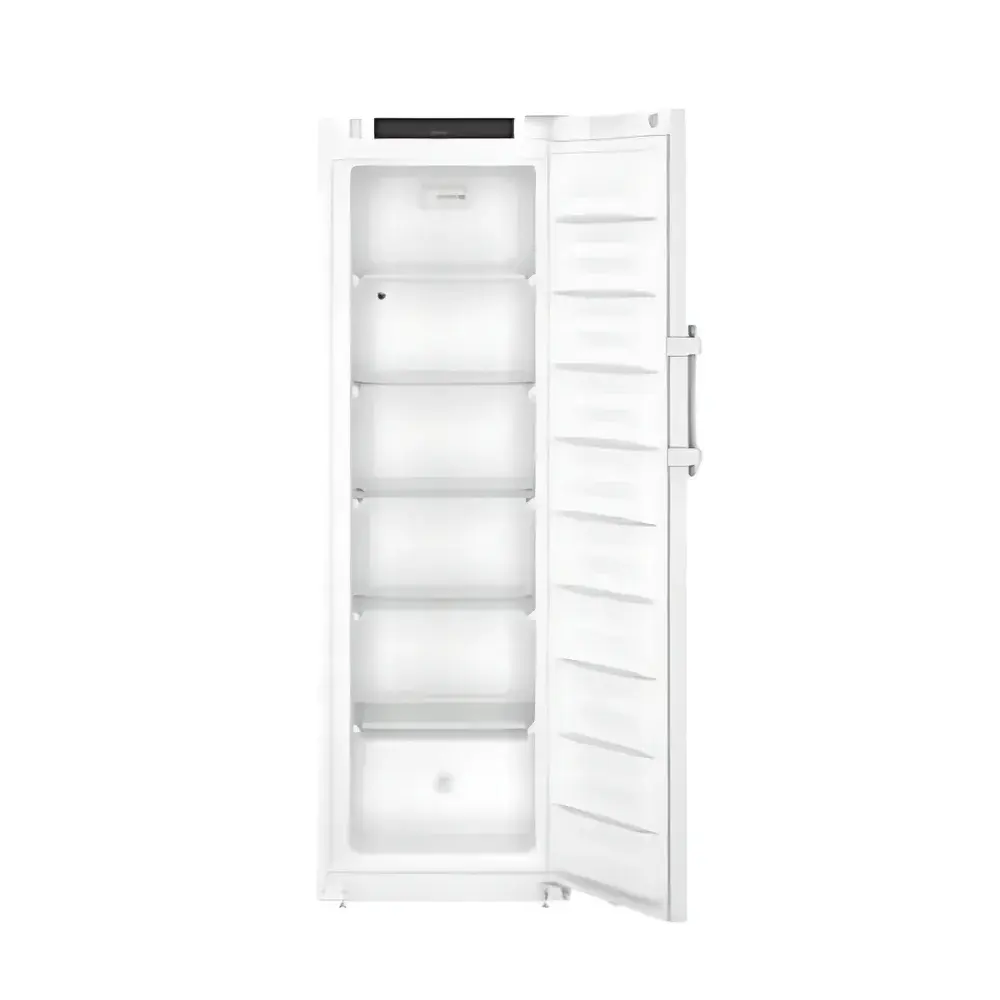
Liebherr SFFfg 4001 Explosion-Proof Laboratory Freezer
| Brand | Liebherr |
|---|---|
| Country of Origin | Austria |
| Model | SFFfg 4001 |
| Type | Upright |
| Total/Net Volume | 316 / 242 L |
| Operating Temperature Range | −9 °C to −30 °C |
| Annual Energy Consumption | 384 kWh/365 days |
| Refrigeration System | Direct Cool |
| Refrigerant | R 290 |
| Control Interface | Monochrome Display with Touch Buttons |
| ATEX Certification | II 3G Ex ec IIC T6, Zone 22 |
| Compliance | EN 1127-1, IEC 60079-0, IEC 60079-15, IEC 61010-2-011, 2014/34/EU |
| Temperature Stability | ±5 °C |
| External Dimensions (W×D×H) | 597 × 654 × 1884 mm |
| Internal Dimensions (W×D×H) | 403 × 402 × 1588 mm |
| Noise Level | 49 dB(A) |
| Power Supply | 220–240 V~, 50 Hz |
| Shelf Capacity | 5 adjustable glass shelves (400 × 402 mm), 40 kg per shelf |
| Max. Unit Load | 270 kg |
| Ambient Temperature Range | +10 °C to +35 °C |
| Heat Output | 529 kJ/h |
Overview
The Liebherr SFFfg 4001 is a certified explosion-proof upright laboratory freezer engineered for the secure, long-term storage of flammable and highly combustible substances in research laboratories, pharmaceutical quality control environments, chemical synthesis facilities, and hazardous materials handling units. Designed and manufactured in Austria, this unit complies fully with the European Union’s ATEX Directive 2014/34/EU and meets the stringent requirements of EN 1127-1 (explosion prevention), IEC 60079-0 (general requirements for explosive atmospheres), and IEC 60079-15 (type of protection “ec” – increased safety). Its interior chamber is classified as II 3G Ex ec IIC T6, indicating suitability for use in Zone 22 — defined as areas where combustible dust clouds are not likely to occur in normal operation but may persist for short periods if they do. The freezer operates within a stable temperature range of −9 °C to −30 °C, maintaining thermal consistency within ±5 °C under standard ambient conditions (+10 °C to +35 °C), ensuring integrity for temperature-sensitive reagents, solvents, standards, and reference materials.
Key Features
- ATEX-certified explosion protection system integrated into all internal components — including lighting, sensors, fans, and control electronics — eliminating ignition sources in potentially explosive atmospheres.
- SmartFrost intelligent frost management technology minimizes ice accumulation on evaporator surfaces and inner walls, reducing manual defrost frequency and simplifying maintenance cycles.
- Direct-cooling refrigeration architecture using environmentally optimized hydrocarbon refrigerant R 290 (propane), offering low global warming potential (GWP = 3) and high thermodynamic efficiency.
- Robust steel cabinet construction with white powder-coated exterior and seamless stainless-steel or coated steel interior; smooth, non-porous surfaces facilitate cleaning and decontamination per GLP/GMP protocols.
- Monochrome touchscreen interface provides intuitive parameter setting, real-time temperature monitoring, alarm status indication, and configurable event logging.
- Five adjustable tempered glass shelves (400 × 402 mm), each rated for 40 kg load capacity, enabling flexible configuration for bottles, flasks, trays, and sample containers.
- Integrated power failure alarm with audible and visual alerts upon restoration — critical for continuity of cold chain integrity during utility interruptions.
Sample Compatibility & Compliance
The SFFfg 4001 is validated for storage of Class I (flammable liquids), Class II (combustible dusts), and Class III (ignitable fibers/flyings) materials as defined by NFPA 497 and IEC 60079 series standards. Its design conforms to IEC 61010-2-011 (safety requirements for laboratory equipment for heating and cooling), ensuring mechanical stability, electrical insulation, and fault-tolerant operation. All internal wiring, switches, and displays are rated for use in explosive atmospheres per EN 60079-15 (increased safety “ec”). The unit supports audit-ready documentation for ISO/IEC 17025-accredited laboratories and fulfills baseline requirements for FDA 21 CFR Part 11-compliant environments when paired with optional LAN/WiFi data logging modules.
Software & Data Management
While the base model features embedded firmware with local display and tactile controls, optional connectivity modules enable integration into centralized laboratory infrastructure. Available Ethernet or Wi-Fi interfaces support remote monitoring via SNMP or Modbus TCP protocols, allowing integration with building management systems (BMS) or LIMS platforms. Event logs—including door openings, temperature excursions, defrost cycles, and alarm triggers—are timestamped and exportable in CSV format. Optional software packages provide configurable thresholds, email/SMS notifications, and trend visualization for preventive maintenance planning. All data handling adheres to GDPR-compliant encryption and access control principles.
Applications
- Storage of volatile organic compounds (VOCs), acetone, ethanol, ether, and other Class IB/IC flammable solvents in analytical chemistry labs.
- Secure containment of pyrophoric reagents, organometallic catalysts, and peroxide-forming chemicals requiring inert, spark-free environments.
- Long-term preservation of calibration standards, certified reference materials (CRMs), and stability-indicating samples under controlled cryogenic conditions.
- Compliance-driven storage in GMP-regulated pharmaceutical manufacturing sites where ATEX compliance intersects with Annex 1 cold chain validation requirements.
- Use in university research labs handling nanomaterials, battery electrolytes, or energetic materials where static discharge and thermal runaway risks must be mitigated.
FAQ
What does “Zone 22” classification mean for this freezer?
Zone 22 refers to locations where combustible dust clouds are not expected to occur in normal operation but may persist briefly if released — such as inside sealed containers or during periodic transfer operations. The SFFfg 4001’s II 3G Ex ec IIC T6 rating confirms suitability for such scenarios.
Is R 290 refrigerant safe for laboratory use?
Yes — R 290 is approved under EC Regulation No. 517/2014 for use in hermetically sealed commercial and laboratory refrigeration systems. Its charge is strictly limited and contained within a double-walled, pressure-tested circuit, with leak detection interlocks integrated into the control logic.
Can temperature data be exported for regulatory audits?
Yes — with optional network interface and compatible software, continuous temperature records with digital signatures, user authentication logs, and electronic audit trails can be generated to satisfy ISO 17025, FDA 21 CFR Part 11, and EU GMP Annex 1 requirements.
How often does manual defrosting need to be performed?
Under typical usage (≤8 door openings/day, ambient ≤30 °C), SmartFrost technology extends defrost intervals to 6–12 months. When required, the smooth interior surface and accessible evaporator design reduce downtime to under 30 minutes.
Does the unit comply with energy efficiency regulations in North America?
While primarily designed for EU regulatory frameworks (Ecodesign Directive 2019/2023), its 384 kWh/year consumption corresponds to ENERGY STAR® Tier 2 equivalent performance for comparable volume freezers, making it suitable for LEED-certified lab facility specifications.
Related Products



