
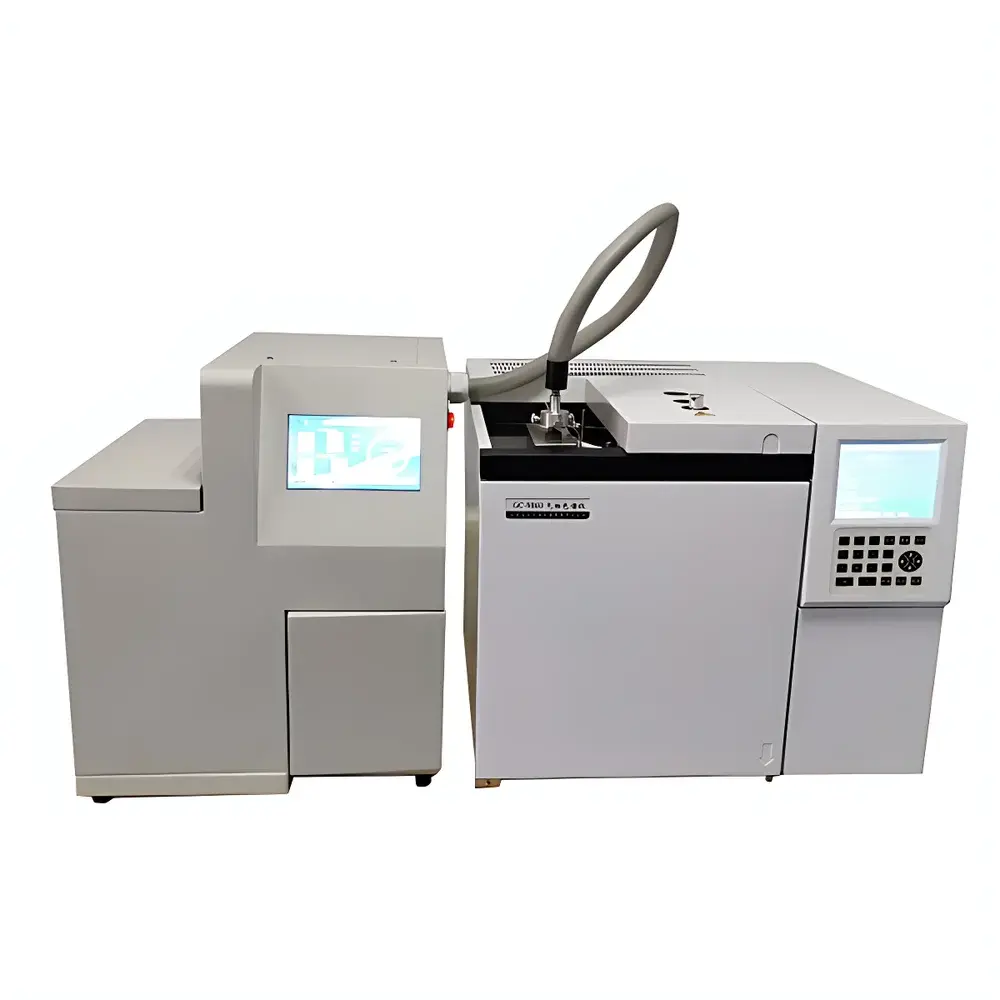
Beifen Sanpu AvHS-20A PLUS Fully Automated Static Headspace Sampler for Ethylene Oxide Residue Testing in Medical Devices
| Brand | Beifen Sanpu |
|---|---|
| Origin | Beijing, China |
| Manufacturer Type | Manufacturer |
| Regional Category | Domestic (China) |
| Model | AvHS-20A PLUS |
| Instrument Type | Static Headspace Sampler |
| Automation Level | Fully Automatic |
| Vial Heating Range | Ambient to 200 °C (1 °C increment) |
| Valve Temperature Control Range | 40–220 °C (±1 °C accuracy) |
| Sample Loop Volume | 1 mL |
| Vial Capacity | 20 positions |
| Compatible Vial Sizes | 10 mL or 20 mL |
Overview
The Beifen Sanpu AvHS-20A PLUS is a fully automated static headspace sampler engineered for precise, reproducible quantification of residual ethylene oxide (EO) and 2-chloroethanol (2-CE) in sterilized medical devices. It operates on the principle of equilibrium headspace gas-phase extraction—where volatile analytes partition from an aqueous or solid matrix into the vapor phase above the sample at controlled temperature and time. This thermodynamic equilibrium enables robust, matrix-independent quantitation when coupled with gas chromatography (GC), fulfilling the stringent requirements of ISO 10993-7:2008 and GB/T 16886.7–2015 for biological evaluation of medical devices. The system is designed to support regulatory-compliant EO residue testing workflows in quality control laboratories operating under GLP, GMP, and FDA 21 CFR Part 11 environments.
Key Features
- Fully automated 20-position carousel with programmable vial recognition and collision avoidance logic, minimizing manual intervention and operator variability.
- Precisely regulated vial heating module (ambient to 200 °C, 1 °C resolution) ensures consistent equilibration across heterogeneous device geometries—including catheters, implants, and porous polymer packaging.
- Independent valve oven (40–220 °C, ±1 °C stability) prevents condensation and carryover during transfer of volatile EO/2-CE vapors to the GC inlet.
- 1 mL fixed-volume quantitative loop guarantees volumetric precision and eliminates syringe-based injection drift—a critical requirement for sub-μg/g detection sensitivity.
- Integrated method validation support: built-in thermal calibration traceability, run-time log generation, and audit-ready event timestamps aligned with ALCOA+ data integrity principles.
Sample Compatibility & Compliance
The AvHS-20A PLUS accommodates standard 10 mL and 20 mL crimp-top headspace vials, enabling direct analysis of extracted device specimens per GB/T 16886.7–2015 Section 6.2. Sample preparation follows validated protocols: device segments (e.g., 1.0 g tubing, membrane, or sponge) are immersed in 5 mL ultrapure water, sealed, and equilibrated at 60 °C for 40 minutes. The system complies with ISO 10993-7:2008 Annex B (static headspace methodology), ASTM D6866-22 (for EO quantification), and supports full alignment with USP validation parameters (accuracy, precision, LOD/LOQ, linearity, robustness). All hardware and software design elements meet IEC 61010-1 safety standards for laboratory equipment.
Software & Data Management
Controlled via Beifen Sanpu’s HS-Link™ workstation software (v3.2+), the AvHS-20A PLUS provides role-based user access, electronic signature capability, and configurable audit trails compliant with FDA 21 CFR Part 11. Method files include embedded metadata (operator ID, calibration status, vial position map), and raw acquisition data are stored in vendor-neutral .csv and .cdf formats. Software supports automatic integration with third-party GC data systems (e.g., Shimadzu GCsolution, Agilent OpenLab CDS) via ASTM E1381-compliant instrument drivers. Batch-level reporting templates align with ISO/IEC 17025 documentation requirements for accredited testing laboratories.
Applications
This headspace sampler is deployed in QC labs performing routine EO residue testing across Class I–III medical devices, including but not limited to: single-use syringes, IV sets, surgical drapes, hemodialysis membranes, ophthalmic implants (e.g., intraocular lenses requiring ≤0.5 μg/day EO limits), and blood oxygenators. It supports risk-based classification per GB/T 16886.1—enabling distinct analytical strategies for short-term (30 days) devices. When paired with a GC-FID or GC-MS system, it achieves detection limits ≤0.1 μg/g for EO and ≤0.5 μg/g for 2-CE—meeting the most restrictive thresholds defined in ISO 10993-7 Table A.1 for permanent implants.
FAQ
What regulatory standards does the AvHS-20A PLUS directly support?
It is validated for use with ISO 10993-7:2008, GB/T 16886.7–2015, ASTM D6866-22, and USP , and its operational parameters satisfy the method equivalence criteria outlined in FDA Guidance for Industry: “Sterile Drug Products Produced by Aseptic Processing” (2004) and EU Annex 1 (2022).
Can the system be integrated into an existing LIMS environment?
Yes—via ODBC-compliant database export, HL7-compatible result transmission, and configurable CSV output paths that map to common LIMS ingestion schemas.
Is method transfer supported between different GC platforms?
The AvHS-20A PLUS uses standardized headspace timing and pressure profiles; method transfer requires only minor GC parameter re-optimization (e.g., column flow, oven ramp) and is documented per ICH Q2(R2) guidelines.
How is carryover mitigated during high-concentration sample runs?
The system employs dual-stage valve purging (inert gas + heated purge), programmable needle wash cycles, and real-time pressure monitoring to detect and flag potential contamination events before sample injection.
Does the instrument support 2-CE quantification alongside EO?
Yes—its wide valve temperature range (up to 220 °C) and inert flow path preserve 2-CE integrity during transfer, enabling simultaneous calibration and detection without derivatization.




