
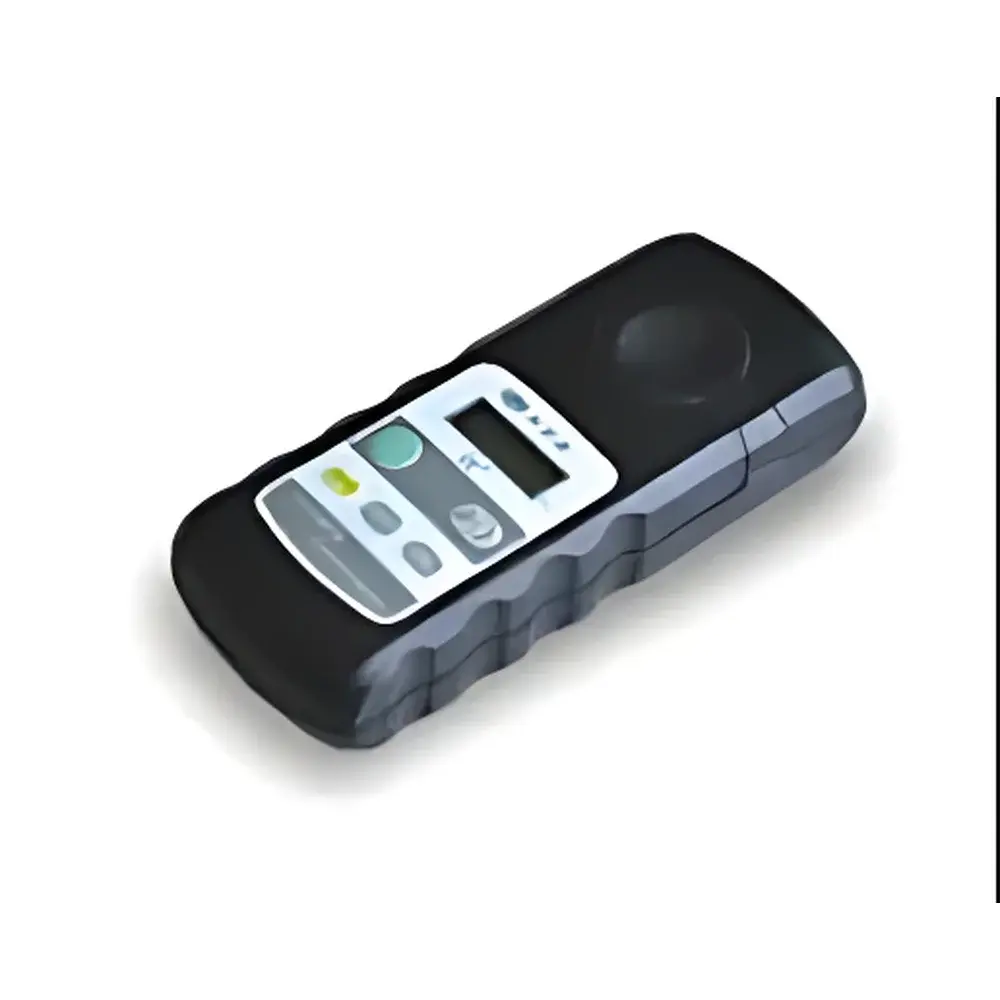
Beifen Sanpu Q-CL501A Portable Dual-Parameter Chlorine Dioxide & Chlorite Analyzer
| Brand | Beifen Sanpu |
|---|---|
| Origin | Beijing, China |
| Manufacturer Type | OEM Manufacturer |
| Product Origin | Domestic (China) |
| Model | Q-CL501A |
| Price | Upon Request |
| Detection Parameters | Chlorine Dioxide (ClO₂), Chlorite (ClO₂⁻) |
| Detection Method | DPD Spectrophotometry (ASTM D6503-compliant) |
| Resolution | 0.01 mg/L |
| Range | ClO₂: 0.02–10.00 mg/L |
| ClO₂⁻ | 0.00–2.00 mg/L |
| Accuracy | ±3% RSD + 0.01 mg/L (full scale) |
| Dimensions | 160 × 62 × 30 mm |
| Weight | 0.15 kg |
| Power Supply | 2 × AA alkaline batteries |
Overview
The Beifen Sanpu Q-CL501A Portable Dual-Parameter Chlorine Dioxide & Chlorite Analyzer is a field-deployable spectrophotometric instrument engineered for simultaneous, on-site quantification of residual chlorine dioxide (ClO₂) and its primary disinfection by-product, chlorite ion (ClO₂⁻), in potable water and process streams. It operates on the standardized N,N-diethyl-p-phenylenediamine (DPD) colorimetric method—fully aligned with GB/T 5750.11–2006 (Standard Methods for Examination of Drinking Water: Disinfectants and Disinfection By-products) and technically consistent with ASTM D6503–2022 (Standard Test Method for Determination of Chlorine Dioxide, Chlorite, and Chlorate in Water by DPD Colorimetric Method). Unlike single-parameter portable meters, the Q-CL501A implements dual-wavelength optical detection with pre-calibrated, digitally stored calibration curves—enabling direct concentration readout without manual interpolation. Its design addresses critical regulatory compliance requirements, particularly the 0.7 mg/L maximum contaminant level (MCL) for chlorite specified in China’s GB 5749–2022 (Hygienic Standard for Drinking Water), as well as WHO Guidelines for Drinking-water Quality (4th ed., 2017) and U.S. EPA Stage 2 Disinfectants and Disinfection Byproducts Rule (DBPR) monitoring frameworks.
Key Features
- True dual-parameter capability: Simultaneous measurement of ClO₂ and ClO₂⁻ in a single instrument platform using dedicated DPD reaction chemistries and wavelength-specific photometric channels (515 nm for ClO₂; 551 nm for ClO₂⁻).
- Field-optimized ruggedization: Hermetically sealed optical path and shock-absorbing housing meet IP65 ingress protection standards—ensuring stable performance under high-humidity, dusty, or temperature-variable conditions typical of distribution system sampling points.
- Regulatory traceability: Pre-loaded calibration algorithms conform to GB/T 5750.11–2006 Method 1 (for ClO₂) and Method 2 (for ClO₂⁻); all factory calibrations are documented with NIST-traceable reference standards.
- Low-power, battery-operated architecture: Consumes <12 mA during measurement cycle; two AA alkaline cells support ≥800 tests per set under standard operating conditions (25°C, ambient light).
- High-precision analog-to-digital conversion: 16-bit ADC coupled with temperature-compensated LED light source minimizes drift across 10–40°C operational range.
Sample Compatibility & Compliance
The Q-CL501A accepts 10 mL water samples directly from taps, storage tanks, or pipeline access points—requiring no filtration for turbidity ≤5 NTU. It is validated for use with chlorinated, chloraminated, and ozonated waters where ClO₂ is applied as a secondary disinfectant. Instrument output complies with data integrity requirements for GLP and ISO/IEC 17025-accredited laboratories: all measurements include timestamp, operator ID (via optional Bluetooth pairing), and automatic flagging of out-of-range absorbance values. The device supports audit-ready reporting when interfaced with Beifen Sanpu’s optional Q-Link Data Manager software (v3.2+), which generates PDF reports compliant with FDA 21 CFR Part 11 electronic record and signature requirements.
Software & Data Management
While standalone operation requires no PC connection, the Q-CL501A integrates via Bluetooth 5.0 with the Q-Link Data Manager desktop application (Windows/macOS). This software enables batch export of CSV-formatted datasets—including raw absorbance, calculated concentrations, QC check results, and environmental metadata (temperature, humidity, GPS coordinates if enabled via paired mobile device). All calibration history, user-defined test protocols, and firmware updates are centrally managed. Audit trails log every parameter change, calibration event, and data export action with immutable timestamps—supporting internal quality audits and third-party regulatory inspections.
Applications
- Drinking water utilities: Routine verification of ClO₂ residual decay and chlorite accumulation at entry points, booster stations, and dead-end mains.
- Food & beverage processing: Monitoring sanitizer efficacy and rinse water safety in bottling plants and dairy facilities.
- Hospital central sterile supply departments (CSSD): Validation of ClO₂-based instrument reprocessing solutions.
- Pharmaceutical water systems: Complementary testing for purified water (PW) and water for injection (WFI) distribution loops where ClO₂ is used for biofilm control.
- Environmental field surveys: Rapid assessment of disinfection by-product formation in surface water treatment and wastewater reuse applications.
FAQ
Does the Q-CL501A require annual recalibration by the manufacturer?
No—field recalibration is performed using certified ClO₂ and NaClO₂ reference standards (NIST SRM 2791 & 2792); full calibration verification is recommended every 90 days or after 200 tests.
Can the instrument distinguish between chlorite and chlorate interference?
Yes—the DPD method employed is selective for chlorite under acidic conditions (pH < 2.5); chlorate does not react with DPD at this pH and is excluded from the measurement.
Is the device suitable for seawater or high-salinity brackish water?
Not without pretreatment—salinity >5,000 µS/cm may cause matrix interference; dilution with deionized water and correction using the built-in dilution factor function is required.
What is the shelf life of the included DPD reagent tablets?
Unopened foil packs retain stability for 24 months when stored at 2–8°C; opened vials must be used within 30 days under desiccated conditions.
Does the analyzer meet international export certification requirements?
Yes—it carries CE marking (EN 61010-1:2019 for electrical safety) and RoHS 2011/65/EU compliance documentation; additional country-specific certifications (e.g., UKCA, KC Mark) available upon request.



