
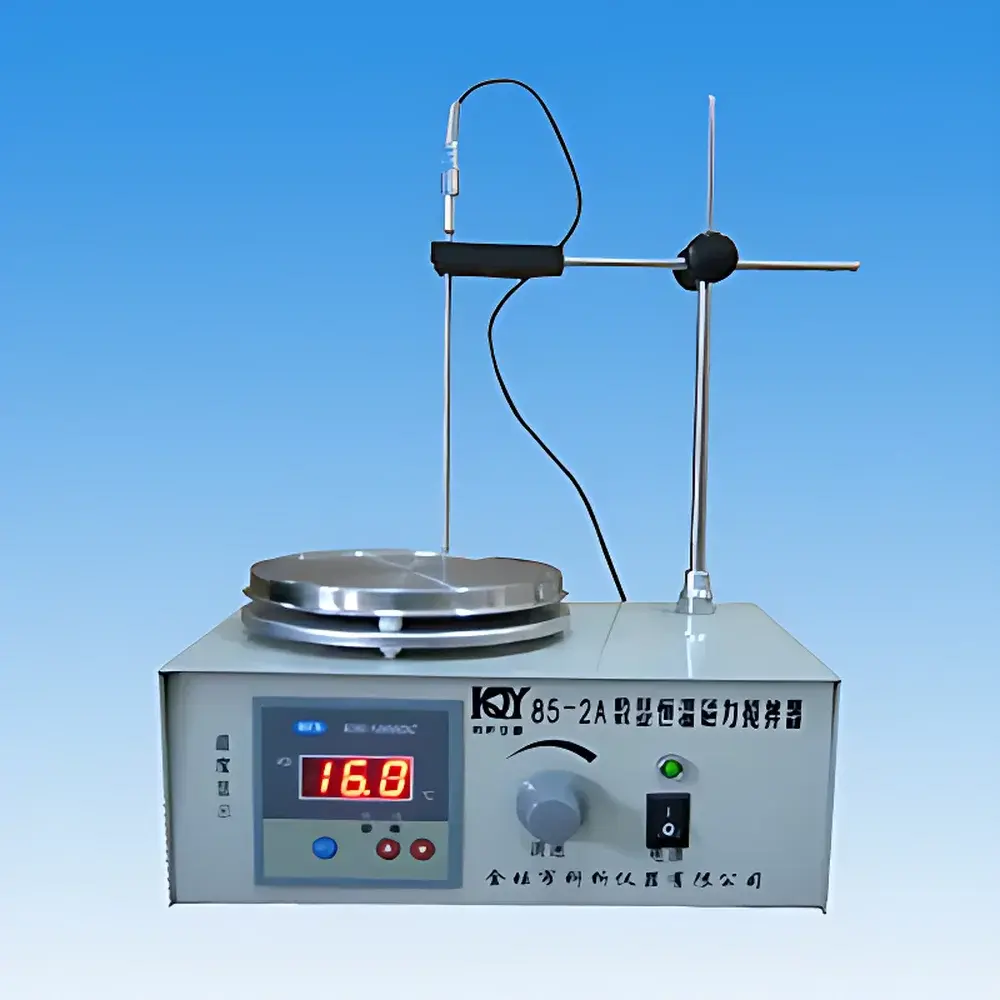
Beifen Sanpu HJ-3 Digital Display Magnetic Hotplate Stirrer
| Brand | Beifen Sanpu |
|---|---|
| Model | HJ-3 |
| Type | Magnetic Hotplate Stirrer |
| Power Supply | 220 V AC, 50 Hz |
| Motor Speed Range | 0–2400 rpm (continuously adjustable) |
| Motor Power | 20 W |
| Heating Power | 300 W |
| Temperature Control Range | Ambient to 100 °C |
| Temperature Control Accuracy | ±1 °C (typical, microprocessor-based PID control) |
| Stirring Capacity | Up to 1000 mL |
| Plate Diameter | Ø125 mm |
| Construction | Cold-rolled steel housing with high-temp epoxy powder coating |
| Compliance | CE-marked for laboratory use |
Overview
The Beifen Sanpu HJ-3 Digital Display Magnetic Hotplate Stirrer is an integrated benchtop instrument engineered for precise, reproducible mixing and temperature-controlled sample preparation in academic, industrial, and regulatory-compliant laboratory environments. It operates on the principle of magnetic coupling—where a rotating permanent magnet beneath the heated ceramic or stainless-steel plate induces synchronous rotation of a PTFE-coated magnetic stir bar immersed in the sample vessel. Combined with a microprocessor-controlled heating system, the HJ-3 delivers simultaneous speed and temperature regulation without mechanical contact, minimizing contamination risk and enabling stable thermal homogeneity across small-to-medium volume samples (up to 1000 mL). Its robust architecture—featuring a cold-rolled steel chassis, high-temperature powder-coated finish, and sealed electronics—ensures long-term reliability under routine QC, R&D, and teaching lab conditions.
Key Features
- Microprocessor-based digital temperature control with real-time LED display and PID algorithm for stable setpoint maintenance (±1 °C typical deviation at steady state)
- Continuously variable motor speed from 0 to 2400 rpm via precision potentiometer; optimized low-noise DC motor rated for >10,000 hours of continuous operation at no-load
- Dual-function hotplate: independent heating (300 W) and stirring actuation, both controllable without cross-interference
- High-strength, corrosion-resistant top plate (Ø125 mm) compatible with standard borosilicate glass vessels including beakers, flasks, and crystallization dishes
- Integrated safety design: grounded chassis, automatic thermal cutoff at 120 °C, overcurrent protection, and splash-resistant control panel
- Low-profile ergonomic form factor (H × W × D ≈ 120 × 160 × 160 mm) suitable for fume hoods, laminar flow cabinets, and shared benchtop workspaces
Sample Compatibility & Compliance
The HJ-3 supports common laboratory containers up to 1000 mL capacity, including Pyrex® and Duran® glassware, polypropylene beakers, and stainless-steel reaction vessels. Stir bar compatibility includes standard PTFE-encapsulated magnets (e.g., 30 × 8 mm, 40 × 10 mm), with optional custom geometries available upon request. The unit conforms to IEC 61010-1:2010 for safety requirements of electrical equipment for laboratory use and carries CE marking for EMC and LVD directives. While not certified for GMP or GLP environments out-of-the-box, its digital logging-capable firmware (via optional RS232/USB interface module) supports traceability frameworks aligned with FDA 21 CFR Part 11 when paired with validated third-party data acquisition software.
Software & Data Management
The HJ-3 operates as a standalone analog-digital hybrid instrument with embedded microcontroller logic. Its front-panel interface provides immediate access to setpoints, real-time RPM and temperature readings, and status indicators (heating active, stirring active, error codes). For laboratories requiring audit-ready records, an optional communication module enables serial output of time-stamped operational parameters—including actual temperature, target temperature, current RPM, and elapsed heating duration—to external PCs or LIMS platforms. This facilitates integration into SOP-driven workflows where calibration verification, usage logs, and preventive maintenance scheduling are mandated under ISO/IEC 17025 or CAP-accredited quality systems.
Applications
- Buffer and reagent preparation in molecular biology and clinical diagnostics labs
- Solubility testing and dissolution profile development per USP and
- Catalyst dispersion and nanoparticle suspension in materials science synthesis
- pH adjustment and titrant homogenization during electrochemical cell conditioning
- Standardized sample conditioning prior to HPLC, GC, or ICP-MS analysis
- Teaching demonstrations of Arrhenius kinetics, reaction rate dependence on mixing efficiency, and thermal equilibration dynamics
FAQ
What is the maximum recommended operating time at full heating and stirring load?
For optimal longevity, continuous operation at 100 °C and ≥1800 rpm should not exceed 4 hours; medium-speed operation (600–1200 rpm) supports up to 8-hour uninterrupted duty cycles.
Is the temperature probe removable or fixed?
The stainless-steel PT100-compatible temperature probe is permanently integrated into the stir bar assembly and not user-replaceable; however, it is calibrated at factory and traceable to NIST standards.
Can the HJ-3 be used with corrosive solvents such as concentrated acids or halogenated organics?
Yes—provided the stir bar is chemically inert (e.g., PTFE- or ETFE-coated) and the vessel is solvent-rated; avoid direct contact between aggressive media and the plate surface or control panel seals.
Does the unit support external temperature feedback via a separate probe?
No—the built-in probe is the sole temperature sensing element; external probe input is not supported in the base configuration.
What maintenance is required to ensure long-term accuracy?
Annual verification of temperature and speed calibration using NIST-traceable reference standards is recommended; cleaning with isopropyl alcohol and lint-free cloth preserves optical encoder integrity and thermal sensor response.



