
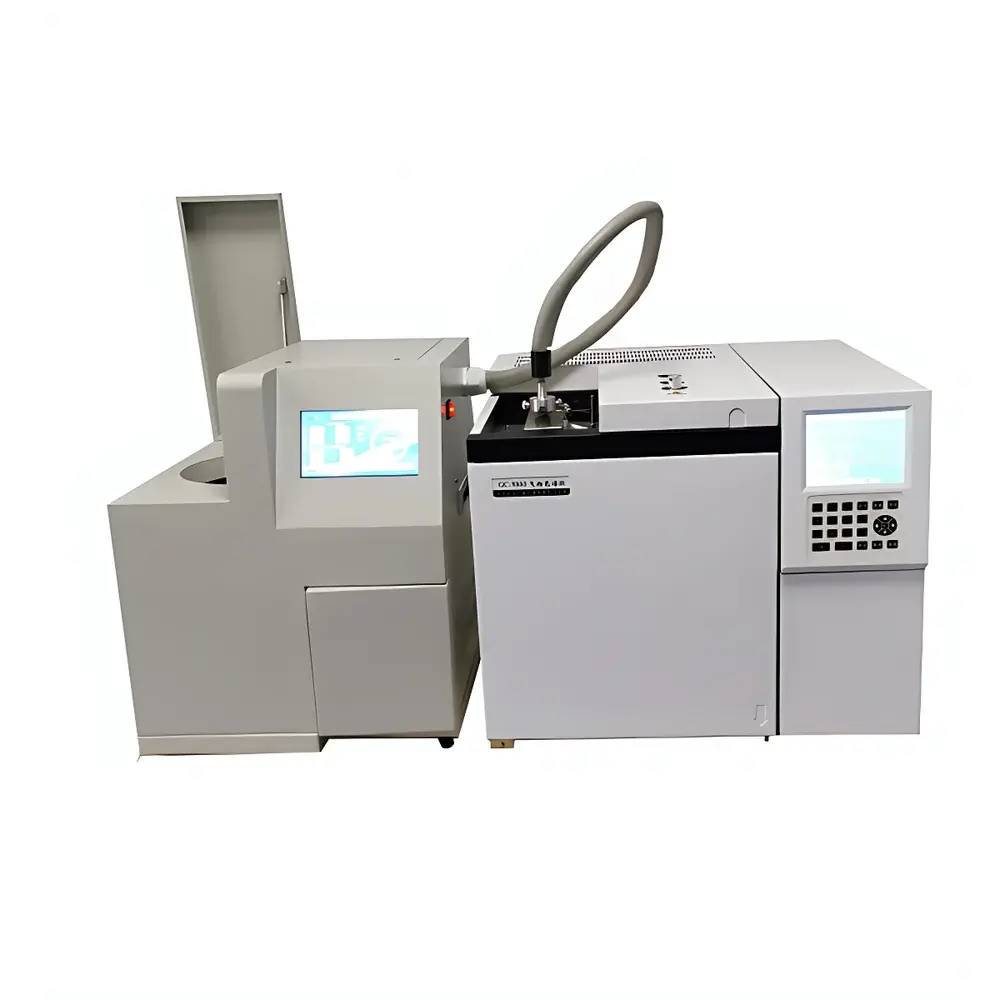
Beifen Sanpu A&HS-20A PLUS Fully Automated Static Headspace Sampler
| Brand | Beifen Sanpu |
|---|---|
| Origin | Beijing, China |
| Manufacturer Type | Manufacturer |
| Product Origin | Domestic (China) |
| Model | A&HS-20A PLUS |
| Instrument Type | Static Headspace Sampler |
| Automation Level | Fully Automatic |
| Vial Heating Range | Ambient to 200 °C (1 °C increments) |
| Valve Temperature Control Range | 40–220 °C (±1 °C accuracy) |
| Sample Loop Volume | 1 mL |
| Sample Capacity | 20 positions |
| Vial Size Compatibility | 10 mL or 20 mL |
Overview
The Beifen Sanpu A&HS-20A PLUS is a fully automated static headspace sampler engineered for precise, reproducible quantification of volatile organic compounds (VOCs) in solid and liquid matrices—particularly critical for regulatory compliance testing of medical devices. Designed to meet the analytical demands of GB 2626-2019 (Respiratory Protective Devices – Self-Contained Filtering Respirators) and GB/T 16886.7-2015 (Biological Evaluation of Medical Devices – Part 7: Ethylene Oxide Sterilization Residuals), this instrument enables robust, trace-level detection of ethylene oxide (EO) and chlorohydrin (ECH) residues in masks, gowns, catheters, and other single-use sterilized healthcare products. Its operation relies on thermally equilibrated static headspace extraction: samples are sealed in inert vials, heated to a precisely controlled temperature, and the vapor-phase equilibrium concentration above the matrix is injected directly into a gas chromatograph via a thermostated sampling valve and fixed-volume loop. This principle ensures high method ruggedness, minimal carryover, and compatibility with flame ionization detection (FID) and other GC-compatible detectors.
Key Features
- Fully automated 20-position carousel with programmable vial selection, eliminating manual handling and reducing analyst variability.
- Independent dual-zone temperature control: vial oven (ambient to 200 °C, ±0.5 °C stability) and transfer line/valve assembly (40–220 °C, ±1 °C accuracy), ensuring complete volatilization and preventing condensation.
- 1 mL fixed-volume sample loop with inert SilcoNert®-treated surfaces, delivering consistent injection volumes and minimizing adsorption of polar analytes like EO.
- Integrated pressure-balanced vial pressurization system using carrier gas (N₂, He, or air), enabling quantitative transfer without sample dilution or pressure-induced peak distortion.
- Comprehensive method storage and recall (≥100 methods), including incubation time, equilibration temperature, agitation speed (if equipped), and injection sequence—supporting audit-ready GLP/GMP workflows.
- RS-232 and USB interfaces for seamless integration with third-party GC systems (e.g., Agilent, Shimadzu, Thermo Fisher, or domestic GC-9860 platforms) and LIMS environments.
Sample Compatibility & Compliance
The A&HS-20A PLUS accommodates standard 10 mL and 20 mL crimp-top or screw-cap headspace vials, compatible with polytetrafluoroethylene (PTFE)-lined septa and aluminum crimp seals. It supports aqueous extraction protocols per GB/T 14233.1-2008 and ISO 10993-7:2018, where test specimens (e.g., 2.0 g of 5-mm mask fabric fragments) are suspended in 10 mL deionized water and equilibrated at 60 °C for 20 minutes. The system is validated for use in laboratories subject to CNAS accreditation (ISO/IEC 17025), FDA 21 CFR Part 11 (when paired with compliant chromatography data systems), and China’s NMPA requirements for medical device biocompatibility testing. All thermal and timing parameters are logged with timestamps and user IDs, fulfilling traceability mandates for regulatory submissions.
Software & Data Management
The instrument operates via embedded firmware with a touchscreen HMI interface supporting multilingual menus (English, Chinese). Method development includes stepwise optimization of equilibration time, vial temperature, and valve heat-up profiles—critical for achieving full EO partitioning from hydrophilic polymer matrices. Raw acquisition parameters (temperature setpoints, dwell times, loop fill/flush cycles) are stored alongside GC run metadata. When integrated with chromatography data systems (CDS) such as OpenLAB CDS or Chromeleon, the sampler supports electronic signature, audit trail generation, and automatic report generation—including EO concentration (mg/kg) calculated per GB/T 16886.7-2015 Annex H equations. All calibration standards (1×10⁻³ to 1×10² g/L) are processed identically to samples, ensuring linearity verification across the working range.
Applications
Primary applications include ethylene oxide residue analysis in sterilized personal protective equipment (PPE), surgical drapes, syringes, and implantable devices. Secondary uses span residual solvent testing in pharmaceuticals (ICH Q3C), flavor compound profiling in food packaging, and VOC screening in environmental soil/water extracts. The system is routinely deployed in QC labs of Class II/III medical device manufacturers, provincial CDCs, and third-party testing institutions accredited under CNAS CL01:2018. Its design facilitates rapid method transfer between laboratories—key for multi-site validation required under ISO 13485 quality management systems.
FAQ
What is the maximum allowable EO residue level for masks per GB 2626-2019?
GB 2626-2019 does not specify a numeric EO limit for respirators; instead, it defers to GB/T 16886.7-2015, which sets a maximum permissible limit of 10 mg/kg for EO in devices with prolonged contact (>24 h) and 60 mg/kg for short-term contact (<24 h).
Can the A&HS-20A PLUS be used with non-FID detectors?
Yes—it is detector-agnostic and compatible with TCD, ECD, and mass spectrometric detectors, provided the GC interface and transfer line temperatures are adjusted to prevent condensation or degradation.
Is method validation support available from Beifen Sanpu?
The manufacturer provides IQ/OQ documentation templates, system suitability test protocols, and application notes aligned with GB/T 27417-2017 for method validation in chemical testing laboratories.
How is carryover minimized during high-concentration EO analysis?
The system employs a three-stage purge: vial pressurization venting, loop flush with carrier gas (≥5× loop volume), and valve bake-out at 220 °C between injections—verified by blank runs showing <0.5% relative standard deviation.
Does the sampler comply with ASTM D6866 or ISO 11358 for polymer characterization?
No—this instrument is optimized for static headspace VOC quantification, not isotopic ratio or thermal degradation analysis. It is not designed for ASTM D6866 (radiocarbon dating) or ISO 11358 (thermogravimetry).






