
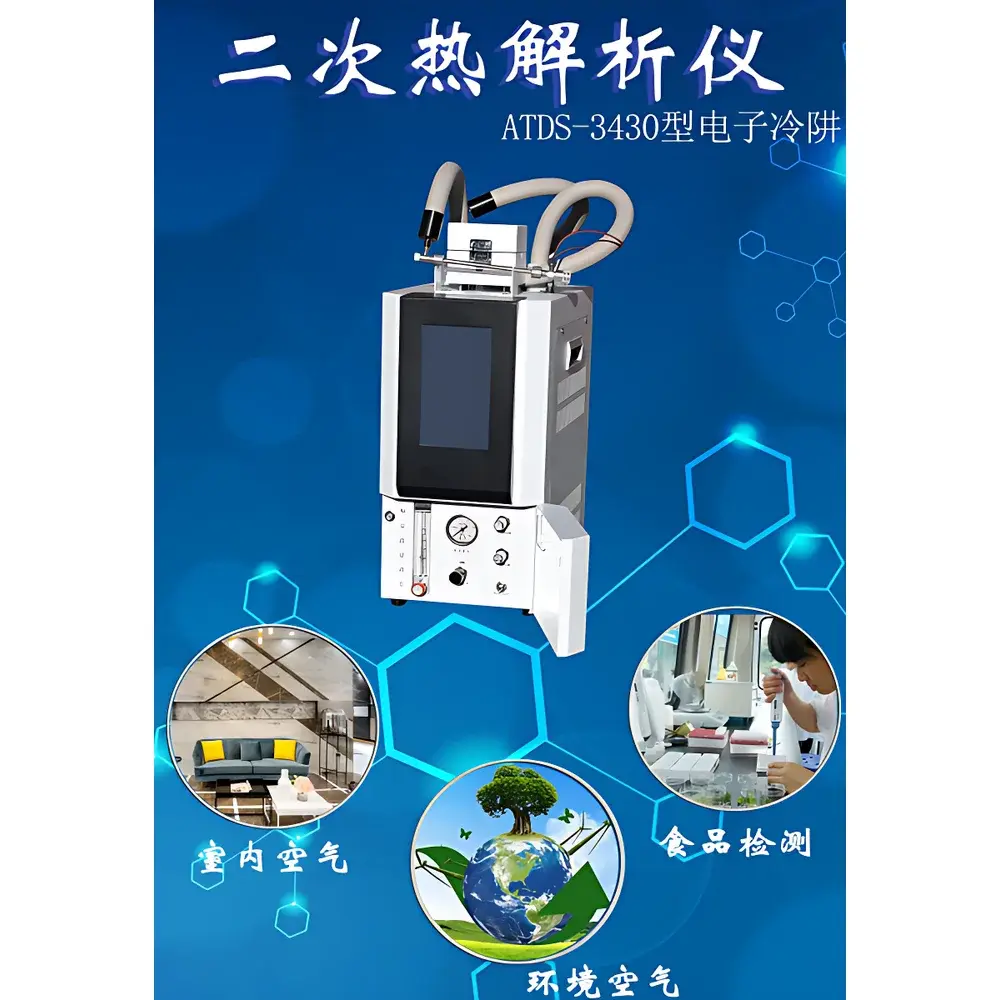
Beifen Sanpu A3TDS-3430 Dual-Stage Thermal Desorber for GB 50325-2020 Indoor Air TVOC Analysis
| Brand | Beifen Sanpu |
|---|---|
| Origin | Beijing, China |
| Manufacturer Type | Direct Manufacturer |
| Regional Classification | Domestic (China) |
| Model | A3TDS-3430 |
| Instrument Type | Dual-Stage Thermal Desorber |
| Desorption Temperature Range | Ambient to 450 °C |
| Cold Trap Temperature Range | −35 °C to Ambient |
| Desorption Recovery Rate | >99% (compound-dependent) |
| Sample Capacity | 1 tube per run |
Overview
The Beifen Sanpu A3TDS-3430 Dual-Stage Thermal Desorber is an engineered solution designed specifically for compliance with GB 50325–2020, the People’s Republic of China National Standard “Standard for Indoor Environmental Pollution Control in Civil Building Engineering.” This standard mandates quantitative analysis of volatile organic compounds (VOCs), including benzene, toluene, ethylbenzene, xylenes (BTEX), and total VOCs (TVOC), in indoor air samples collected on sorbent tubes—particularly T-C composite tubes. The A3TDS-3430 implements a two-stage thermal desorption process: primary desorption from the sampling tube followed by cryofocusing in a thermoelectrically cooled cold trap (−35 °C minimum), then rapid flash desorption into the GC inlet. This architecture ensures high analyte transfer efficiency, minimal band broadening, and compatibility with capillary gas chromatography systems equipped with flame ionization detection (FID) or mass spectrometry (MS). Its design aligns with fundamental principles of thermal desorption kinetics and adsorbent thermodynamics, supporting trace-level quantification at sub-ppbv concentrations when paired with appropriate GC–FID configurations.
Key Features
- Dual-stage architecture with independent temperature control for desorption oven, cold trap, valve box, and transfer lines—enabling precise thermal management across all critical zones.
- Desorption temperature range up to 450 °C, suitable for high-boiling-point VOCs and semi-volatile compounds without tube degradation.
- Cryogenic cold trap operating down to −35 °C, facilitating effective focusing of C2–C16 hydrocarbons and polar VOCs prior to GC injection.
- Integrated tube aging and calibration standard simulation functionality, supporting routine system validation and drift monitoring per GLP requirements.
- Automated direct-injection workflow with programmable parameters: desorption time, cold trap hold time, flash duration (e.g., 10 s), and back-flush cycle (e.g., 10 min) to minimize carryover.
- Single-tube configuration optimized for method development, reference material verification, and low-throughput regulatory testing aligned with GB 50325–2020 Annex D protocols.
Sample Compatibility & Compliance
The A3TDS-3430 is validated for use with standardized sorbent tubes specified in GB 50325–2020, including Tenax TA, Carbopack B/C, and T-C composite tubes. It supports both active (pumped) and passive sampling methodologies as referenced in ISO 16000-6 and ASTM D6196. All thermal profiles—including 300 °C desorption, −30 °C cold trapping, and 180 °C valve/line heating—are reproducible within ±1 °C, meeting instrumental precision criteria outlined in CNAS-CL01:2018 (equivalent to ISO/IEC 17025). The system facilitates full traceability through logged temperature/time sequences and user-accessible method files—supporting audit readiness for environmental testing laboratories accredited under CMA (China Metrology Accreditation) or seeking alignment with FDA 21 CFR Part 11 data integrity expectations.
Software & Data Management
Instrument operation is managed via embedded firmware with USB interface and PC-based control software. Method parameters are stored in encrypted binary format with timestamped versioning. Software supports export of raw thermal event logs (desorption start/end, cold trap cooldown/flash, valve actuation) in CSV for integration with LIMS platforms. Calibration curves generated from 16-component BTEX/TVOC standards (200 µg/mL) can be imported directly; peak integration settings comply with USP and ISO 17025 clause 7.7 on measurement uncertainty estimation. Audit trail functionality records operator ID, method modification history, and run completion status—essential for GMP-aligned indoor air quality laboratories conducting third-party certification testing.
Applications
- Quantitative determination of TVOC and individual aromatic hydrocarbons (benzene, toluene, xylenes) in residential, commercial, and institutional building air per GB 50325–2020 Sections 6.2–6.4.
- Method development and validation for alternative sorbent media and sampling durations under controlled chamber conditions (e.g., ISO 16000-9).
- Reference material analysis and interlaboratory comparison studies requiring high recovery consistency (>99%) across replicate desorption cycles.
- Support for ISO 16000-22 (indoor air—determination of VOCs using thermal desorption–GC–MS) when coupled with compatible quadrupole MS detectors.
- Quality assurance of HVAC system emissions and building material off-gassing profiles during commissioning and post-renovation clearance testing.
FAQ
Does the A3TDS-3430 meet GB 50325–2020 Annex D requirements for dual-stage thermal desorption?
Yes—the instrument implements all mandatory thermal program steps, including cold trapping at ≤−20 °C and flash desorption into the GC inlet, as specified in Annex D.2.3.
Can it be used with non-T-C sorbent tubes such as single-bed Tenax TA?
Yes; tube geometry and fitting dimensions conform to standard 1/4″ OD stainless steel or quartz tubes. Method parameters may require optimization for bed composition and mass.
Is remote diagnostics or network connectivity supported?
No—this model operates via local USB connection only. Network-enabled variants are available under separate product codes for enterprise laboratory deployment.
What maintenance intervals are recommended for the cold trap and desorption heater?
Cold trap thermoelectric modules require annual performance verification; desorption furnace calibration is advised every 6 months using NIST-traceable thermocouples.
How is recovery rate >99% verified and documented?
Recovery is determined per GB 50325–2020 Appendix E using certified reference standards spiked onto blank tubes; validation reports include RSD (<3%) and linearity (r² ≥ 0.999) across 5–500 ng ranges.





