
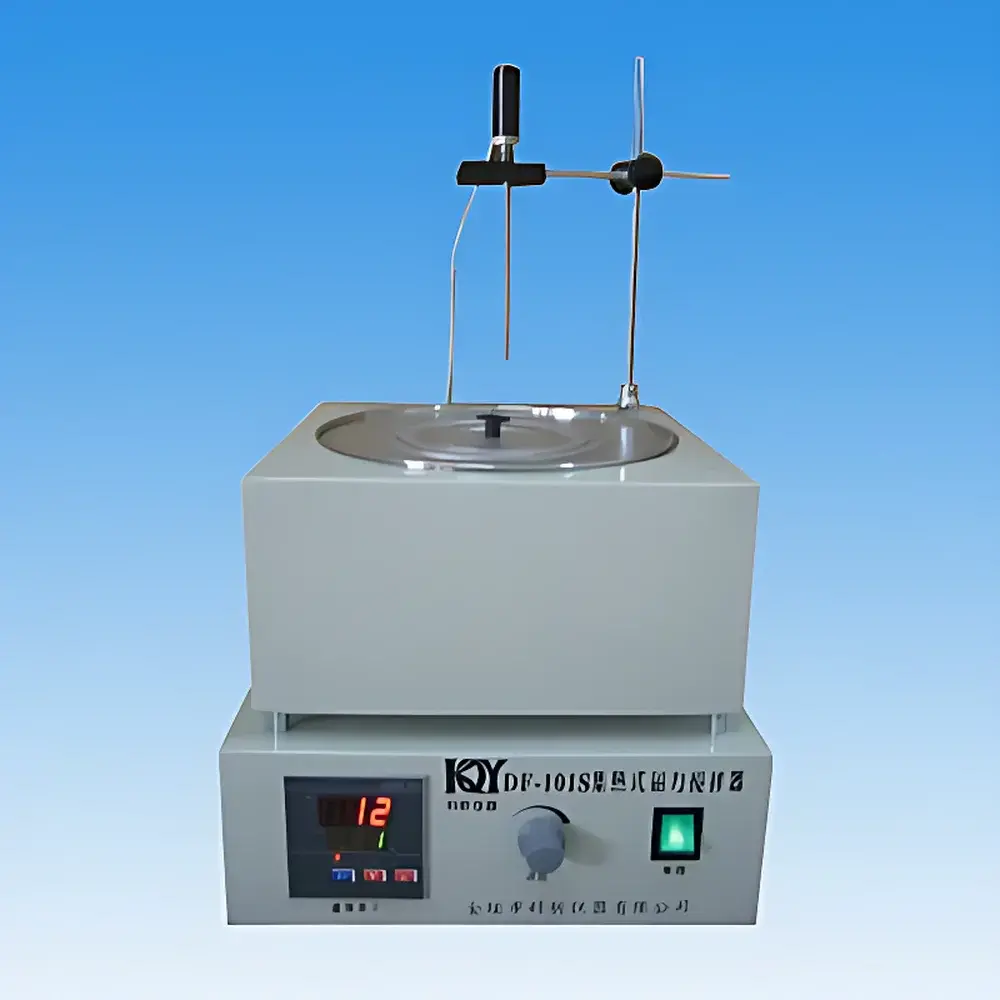
Beifen Sanpu DF-101S Integrated Heating Magnetic Stirrer
| [Brand | Beifen Sanpu |
|---|---|
| Origin | Beijing, China |
| Manufacturer Type | Direct Manufacturer |
| Model | DF-101S |
| Power Supply | 220 V AC, 50 Hz |
| Motor Speed Range | 0–2600 rpm (infinitely adjustable) |
| Motor Power | 40 W |
| Heating Power | 600 W |
| Temperature Control Range | Ambient to 300 °C (digital PID display) |
| Construction | Cold-rolled steel housing with high-temperature epoxy powder coating |
| Motor Type | Permanent-magnet DC motor |
| Continuous Operation | >10,000 hours (no-load) |
| Max. Continuous Duty | 8 h at medium speed |
| Compliance | CE-marked design principles |
Overview
The Beifen Sanpu DF-101S Integrated Heating Magnetic Stirrer is an engineered solution for precise, reproducible thermal mixing in analytical and preparative laboratory workflows. Unlike conventional hotplate stirrers with separate heating and stirring zones, the DF-101S integrates a uniformly heated aluminum alloy heating block directly beneath the stirring surface—enabling rapid thermal equilibration and minimizing radial temperature gradients across reaction vessels. Its operation relies on rotating magnetic fields generated by a sealed permanent-magnet DC motor, which couples with PTFE-coated magnetic stir bars to induce laminar fluid motion without mechanical shaft penetration. This design eliminates seal wear, contamination risk, and maintenance downtime—critical for QC labs performing routine dissolution testing, buffer preparation, reagent synthesis, or sample homogenization under controlled thermal conditions.
Key Features
- Integrated heating block architecture with digital PID temperature controller ensures ±1.5 °C accuracy from ambient to 300 °C—validated for water bath, oil bath, and dry-heating applications.
- Infinitely variable speed control (0–2600 rpm) with soft-start logic prevents stir bar ejection during acceleration; torque remains stable across the full range due to high-coercivity neodymium magnet assembly.
- Robust cold-rolled steel chassis finished with high-temp epoxy powder coating provides chemical resistance against common solvents, acids, and bases encountered in pharmaceutical and environmental labs.
- Low-noise DC motor rated for >10,000 hours of continuous no-load operation; thermal cutoff protection activates automatically if internal temperature exceeds safe limits.
- Front-panel LED indicators for power status, heating mode, and real-time temperature readout—designed for unambiguous operator feedback during GLP-compliant procedures.
Sample Compatibility & Compliance
The DF-101S accommodates standard laboratory glassware including borosilicate beakers (50–2000 mL), Erlenmeyer flasks, and jacketed reactors up to 150 mm base diameter. Its flat, recessed heating surface ensures optimal thermal contact and minimizes heat loss. The unit meets electromagnetic compatibility (EMC) requirements per IEC 61326-1 for laboratory equipment and incorporates grounding terminals compliant with IEC 61000-3-2 harmonic current limits. While not certified to ISO/IEC 17025 or FDA 21 CFR Part 11 out-of-the-box, its stable thermal and rotational performance supports data integrity in methods aligned with USP , ASTM E2912, and ISO 8573-1 when used within documented SOPs and calibrated against traceable standards.
Software & Data Management
The DF-101S operates as a standalone analog-digital hybrid instrument with no embedded firmware or network interface. Temperature setpoints and actual readings are displayed via a 3-digit LED screen; no data logging, USB export, or remote control capability is provided. For laboratories requiring audit trails, users may integrate external PT100 probes connected to validated data acquisition systems (e.g., LabVIEW or DeltaV) to record time-stamped temperature and speed profiles—supporting 21 CFR Part 11 compliance when paired with appropriate electronic signature protocols and system validation documentation.
Applications
- Preparation of homogeneous calibration standards and reference materials in environmental testing (e.g., EPA Method 300.0, ISO 11885).
- Dissolution testing of solid oral dosage forms under USP Apparatus II conditions, where consistent agitation and thermal stability are critical for release profile reproducibility.
- Synthesis of metal-organic frameworks (MOFs) and nanoparticle dispersions requiring prolonged heating with vigorous mixing to prevent sedimentation.
- pH adjustment and buffer equilibration in cell culture media preparation, where localized overheating must be avoided to preserve growth factor integrity.
- Extraction procedures in food safety labs (e.g., AOAC 992.15), where simultaneous heating and stirring accelerate analyte liberation from complex matrices.
FAQ
Can the DF-101S be used for oil bath heating up to 250 °C?
Yes—the integrated heating block and temperature sensor are rated for continuous operation at 300 °C; however, ensure the oil used has a flash point exceeding 300 °C (e.g., silicone oil) and maintain ventilation to avoid vapor accumulation.
Is the unit suitable for corrosive solutions like concentrated HCl or NaOH?
The PTFE-coated stir bar and stainless-steel temperature probe are chemically resistant, but direct splashing onto the powder-coated housing must be avoided; wipe spills immediately with neutral detergent and distilled water.
Does the DF-101S support external temperature probe input for closed-loop control?
No—it uses only its built-in NTC thermistor; for external probe integration, a separate programmable temperature controller with relay output is required.
What is the recommended maintenance interval for long-term reliability?
Inspect the stir bar coupling efficiency and housing integrity every 6 months; clean the heating block surface with isopropyl alcohol after each use involving volatile organics.
How does the DF-101S compare to planetary or overhead stirrers for high-viscosity samples?
It is optimized for low-to-medium viscosity liquids (<500 mPa·s); for viscosities above 1000 mPa·s, overhead stirrers with torque-sensing feedback are recommended to maintain laminar flow and prevent motor stall.



