
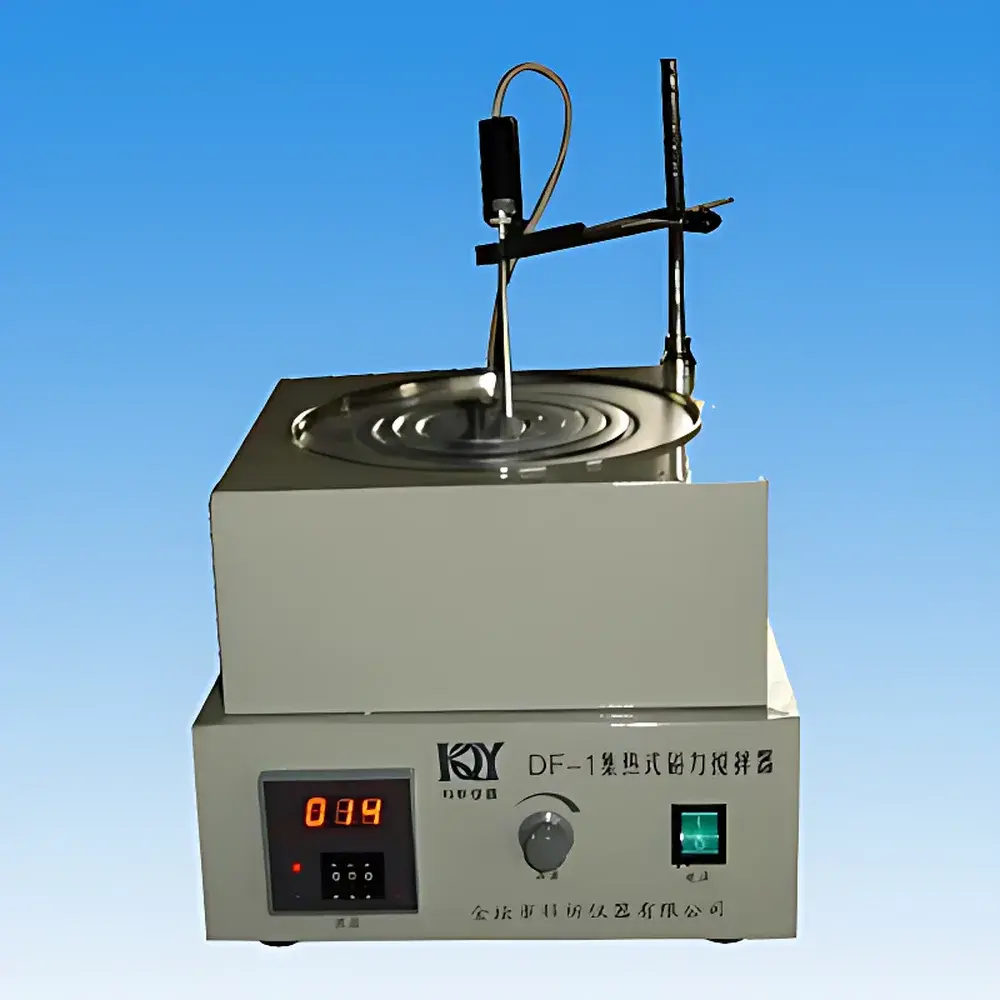
Beifen Sanpu DF-1 Integrated Heating Magnetic Stirrer
| Brand | Beifen Sanpu |
|---|---|
| Origin | Beijing, China |
| Manufacturer Type | Direct Manufacturer |
| Product Origin | Domestic (China) |
| Model | DF-1 |
| Pricing | Available Upon Request |
| Power Supply | 220 V AC, 50 Hz |
| Motor Speed Range | 0–2600 rpm (Continuously Adjustable) |
| Motor Power | 40 W |
| Heating Power | 600 W |
| Temperature Range | Ambient to 300 °C (Digital PID Temperature Control) |
| Construction | Cold-Rolled Steel Housing with High-Temperature Powder Coating |
| Motor Type | Permanent Magnet DC Motor |
| Magnetic Coupling | High-Performance Rare-Earth Magnet Assembly |
| Max. Continuous Operation | 8 h at Medium Speed, 4 h at High Speed |
| Safety Features | Grounding Terminal, Over-Temperature Protection (via Thermostat), Non-Ingress Design for Liquid Resistance |
Overview
The Beifen Sanpu DF-1 Integrated Heating Magnetic Stirrer is a precision-engineered laboratory instrument designed for simultaneous heating and magnetic stirring of liquid samples in glass vessels. It operates on the principle of contactless rotational torque transfer via permanent magnetic coupling between an internal rotating magnet (driven by a brushless DC motor) and a magnetic stir bar placed inside the sample container. Heat is delivered uniformly through an integrated aluminum alloy heating block—commonly referred to as a “heating mantle” or “hotplate-stirrer hybrid”—which ensures rapid thermal response and minimal temperature gradient across the vessel bottom. Unlike conventional hotplate stirrers with separate heating and stirring modules, the DF-1 integrates both functions into a single compact platform, optimizing thermal efficiency and mechanical stability. This architecture supports reproducible experimental conditions in applications requiring precise temperature control alongside homogeneous mixing—particularly critical in kinetic studies, dissolution testing, buffer preparation, and reagent synthesis.
Key Features
- Integrated heating and stirring platform with digitally controlled PID temperature regulation (ambient to 300 °C), enabling stable thermal setpoints with ±1 °C accuracy under standard lab conditions.
- High-torque permanent magnet DC motor rated for >10,000 hours of continuous operation at no-load; delivers smooth, low-noise rotation across the full 0–2600 rpm range with stepless speed adjustment via front-panel rotary encoder.
- Robust cold-rolled steel chassis with high-temperature epoxy powder coating provides corrosion resistance and mechanical durability in routine wet-lab environments.
- Thermally optimized aluminum heating block ensures uniform heat distribution and minimizes thermal lag during ramp-and-hold protocols.
- Dedicated grounding terminal and built-in over-temperature cutoff safeguard against electrical hazards and thermal runaway.
- Non-porous, chemically inert surface design prevents liquid ingress; compatible with aqueous, organic, and mildly acidic/basic solutions when used with appropriate PTFE-coated stir bars.
Sample Compatibility & Compliance
The DF-1 accommodates standard laboratory glassware including borosilicate beakers (50–1000 mL), Erlenmeyer flasks, and round-bottom flasks up to 120 mm diameter. Its magnetic coupling system maintains consistent torque transmission even at elevated temperatures (up to 300 °C), eliminating demagnetization risks associated with lower-grade ferrite magnets. While not certified to IEC 61010-1 or UL 61010B as a standalone safety-marked device, the unit conforms to general electrical safety practices expected in ISO/IEC 17025-accredited laboratories. Its operational parameters align with common method requirements in ASTM D129, USP , and ISO 6425 for dissolution and homogenization procedures. For GLP/GMP environments, users may implement manual logbook entries or integrate external data acquisition systems for audit-trail compliance.
Software & Data Management
The DF-1 operates as a stand-alone analog-digital hybrid instrument with no embedded microcontroller or firmware-based connectivity. Temperature and speed settings are adjusted manually using tactile controls, and real-time values are displayed on dual LED indicators (temperature in °C, speed in rpm). No proprietary software, drivers, or cloud interfaces are provided. However, its analog output signals (e.g., optional PT100 probe voltage or 0–5 V temperature feedback) can be interfaced with third-party DAQ systems (e.g., National Instruments USB-6009, LabVIEW-compatible hardware) for automated logging, trend analysis, or integration into LIMS workflows. Users deploying the instrument in regulated settings should document calibration intervals per internal SOPs—typically recommended every 6 months using NIST-traceable thermocouples and tachometers.
Applications
- Preparation of standardized buffer solutions and culture media in microbiology and molecular biology labs.
- Controlled heating and agitation during titration, precipitation, and crystallization experiments.
- Dissolution testing of pharmaceutical dosage forms per USP apparatus II (paddle) validation protocols.
- Homogenization of polymer solutions, colloidal suspensions, and nanoparticle dispersions prior to rheological or spectroscopic analysis.
- Supporting synthetic chemistry workflows involving reflux, condensation, and multi-step reaction monitoring.
- Environmental testing labs performing BOD/COD sample conditioning and extraction procedures.
FAQ
What is the maximum recommended vessel size for optimal stirring performance?
For consistent vortex formation and thermal uniformity, use vessels with diameters ≤120 mm and volumes ≤1000 mL. Larger containers may require higher torque stir bars or reduced speed to avoid splashing.
Can the DF-1 be used with corrosive solvents such as concentrated HCl or HNO₃?
The unit’s exterior housing and heating surface are resistant to incidental splashes, but direct exposure to aggressive vapors or prolonged immersion is not advised. Always use PTFE-coated stir bars and ensure adequate fume hood ventilation.
Is temperature calibration traceable to national standards?
The built-in digital controller is factory-calibrated; users must perform periodic verification using an independent, NIST-traceable thermometer (e.g., calibrated RTD or thermistor probe) inserted directly into the sample.
Does the DF-1 support programmable ramp-soak profiles?
No—it features only manual setpoint control. For time-dependent thermal protocols, external programmable temperature controllers or PLC-based integration is required.
What maintenance is required to sustain long-term reliability?
Wipe the heating surface after each use with a non-abrasive cloth; inspect the stir bar for chipping or coating wear before reuse; verify grounding continuity annually; and avoid operating the unit in high-humidity or dust-laden environments without protective enclosures.



