
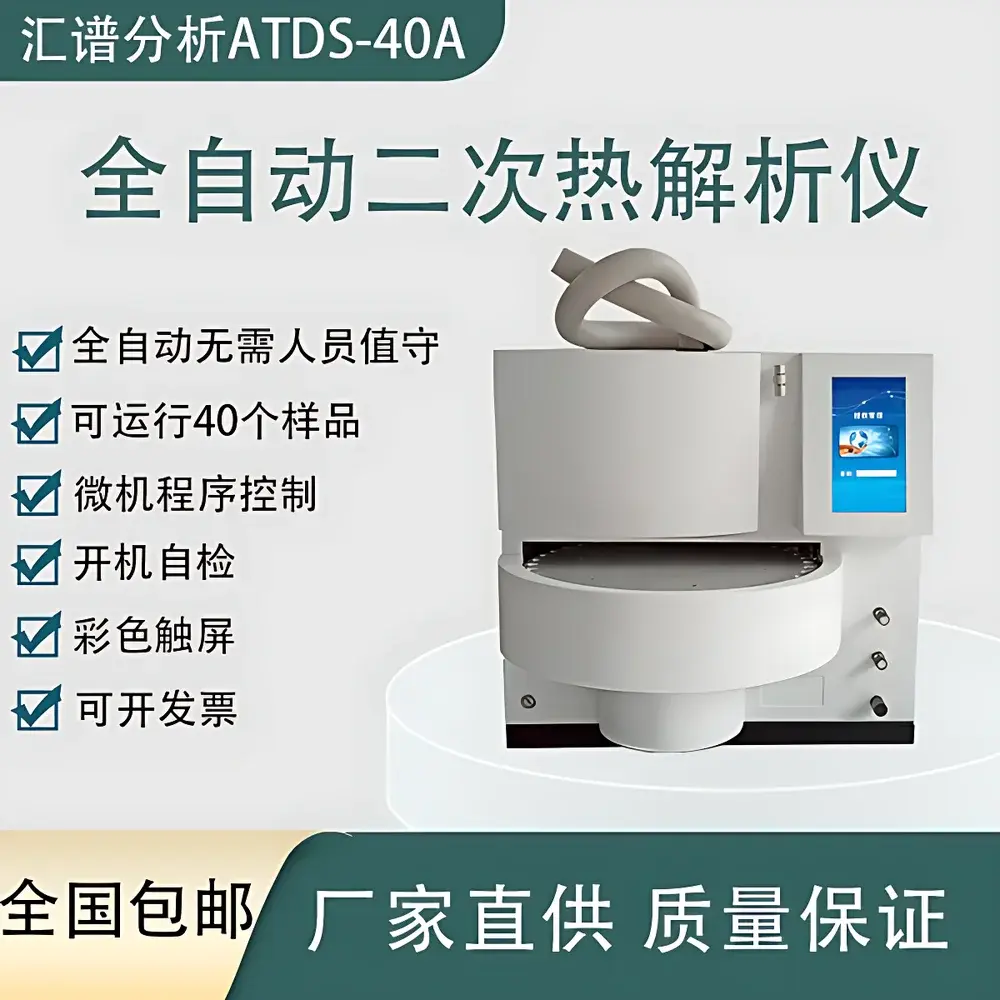
Beifen Sanpu ATD1S-40A Fully Automated Two-Stage Thermal Desorber
| Brand | Beifen Sanpu |
|---|---|
| Origin | Beijing, China |
| Manufacturer Type | Direct Manufacturer |
| Instrument Type | Two-Stage Thermal Desorber |
| Automation Level | Fully Automated |
| Primary Desorption Temperature Range | Ambient to 450 °C |
| Valve Injection Zone Temperature Range | Ambient to 300 °C |
| Transfer Line Temperature Range | Ambient to 300 °C |
| Cryo-Focusing Trap Temperature Range | −35 °C to Ambient (1 °C increments) |
| Temperature Control Accuracy | < ±0.5 °C |
| Analyte Recovery Rate | >99% (compound-dependent) |
| Sample Capacity | 40 positions |
| Dimensions | 350 × 450 × 550 mm (W × D × H) |
| Weight | ~45 kg |
| Sample Tube Format | 1/4″ OD × 3.5″ (ASTM D6196-compliant) |
Overview
The Beifen Sanpu ATD1S-40A is a fully automated two-stage thermal desorber engineered for high-throughput, trace-level volatile and semi-volatile organic compound (VOC/SVOC) analysis in environmental, occupational health, food safety, and building materials testing laboratories. It operates on the principle of cryogenic focusing followed by rapid thermal desorption—first releasing analytes from sorbent tubes under controlled heating (primary desorption), then refocusing them onto a cooled trap (−35 °C), and finally injecting the narrow, solvent-free analyte band into a gas chromatograph (GC) or GC–MS system via secondary desorption at up to 450 °C. This two-stage architecture significantly enhances sensitivity, peak shape symmetry, and quantitative reproducibility compared to single-stage systems—particularly critical for low-concentration analytes such as benzene, toluene, ethylbenzene, xylenes (BTEX), formaldehyde precursors, and regulated SVOCs per EPA TO-17, ISO 16017-1, and ASTM D6196 standards.
Key Features
- Fully automated 40-position sample carousel with robotic tube handling—enables unattended overnight operation and integration into multi-instrument lab workflows.
- Independent four-zone temperature control: primary desorption oven, secondary desorption furnace, valve manifold, and transfer line—each adjustable in 1 °C increments (ambient to 450 °C for desorption zones; ambient to 300 °C for valve and line).
- High-efficiency electronic cooling trap with precise −35 °C to ambient range (1 °C resolution), eliminating liquid nitrogen dependency while ensuring consistent cryo-focusing performance.
- Motor-driven 6-port switching valve with integrated temperature regulation—minimizes carryover and supports programmable back-flush (0–100 mL/min) and simulated sampling (0–160 mL/min).
- Onboard tube activation protocol: automatically conditions used or new sorbent tubes prior to analysis—reducing blank interference and extending tube lifetime.
- Real-time status visualization via 7-inch capacitive touchscreen interface with animated workflow display, method editing, and event logging.
- GC synchronization capability: triggers GC start via TTL signal or accepts external start commands—ensuring tight timing alignment between desorption and chromatographic acquisition.
- Modular design supports optional upgrades including low-temperature secondary desorption modules and fused quartz transfer lines for active compound analysis (e.g., aldehydes, acids, amines).
Sample Compatibility & Compliance
The ATD1S-40A accommodates standard 1/4″ OD × 3.5″ stainless steel or quartz sorbent tubes compliant with ASTM D6196 and EPA Method TO-17. Its dual-stage thermal protocol meets data quality requirements for regulatory submissions under US EPA, EU EN 16701, and China’s HJ 644–2013 and HJ 734–2014 standards. The instrument supports GLP/GMP-aligned operation through audit-trail-capable method storage, user-access level controls, and timestamped run logs. All temperature zones are calibrated traceably to NIST-certified references, and system suitability testing—including recovery verification (>99% for BTEX), precision assessment (RSD ≤2.5% at 0.05 μg benzene), and blank integrity checks—is fully programmable within the onboard software.
Software & Data Management
Control and method development are performed via embedded firmware with intuitive graphical workflow configuration. Users define multi-step sequences—including primary desorption time (0–60 min), cold trap hold time, secondary desorption ramp rate (>3000 °C/min), injection duration (0–60 min), and post-run tube bake-out—without scripting. Raw method files include full parameter metadata and are exportable in CSV format for LIMS integration. While the device does not embed FDA 21 CFR Part 11 compliance natively, its deterministic execution, immutable run logs, and hardware-enforced method locking enable validation in regulated environments when deployed with validated third-party chromatography data systems (CDS) such as Thermo Chromeleon, Agilent OpenLab CDS, or Waters Empower.
Applications
- Indoor air quality monitoring: quantification of VOCs in residential, commercial, and school environments per ISO 16000 series.
- Building material emissions testing: determination of formaldehyde, TVOC, and aldehyde derivatives from carpets, adhesives, and composite wood products (EN 13419, GB/T 29899).
- Food packaging migration studies: screening of residual solvents and odorants in plastic and paper-based packaging (EU 10/2011, GB 31604.8).
- Occupational hygiene: personal and area sampling for OSHA- and NIOSH-listed compounds using charcoal or Tenax TA tubes.
- Forensic and failure analysis: identification of off-gassing components in electronics, polymers, and automotive interiors.
FAQ
What sorbent tube formats are supported?
Standard 1/4″ OD × 3.5″ (6.35 × 89 mm) metal or quartz tubes—compatible with common multi-bed sorbents (e.g., Tenax TA, Carbopack B/C, Carboxen 1000) per ASTM D6196.
Does the system support method validation per ISO/IEC 17025?
Yes—the independent temperature zoning, documented calibration procedures, recovery and precision testing protocols, and electronic log integrity support full method validation and accreditation readiness.
Can the ATD1S-40A be integrated into an existing GC–MS workflow with autosampler coordination?
Yes—via TTL trigger output or external start input, enabling synchronized sequence control across platforms without middleware.
Is liquid nitrogen required for cryo-focusing?
No—electronic Peltier cooling achieves stable −35 °C trap temperatures without consumables or cryogen handling.
What maintenance intervals are recommended for routine operation?
Valve seal inspection every 500 runs; trap cleaning every 1,000 runs; full system performance check (recovery, RSD, blank) quarterly or per SOP-defined frequency.




