
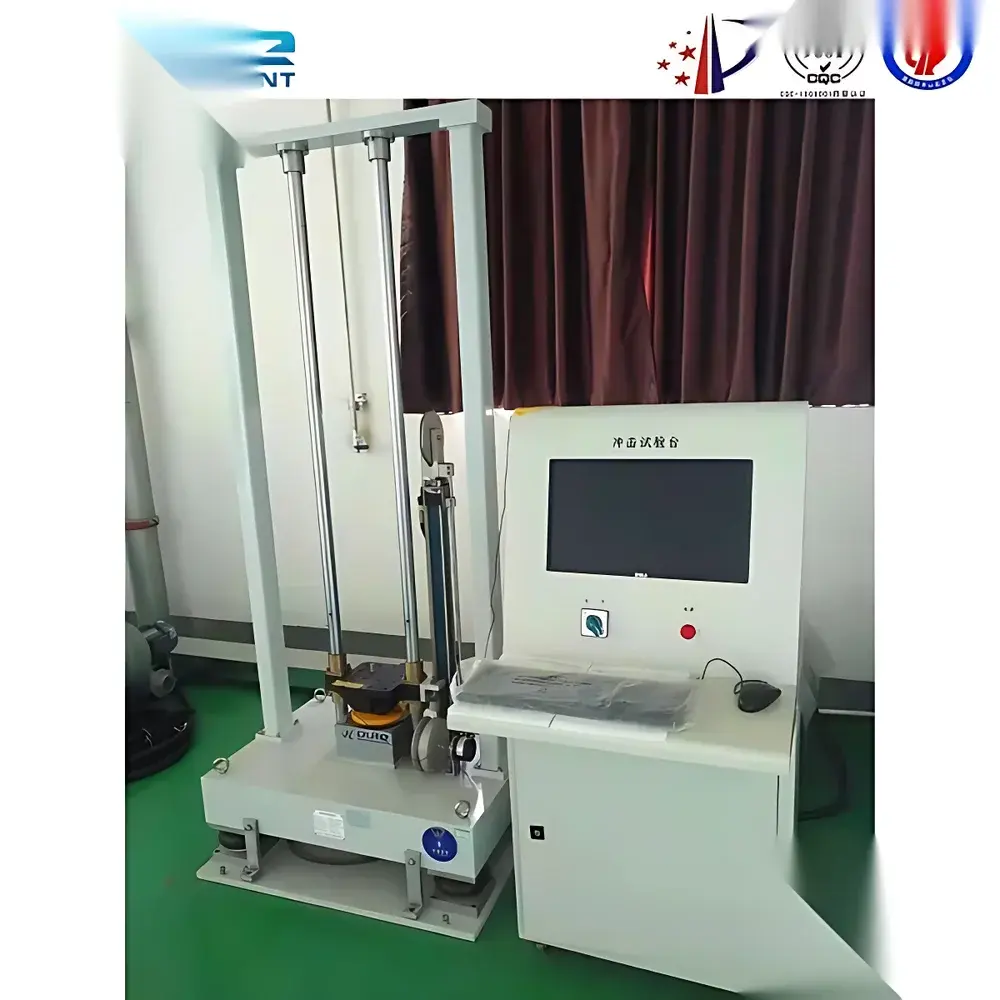
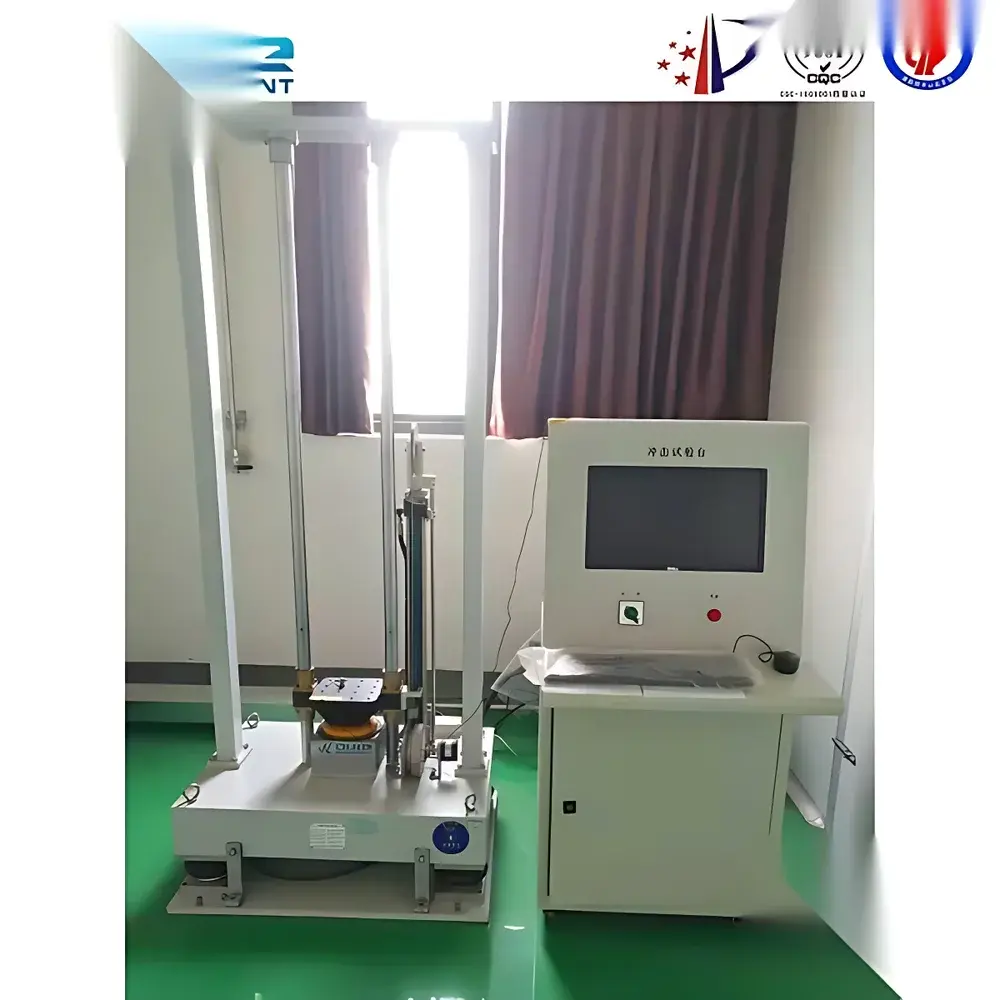
Other Brands OK-S Series Electromechanical Shock Testing Machine
| Brand | Other Brands |
|---|---|
| Origin | Imported |
| Manufacturer Type | General Distributor |
| Price | USD 14,000 (approx.) |
| Load Capacity | 10–100 kg |
| Table Dimensions | 20×20 to 80×65 cm |
| Acceleration Range | 150–15,000 m/s² |
| Pulse Duration | 0.5–30 ms |
| Waveform Options | Half-sine, Trapezoidal, Post-peak Sawtooth |
| Power Supply | AC 380 V ±5%, 50/60 Hz, 3-phase 5-wire |
Overview
The OK-S Series Electromechanical Shock Testing Machine is a precision-engineered impact test system designed for controlled, repeatable mechanical shock simulation in compliance with international environmental stress testing standards. It operates on the principle of controlled free-fall or spring-driven impact generation, enabling accurate reproduction of standardized shock pulses—including half-sine, trapezoidal, and post-peak sawtooth waveforms—as defined in IEC 60068-2-27, MIL-STD-810H Method 516.8, GJB 150.18A, JIS C 0041, and ASTM D999. The system employs a DC motor coupled with a gear-reduction lifting mechanism to elevate the test table and impact mass; upon release, the mass strikes a calibrated energy-absorbing cushion, generating a deterministic acceleration transient. Pulse amplitude (acceleration), duration, and shape are independently adjustable via drop height, spring pre-compression, cushion material/thickness, and motor speed—ensuring full traceability and waveform fidelity across qualification, reliability screening, and design verification applications.
Key Features
- Electromechanical actuation architecture eliminates hydraulic fluid dependency and ensures long-term calibration stability
- Integrated damping base and structural isolation minimize transmission of reaction forces to facility foundations
- Programmable pulse repetition frequency (0.1–60 Hz) via variable-speed DC motor control
- No secondary impact design guarantees single-event waveform integrity per test cycle
- Modular cushion interface supports rapid interchange of elastomeric, polyurethane, and composite absorbers for precise pulse tailoring
- Robust steel frame construction with reinforced load-bearing columns ensures dimensional stability under maximum rated loads (up to 100 kg)
- Compliance-ready safety architecture: emergency stop circuitry, mechanical limit switches, power-loss braking, and interlocked access guards
Sample Compatibility & Compliance
The OK-S series accommodates a broad range of product sizes—from small electronic modules (mounted on 20×20 cm tables) to large industrial assemblies (on 80×65 cm platforms). Fixturing is compatible with standard ISO 2247 mounting patterns and includes T-slot grooves for universal bracket integration. All models meet electromagnetic compatibility (EMC) requirements per EN 61326-1 and are certified for operation in Class II, Division 1 hazardous locations when equipped with optional ATEX-rated components. Test data generated satisfies audit requirements for ISO/IEC 17025-accredited laboratories and supports GLP/GMP documentation workflows, including full traceability of setup parameters, operator ID, and environmental conditions (temperature/humidity logging optional).
Software & Data Management
Each system ships with PC-based control software supporting real-time waveform preview, parameter scripting, and automated test sequence execution. The software logs all critical variables—including actual drop height, measured peak acceleration, pulse duration, zero-crossing time, and velocity change (Δv)—in CSV and XML formats compliant with ASTM E2927. Built-in FFT analysis enables spectral verification against specification limits. Audit trail functionality records user actions, timestamped parameter changes, and calibration events in accordance with FDA 21 CFR Part 11 requirements (electronic signatures and role-based access control available as optional modules). Data export interfaces include OPC UA and Modbus TCP for integration into enterprise MES or PLM systems.
Applications
- Qualification testing of avionics, automotive ECUs, and rail signaling equipment per DO-160 Section 8, SAE J1211, and EN 50121-3-2
- Package integrity validation for medical device shipping containers (ASTM D4169, ISTA 3A)
- Reliability screening of solder joint fatigue in PCBAs subjected to field transport shocks
- Material response characterization under high-strain-rate loading (e.g., polymer creep recovery, MEMS device stiction evaluation)
- Verification of shock isolation mount performance in vibration-sensitive instrumentation
- Design validation of consumer electronics enclosures against drop-induced fracture propagation
FAQ
What shock waveforms can the OK-S series generate?
The standard configuration delivers half-sine pulses; trapezoidal and post-peak sawtooth waveforms are available as factory-installed options with dedicated cushion kits and firmware calibration profiles.
Is the system compliant with MIL-STD-810H Method 516.8?
Yes—the mechanical design, control algorithm, and waveform validation protocol are fully aligned with the test article mounting, pulse tolerance bands, and repeatability requirements specified in Revision H.
Can the system be integrated into an automated test cell?
Absolutely. Digital I/O ports, Ethernet-based remote command set (SCPI-compatible), and optional PLC interface modules support seamless integration with robotic handlers and central test management systems.
What maintenance is required to maintain calibration validity?
Annual verification of accelerometer sensitivity, table parallelism, and drop-height encoder linearity is recommended; NIST-traceable calibration certificates are available through authorized service centers.
Does the system support multi-axis sequential shock testing?
While the OK-S series is a single-axis vertical冲击 platform, it can be mounted on precision rotary stages (sold separately) to enable programmable orientation sequencing for orthogonal axis qualification per IEC 60068-2-27 Annex B.



