
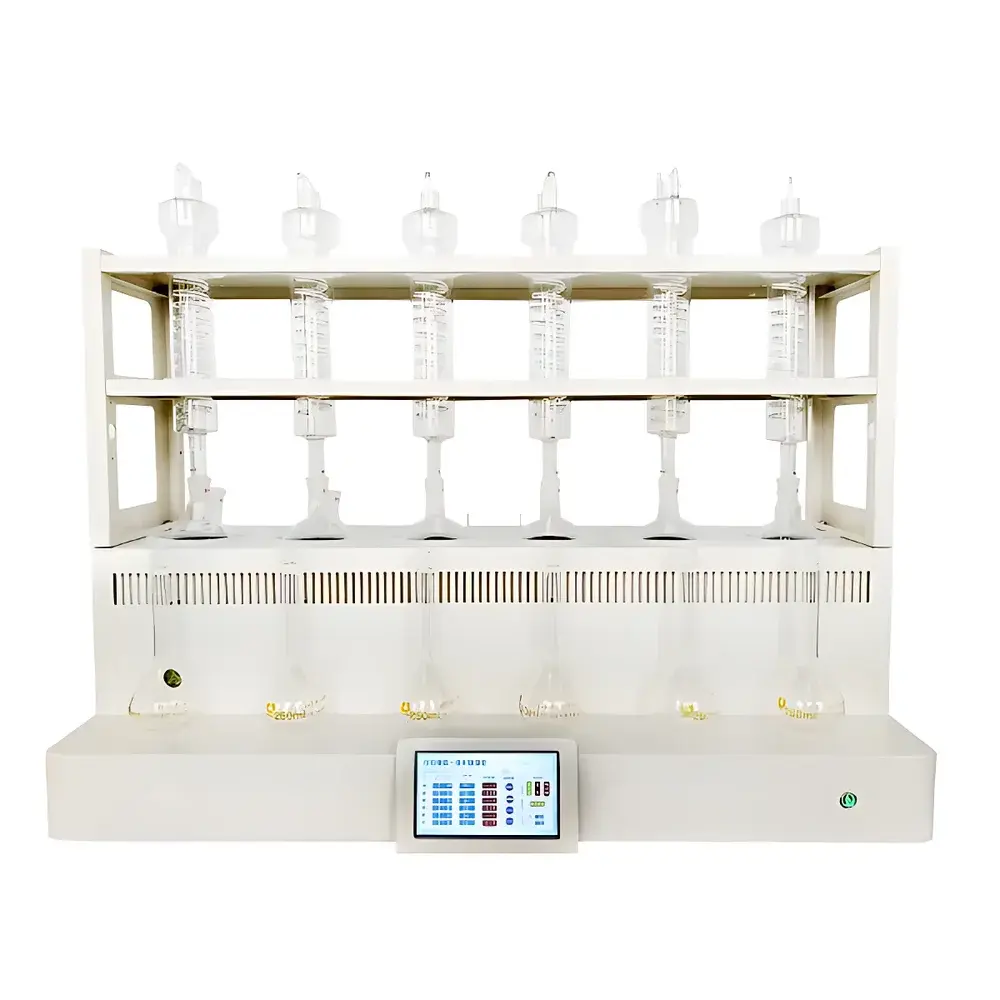
Beifen Sanpu CA-Z100 Integrated Distillation Apparatus
| [Brand | Beifen Sanpu |
|---|---|
| Origin | Beijing, China |
| Manufacturer Type | Direct Manufacturer |
| Model | CA-Z100 |
| Heating Method | Far-infrared Ceramic Heater (Domestic) |
| Number of Heating Units | 6 |
| Adjustable Power per Unit | 1–800 W |
| Total Rated Power | 4800 W (adjustable) |
| Distillation Rate | 8–12 mL/min |
| Endpoint Control | Time-based, 0–999 min adjustable, ±2 mL accuracy |
| Cooling | External Compressor Chiller or Tap Water, Condenser Temperature <30 °C |
| Display | 7-inch Resistive Touchscreen |
| Sample Capacity | 1–6 independent channels |
| Heating Uniformity | Uniform Far-infrared Radiation |
| Anti-Backsuction | Integrated Silicone Stopper & PE Tube Assembly |
| Distillation Vessel | 500 mL Round-Bottom Flask (6 pcs) |
| Condenser | Coiled Reflux Condenser (6 pcs) |
| Receiving Vessels | Compatible with Volumetric Flasks (250 mL), Erlenmeyer Flasks, Graduated Cylinders, Beakers |
| Power Supply | Dual-input 220 V / 50 Hz |
| Dimensions (L×W×H) | 1000 × 520 × 800 mm |
| Compliance | Verified Recovery Rate ≥95% in CAL/ISO/IEC 17025 Accredited Laboratories for Phenols, Ammonia Nitrogen, Cyanide, Kjeldahl Nitrogen, and Oil Moisture Determination] |
Overview
The Beifen Sanpu CA-Z100 Integrated Distillation Apparatus is an engineered solution for standardized, reproducible distillation in analytical chemistry laboratories. Designed in accordance with ISO 6439 (determination of phenols in water), ISO 5667-16 (ammonia nitrogen), ISO 6438 (cyanide), and AOAC 984.27 (Kjeldahl nitrogen), the system implements a closed-loop thermal process based on controlled far-infrared ceramic heating and precise endpoint timing. Unlike conventional open-flame or hotplate-based setups, the CA-Z100 eliminates combustion hazards and ensures uniform energy transfer across all six independent heating zones—critical for inter-sample comparability in multi-batch environmental or regulatory testing workflows. Its modular architecture supports both batch and staggered distillation protocols while maintaining compliance with GLP documentation requirements through traceable time-stamped operation logs.
Key Features
- Six-channel independent heating control: Each of the six far-infrared ceramic heating units operates at 1–800 W with real-time power modulation, enabling simultaneous but individually optimized distillation of heterogeneous sample matrices (e.g., wastewater, soil extracts, biological fluids).
- Endpoint precision via time-based termination: Programmable distillation duration (0–999 minutes) with ±2 mL volumetric repeatability, validated against certified reference materials in accredited laboratories (recovery ≥95% for volatile phenols and ammonia nitrogen).
- Integrated anti-backsuction protection: Dual-stage mechanical safeguard using silicone stoppers and calibrated PE tubing assemblies prevents vacuum-induced backflow during cooling phase—eliminating cross-contamination risk between runs.
- Thermal management system: Supports either external compressor chiller integration or municipal tap water circulation to maintain condenser jacket temperature below 30 °C, ensuring efficient vapor condensation across full operational range (8–12 mL/min throughput).
- Human-machine interface: 7-inch resistive touchscreen provides intuitive access to heating profiles, timer settings, status monitoring, and error diagnostics without requiring external software or PC connection.
- Universal receiving compatibility: Accepts standard laboratory glassware—including 250 mL volumetric flasks, 250 mL Erlenmeyer flasks, graduated cylinders, and beakers—removing constraints associated with proprietary receiver designs.
Sample Compatibility & Compliance
The CA-Z100 is routinely deployed in laboratories performing EPA Method 425.1 (phenols), EPA Method 350.1 (ammonia nitrogen), ISO 6438 (cyanide), and ASTM D129 (sulfur in petroleum products). Its design accommodates aqueous, semi-aqueous, and oil-in-water emulsions—provided samples meet standard pre-distillation filtration and pH adjustment criteria. All wetted components are borosilicate glass or food-grade silicone/PE, ensuring chemical resistance to dilute acids, alkalis, and organic solvents commonly used in pretreatment (e.g., H3PO4, NaOH, EDTA buffers). The apparatus has undergone third-party verification for recovery performance in CNAS-accredited calibration labs, meeting minimum validation thresholds defined in ISO/IEC 17025:2017 Clause 7.7 (uncertainty estimation) and USP (distillation method suitability).
Software & Data Management
While the CA-Z100 operates as a standalone instrument without embedded data export capability, its touchscreen interface maintains local operational history—including start/stop timestamps, set durations, and channel-wise power usage—for manual GLP audit trail reconstruction. For regulated environments requiring electronic records, users may integrate the unit into existing LIMS or ELN platforms via optional RS-232 or USB-to-serial adapters (not included). All firmware updates are delivered via secure offline USB drive to preserve data integrity and avoid network exposure—a requirement aligned with FDA 21 CFR Part 11 Annex 11 principles for non-networked analytical devices.
Applications
- Environmental analysis: Quantification of volatile phenols, ammonia nitrogen, cyanide, and total Kjeldahl nitrogen in surface water, wastewater, and sediment pore water.
- Food & agriculture testing: Determination of moisture content in edible oils per AOAC 974.13; distillative separation of volatile flavor compounds prior to GC-MS analysis.
- Pharmaceutical QC: Residual solvent removal from active pharmaceutical ingredients (APIs) under ICH Q3C-compliant conditions.
- Academic research: Teaching laboratories use the CA-Z100 for undergraduate instruction in quantitative separation techniques, emphasizing endpoint control theory and heat transfer fundamentals.
- Industrial hygiene: Extraction of airborne aldehydes and ketones from impinger solutions prior to HPLC quantification.
FAQ
Is the CA-Z100 compatible with ASTM D129 or ISO 20727 sulfur determination methods?
Yes—the system supports the required atmospheric-pressure distillation step when paired with appropriate digestion and absorption accessories. Users must validate recovery using matrix-matched CRMs per ISO 17025 Section 7.7.
Can the heating power be logged digitally for audit purposes?
Power settings are displayed and retained per channel during operation, but raw telemetry logging requires external data acquisition hardware. A USB data logger adapter kit is available upon request.
What maintenance intervals are recommended for the ceramic heating modules?
Under normal usage (≤8 hrs/day, ≤5 days/week), far-infrared ceramic elements require no scheduled replacement. Visual inspection every 6 months for surface discoloration or cracking is advised.
Does the unit comply with CE or UKCA marking requirements?
The CA-Z100 meets IEC 61010-1:2010 safety standards for laboratory electrical equipment. CE marking is not applicable as it is manufactured exclusively for markets accepting GB/T 4793.1–2007 compliance; UKCA adoption requires additional conformity assessment by an appointed UK body.





