
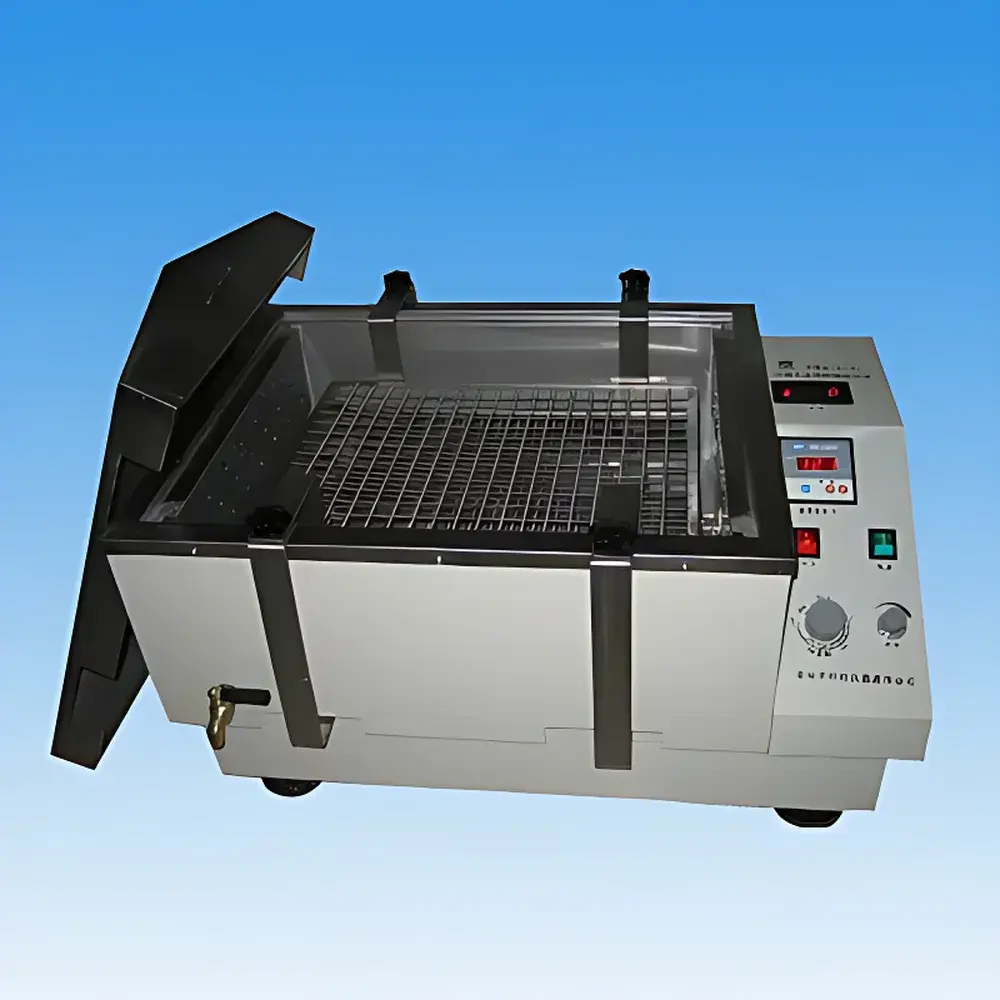
Beifen Sanpu THZ-82(A) Orbital Water Bath Incubator Shaker
| Brand | Beifen Sanpu |
|---|---|
| Origin | Hebei, China |
| Manufacturer Type | Direct Manufacturer |
| Instrument Type | Orbital Water Bath Incubator Shaker |
| Timer Range | 5–120 min |
| Oscillation Frequency | 0–300 rpm |
| Oscillation Amplitude | 20 mm |
| Temperature Range | Ambient to 100 °C |
| Temperature Accuracy | ±0.5 °C |
| Heating Power | 1880 W |
| Tray Dimensions | 39 × 29 cm |
| Overall Dimensions | 700 × 550 × 480 mm |
| Power Supply | AC 220 V, 50 Hz |
| Chamber Material | Stainless Steel (304) |
| Drive Mechanism | Belt-driven orbital motion with mechanical speed regulation |
| Timer Function | Mechanical dial timer with “continuous” position |
Overview
The Beifen Sanpu THZ-82(A) Orbital Water Bath Incubator Shaker is an integrated benchtop instrument engineered for precise temperature-controlled agitation of liquid-phase biological samples in research, teaching, and quality control environments. It combines a thermostatically regulated water bath with a mechanically driven orbital shaker platform—operating on the principle of uniform circular motion (orbital oscillation) at adjustable rotational speeds—to ensure homogeneous heat transfer and gentle yet effective mixing. Unlike air-jacketed incubators or dry-block shakers, this design provides superior thermal stability and minimal sample evaporation, making it especially suitable for long-duration microbial growth assays, enzyme kinetics studies, solubility testing, and cell suspension maintenance where both thermal uniformity and mechanical consistency are critical. The unit operates within a calibrated temperature range from ambient to 100 °C, with digital temperature control delivering ±0.5 °C accuracy across the working volume, verified per ASTM E2209-21 guidelines for laboratory thermal equipment performance verification.
Key Features
- Stainless steel (304) water bath chamber and tray—resistant to corrosion from aqueous buffers, saline solutions, and mild reagents commonly used in microbiology and molecular biology workflows.
- Orbital motion drive system with belt transmission and mechanical speed adjustment—enabling smooth, low-vibration operation from 0 to 300 rpm without electronic noise or electromagnetic interference.
- Digital PID temperature controller with LED display—providing real-time monitoring and automatic stabilization; sensor calibration traceable to NIST-traceable reference standards.
- Adjustable mechanical timer (5–120 minutes) with continuous (“ON”) mode—designed for reproducible experimental timing under GLP-compliant protocols.
- Spring-loaded universal bottle holder—accommodates multiple tube formats (e.g., 15 mL, 50 mL conical tubes, culture flasks) while maintaining balanced load distribution during oscillation.
- High-power heating element (1880 W) with overheat protection cutoff—ensuring rapid thermal recovery after sample loading and safe operation under sustained high-temperature conditions.
- Low-splash orbital motion profile—minimizing surface turbulence and condensation-induced contamination risk, particularly important for sealed culture vessels and sensitive protein solutions.
Sample Compatibility & Compliance
The THZ-82(A) supports standard laboratory consumables including glass and polypropylene culture flasks (up to 2 L), centrifuge tubes, and multi-well plates placed on optional adapter platforms. Its water bath configuration complies with ISO 13408-2:2018 (aseptic processing—environmental monitoring requirements) when operated in cleanroom-adjacent labs. While not certified for IEC 61010-1 safety marking outside China, its electrical architecture conforms to GB 4793.1–2019 (equivalent to IEC 61010-1 Ed.3), and thermal performance meets the repeatability criteria outlined in USP for incubator qualification. For GMP-regulated applications, users may implement supplementary validation protocols—including temperature mapping (per WHO TRS 961 Annex 11), speed verification using calibrated tachometers, and audit trail documentation via external loggers—to satisfy FDA 21 CFR Part 11 data integrity expectations.
Software & Data Management
This model operates as a standalone analog-digital hybrid instrument with no embedded microprocessor or network interface. All operational parameters—including setpoint temperature, timer duration, and speed setting—are manually configured via front-panel dials and switches. For laboratories requiring electronic data capture, integration is supported through third-party USB or RS-232 temperature/data loggers (e.g., Omega OM-DAQPRO-5300 series), which can record bath temperature and elapsed time at user-defined intervals. The absence of firmware eliminates cybersecurity vulnerabilities associated with connected lab instruments, aligning with NIH and EU Horizon security guidelines for legacy-compatible infrastructure in core facilities.
Applications
- Microbial cultivation (E. coli, yeast, Bacillus spp.) under controlled thermal and agitation conditions for OD600-based growth curve analysis.
- Antibiotic susceptibility testing (AST) using broth microdilution methods per CLSI M07-A11 standards.
- Protein solubilization and ligand-binding equilibration in buffer systems prior to HPLC or SPR analysis.
- Environmental water sample enrichment for coliform detection (APHA 9221B).
- Cell line passaging and suspension maintenance for bioreactor seed train preparation.
- Standardized extraction protocols in pharmacognosy and natural product chemistry (e.g., Soxhlet-assisted maceration).
- Calibration support for viscometers and densitometers requiring thermostated fluid baths.
FAQ
What is the maximum recommended fill level for the water bath?
The water level must exceed the height of the immersed portion of sample containers by at least 10 mm but remain ≥20 mm below the top rim of the bath chamber to prevent overflow during oscillation.
Can this unit be used for sterile applications?
It is not autoclavable or ISO Class 5-certified; however, the stainless steel chamber may be sterilized between runs using 70% ethanol followed by UV-C exposure (254 nm, 30 min) if housed in a laminar flow hood.
Is speed calibration required before first use?
Yes—users should verify actual rpm using a contactless optical tachometer against the dial setting at three points (100, 200, and 300 rpm) and document deviations in their instrument logbook per ISO/IEC 17025:2017 clause 6.4.10.
Does the THZ-82(A) support external temperature probes?
No—the built-in Pt100 sensor is fixed and non-removable; for sample-core temperature monitoring, insert a separate calibrated probe into a dedicated port in the bath medium.
What maintenance schedule is recommended for GLP compliance?
Perform quarterly visual inspection of water quality and heater element integrity; lubricate drive bearings every six months with calcium-sodium grease (NLGI #1); replace the mechanical timer dial spring if hysteresis exceeds ±30 seconds after 10,000 actuations.





