
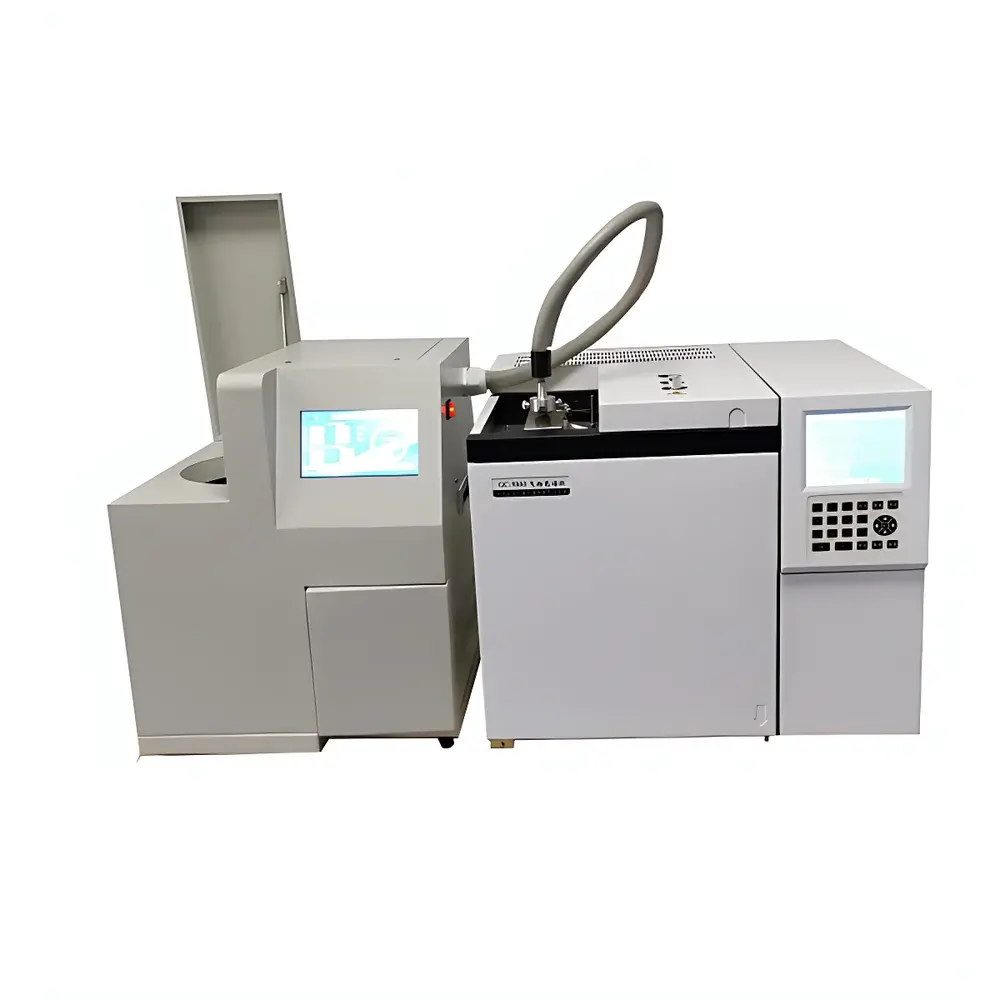
Beifen Sanpu AHS9-20A PLUS Fully Automated Static Headspace Sampler
| Brand | Beifen Sanpu |
|---|---|
| Origin | Beijing, China |
| Manufacturer Type | Direct Manufacturer |
| Regional Category | Domestic (China) |
| Model | AHS9-20A PLUS |
| Instrument Type | Static Headspace Sampler |
| Automation Level | Fully Automatic |
| Vial Heating Range | Ambient to 200 °C (1 °C increment) |
| Valve Temperature Control Range | 40–220 °C (±1 °C accuracy) |
| Sample Loop Volume | 1 mL |
| Sample Capacity | 20-position carousel |
| Compatible Vial Sizes | 10 mL or 20 mL |
Overview
The Beifen Sanpu AHS9-20A PLUS is a fully automated static headspace sampler engineered for precise, reproducible quantification of residual ethylene oxide (EO) in medical devices following sterilization. It operates on the principle of equilibrium headspace gas-phase extraction: solid or liquid samples are sealed in vials, heated to a defined temperature, and allowed to reach vapor-phase equilibrium; the headspace gas above the sample is then transferred via a thermostatted valve and quantitative loop into a gas chromatograph (GC) for separation and detection. This method eliminates matrix interference from non-volatile components and ensures high sensitivity for EO—typically detectable at sub-ppm levels when paired with flame ionization detection (FID) or mass spectrometry (MS). Designed specifically to support regulatory compliance in biomedical manufacturing, the AHS9-20A PLUS integrates seamlessly with GC systems—including Shimadzu GC-2010, Agilent 7890/8890, and Thermo ISQ series—to execute validated EO residue testing protocols aligned with ISO 10993-7:2008 and GB/T 16886.7–2001.
Key Features
- Fully automated 20-position carousel with programmable vial selection and randomized sequence execution for enhanced throughput and reduced analyst bias
- Precise dual-zone thermal control: independent heating of sample vials (ambient to 200 °C, ±0.5 °C uniformity) and injection valve (40–220 °C, ±1 °C stability), minimizing carryover and ensuring consistent vapor-phase composition
- 1 mL fixed-volume quantitative loop with inert, low-dead-volume pathway—optimized for trace-level EO analysis and compatible with standard GC split/splitless injectors
- Robust pneumatic architecture with pressure-regulated carrier gas delivery and leak-tight septum-piercing needle mechanism for >10,000 repeat injections without performance drift
- Intuitive touchscreen interface supporting method storage, audit trail logging, and password-protected user roles—facilitating 21 CFR Part 11–compliant operation when integrated with validated chromatography data systems (CDS)
Sample Compatibility & Compliance
The AHS9-20A PLUS accommodates both 10 mL and 20 mL crimp-top headspace vials, enabling direct analysis of diverse sample formats including polymeric device components, hydrophilic gels, sponges, and lyophilized pharmaceuticals. Its design supports aqueous dissolution protocols per Chinese Pharmacopoeia (ChP) Volume II (2020 Edition), particularly methods referenced in monographs for polysorbate 80 (Tween 80) and gelatin capsules. The system meets essential requirements for GLP/GMP environments: temperature calibration certificates traceable to NIST standards, configurable run logs with electronic signatures, and hardware-level interlocks preventing valve actuation outside validated thermal ranges. It is routinely deployed in EO residue validation studies satisfying ISO 10993-7, ASTM F1980, and FDA Guidance for Industry on Sterile Device Labeling.
Software & Data Management
Controlled via embedded firmware with USB and RS-232 connectivity, the AHS9-20A PLUS synchronizes acquisition timing and parameter logging with major GC data systems—including OpenLab CDS, Chromeleon, and GCsolution—enabling end-to-end audit trails. All method parameters (vial temp, equilibration time, pressurization pressure, loop fill time, injection volume) are stored with timestamps and operator IDs. Raw event logs—including vial position, valve cycle count, thermal deviation alerts, and error codes—are exportable as CSV for internal QA review or regulatory submission. Optional integration with LIMS allows automated sample ID propagation and result flagging against pre-defined acceptance criteria (e.g., ≤10 µg/g EO for Class III devices).
Applications
- Quantitative EO residue testing in ethylene oxide-sterilized medical devices (catheters, syringes, surgical drapes, implant packaging)
- Stability-indicating analysis of EO degradation products (ethylene glycol, ethylene chlorohydrin) under accelerated aging conditions
- Method development and transfer for pharmacopeial compliance (ChP, USP , EP 2.2.48)
- Batch release testing per ISO 11135–1:2014 Annex D and manufacturer-specific validation protocols
- Residual solvent analysis in pharmaceutical excipients (e.g., PEG, polysorbates) and biopolymer scaffolds
FAQ
What sample preparation is required for EO residue testing using this headspace sampler?
Samples are typically cut into small fragments (≤5 mm), weighed (1.0 g recommended), placed in a 20 mL headspace vial, and rehydrated with 5 mL ultrapure water. Vials are sealed immediately and equilibrated at 60 °C for 40 minutes prior to injection.
Does the AHS9-20A PLUS support dynamic headspace or purge-and-trap configurations?
No—it is configured exclusively for static headspace analysis. Dynamic modes require separate instrumentation with gas flow controllers and cold traps.
Can it be used with cryogenic focusing or mass spectrometric detection?
Yes, provided the GC inlet and detector support the required transfer line temperatures and flow rates; the 1 mL loop and valve thermal stability ensure compatibility with GC-MS interfaces operating up to 220 °C.
How is system suitability verified during routine operation?
Daily verification includes repeated injection of a mid-level EO standard (e.g., 2 µg/mL), confirming retention time stability (±0.02 min), peak area RSD ≤3%, and absence of ghost peaks indicative of carryover.
Is third-party IQ/OQ/PQ documentation available?
Yes—Beifen Sanpu provides vendor-qualified installation and operational qualification templates compliant with ISO/IEC 17025 and GAMP 5, including temperature mapping reports and mechanical function tests.






