
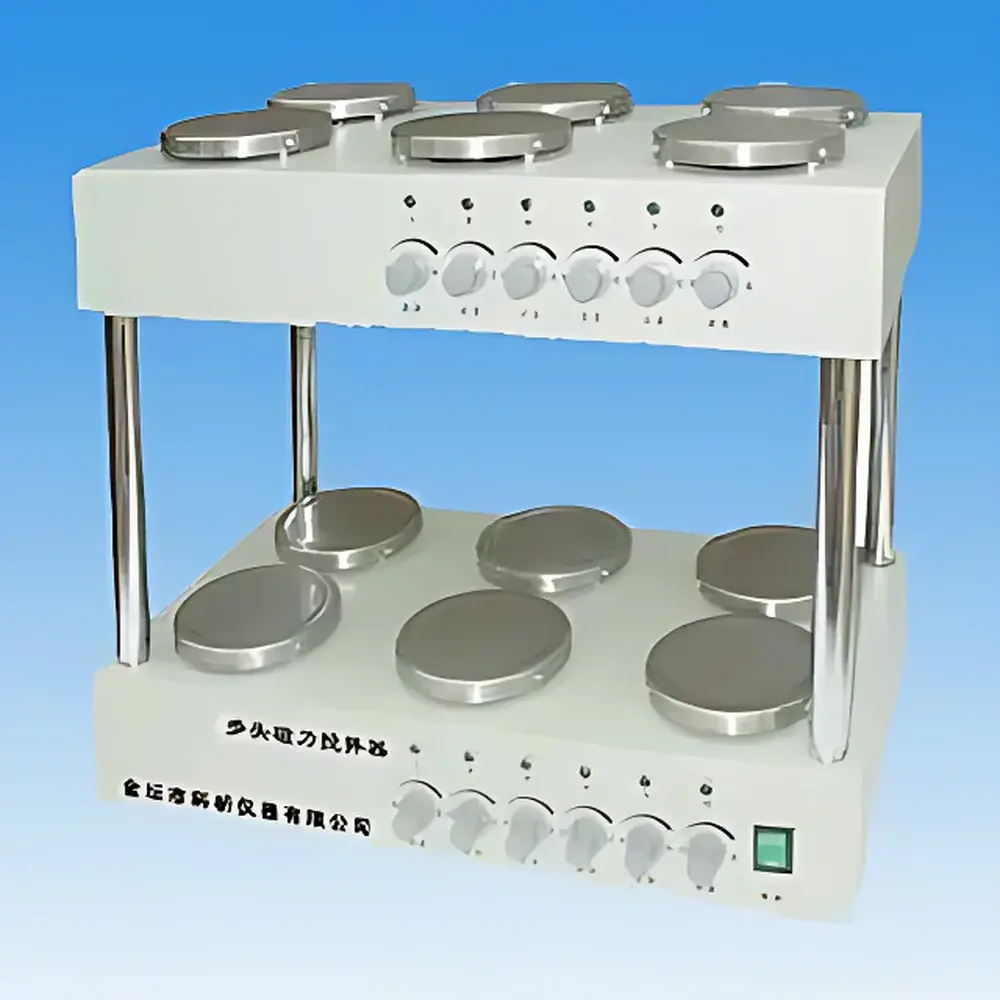
Beifen Sanpu JB-12 Dual-Deck Magnetic Stirrer
| Brand | Beifen Sanpu |
|---|---|
| Model | JB-12 |
| Type | Dual-Deck Magnetic Stirrer |
| Power Supply | 220 V AC, 50 Hz |
| Motor Speed Range | 0–2400 rpm (infinitely variable) |
| Number of Stations | 12 (6 per deck, independently controllable) |
| Motor Power | 20 W × 12 stations |
| Heating Power | 150 W × 12 stations |
| Heating Performance | ~80 °C in 8 min for 100 mL water at 20 °C ambient |
| Construction | Cold-rolled steel housing with high-temperature epoxy powder coating |
| Compliance | CE-marked design principles |
Overview
The Beifen Sanpu JB-12 Dual-Deck Magnetic Stirrer is an engineered solution for high-throughput sample preparation in analytical, quality control, and research laboratories. Designed around the principle of magnetic coupling—where a rotating permanent magnet beneath the work surface induces torque on a PTFE-coated stir bar immersed in liquid—the JB-12 delivers precise, contactless agitation across twelve independent positions. Its dual-deck architecture (two staggered rows of six stations each) enables spatially efficient use of benchtop space while maintaining full operational autonomy per station. This configuration supports parallel processing of heterogeneous sample sets—such as pH-adjusted buffers, dissolution media, or reagent dilutions—without cross-contamination risk. The unit integrates both stirring and resistive heating functions within a single robust chassis, eliminating the need for separate hotplates and reducing thermal drift during extended protocols.
Key Features
- Dual-deck layout with 12 individually addressable stations—6 on upper deck, 6 on lower deck—each equipped with dedicated speed and heating controls
- Brushless permanent-magnet DC motors rated for >10,000 hours continuous operation at no-load; engineered for low acoustic emission (<45 dB(A)) and minimal mechanical vibration
- Infinitely variable speed control (0–2400 rpm) with soft-start circuitry to prevent stir bar ejection during acceleration
- Independent 150 W resistive heating elements per station, optimized for rapid thermal response in volumes from 10 mL to 500 mL
- Cold-rolled steel enclosure fabricated via precision spot welding and finished with industrial-grade epoxy powder coating for chemical resistance and long-term structural integrity
- Integrated safety architecture: ground-fault protection, over-temperature cutoff (auto-shutdown at ≥120 °C surface temperature), and polarity-sensitive power input
Sample Compatibility & Compliance
The JB-12 accommodates standard laboratory glassware including borosilicate beakers (50–500 mL), Erlenmeyer flasks, and crystallizing dishes up to 90 mm base diameter. Stir bar compatibility includes standard PTFE-encapsulated magnets (5–30 mm length), supplied with ten 25 mm rods per unit. The device meets electromagnetic compatibility (EMC) requirements aligned with IEC 61326-1 for laboratory equipment and conforms to basic safety principles referenced in IEC 61010-1. While not certified for hazardous location use, its construction and grounding provisions support deployment in ISO/IEC 17025-accredited testing laboratories. When used with validated SOPs—including pre-use verification of voltage stability (220 V ±10 V), stir bar centering, and periodic calibration of temperature sensors—it satisfies documentation requirements for GLP and internal QA audits.
Software & Data Management
The JB-12 operates as a standalone analog instrument without embedded firmware or digital connectivity. All adjustments—speed, heating setpoint, and station activation—are performed manually via front-panel rotary dials and toggle switches. This architecture eliminates software validation overhead and ensures deterministic behavior under regulated workflows. For traceability, users are advised to record operational parameters (e.g., rpm, duration, target temperature) in lab notebooks or LIMS-integrated electronic records. Optional external data loggers (e.g., USB thermocouple interfaces) may be deployed to capture real-time temperature profiles per station, supporting 21 CFR Part 11-compliant audit trails when paired with appropriate electronic signature controls.
Applications
- Parallel dissolution testing per USP and Ph. Eur. 2.9.3 protocols using standardized vessels and sink conditions
- Buffer equilibration and pH stabilization prior to HPLC or IC analysis
- Homogenization of suspensions for particle size distribution studies (e.g., ISO 13320 laser diffraction sample prep)
- Accelerated stability trials requiring controlled thermal agitation of excipient blends
- Preparation of calibration standards across concentration gradients in environmental and clinical chemistry labs
- Cell culture media warming and mixing under aseptic hood conditions (non-sterile unit; requires post-installation decontamination)
FAQ
What is the maximum recommended operating time at high speed?
Continuous operation at speeds above 1800 rpm is limited to 4 hours per session to maintain motor thermal stability and bearing longevity.
Can the JB-12 be used with corrosive solvents such as concentrated acids or organic halides?
The PTFE-coated stir bars provided are chemically resistant to most common laboratory solvents; however, direct exposure of the heated ceramic plate surface to aggressive agents (e.g., fuming nitric acid, bromine) is prohibited and voids warranty.
Is temperature calibration required before use?
Yes—users must verify actual bath temperature against a NIST-traceable thermometer at least once per shift when performing temperature-critical applications; the unit’s analog heater lacks built-in PID feedback or digital readout.
Does the JB-12 support external timer integration?
No native interface exists, but third-party programmable relay modules (e.g., Omron H3CR-F8) can be wired in series with the main power line to enforce timed duty cycles.
What maintenance is recommended for long-term reliability?
Monthly inspection of stir bar integrity, biannual cleaning of ventilation grilles with dry compressed air, and annual verification of grounding continuity using a calibrated earth bond tester (≤0.1 Ω resistance).



