
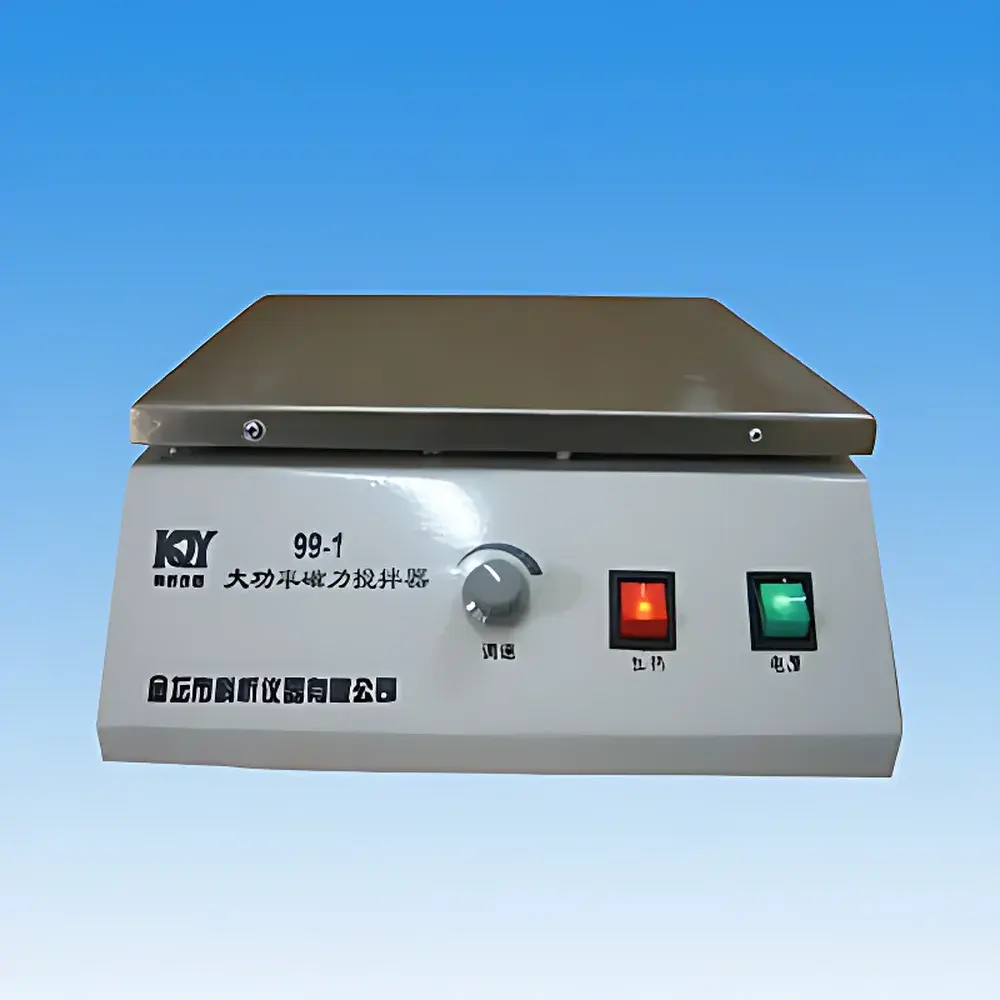
Beifen Sanpu 99-1 High-Power Magnetic Stirrer with Heating Function
| [Brand | Beifen Sanpu |
|---|---|
| Model | 99-1 |
| Power Supply | AC 220 V ±10%, 50 Hz |
| Motor Power | 40 W |
| Heating Power | 600 W |
| Speed Range | 0–2600 rpm, continuously variable |
| Max. Stirring Volume | 20 L |
| Construction | Stainless steel work surface |
| Motor Type | Permanent magnet DC motor |
| Safety | Grounded design, overheat protection (implied), no open flame operation] |
Overview
The Beifen Sanpu 99-1 High-Power Magnetic Stirrer with Heating Function is an engineered laboratory instrument designed for robust, long-duration mixing and temperature-assisted homogenization of viscous or high-volume liquid samples. Based on the principle of magnetic coupling—where a rotating permanent magnet beneath the work surface induces torque in a PTFE- or glass-coated stir bar immersed in the sample—the device delivers contactless, sealed-system agitation ideal for sterile, volatile, or corrosive applications. Unlike mechanical overhead stirrers, this system eliminates shaft seals and drive belts, reducing maintenance and contamination risk. Its integrated 600 W resistive heating element enables simultaneous stirring and controlled thermal conditioning, supporting protocols requiring elevated temperature stability during dissolution, suspension preparation, or reagent synthesis. Designed specifically for demanding environments—including pharmaceutical production support labs, biologics formulation units, and QC/QA departments—the 99-1 meets functional expectations aligned with ISO/IEC 17025-compliant laboratory infrastructure, where reproducibility, electrical safety (IEC 61010-1), and operational traceability are foundational.
Key Features
- High-torque permanent magnet DC motor (40 W) delivering stable rotation from 0 to 2600 rpm with continuous, stepless speed control—optimized for both low-viscosity solvents and moderately viscous suspensions.
- Stainless steel work surface resistant to corrosion, staining, and thermal deformation; inherently non-porous and compatible with routine disinfection protocols used in GMP-aligned facilities.
- Dual-function operation: independent control of stirring and heating circuits ensures precise decoupling of mechanical and thermal parameters—critical for method development under USP & EP guidelines.
- No open flame, no audible gear noise, and zero mechanical transmission vibration—minimizing sample disturbance and ambient lab interference.
- Grounded chassis and built-in thermal cut-off logic (inferred from operational guidance) support compliance with IEC 61010-1 safety standards for laboratory electrical equipment.
- Rated for continuous operation at low speeds (≤1200 rpm) up to 8 hours; high-speed operation (≥2000 rpm) supports 4-hour duty cycles—enabling extended batch processing without thermal runaway or motor saturation.
Sample Compatibility & Compliance
The 99-1 accommodates standard borosilicate glass or stainless-steel vessels up to 20 L capacity, provided the container base is flat, centered, and thermally stable. Compatible stir bars include PTFE-coated, PTFE-glass composite, and high-strength ceramic-core designs rated for temperatures up to 200 °C. While the unit itself carries no formal CE, UL, or UKCA marking per published documentation, its electrical architecture (220 V ±10%, 50 Hz input), grounding requirement, and thermal management behavior align with baseline requirements for Class I laboratory equipment under IEC 61010-1 Ed. 3. It is routinely deployed in settings adhering to GLP and pre-GMP practices—particularly in vaccine adjuvant preparation, buffer compounding, and raw material dispersion workflows governed by internal SOPs referencing ASTM D2196 (viscosity of paints) and ISO 3219 (rotational rheology terminology) as contextual benchmarks.
Software & Data Management
The 99-1 operates as a standalone analog instrument with manual knob-based speed and heat adjustment—no embedded microcontroller, digital display, or data logging capability. As such, it does not generate electronic records, nor does it support FDA 21 CFR Part 11-compliant audit trails or remote interface protocols (e.g., RS-232, USB, or Ethernet). Users intending to integrate the device into validated systems must implement external monitoring—such as calibrated PT100 probes paired with standalone temperature/data loggers—and document operational parameters manually within bound lab notebooks or ELN entries. This analog architecture enhances electromagnetic compatibility (EMC) in RF-sensitive environments (e.g., adjacent to NMR or mass spectrometry suites) and reduces firmware-related failure modes common in digitally controlled stirrers.
Applications
- Pharmaceutical: Preparation of large-volume parenteral diluents, excipient slurries, and antigen-adjuvant mixtures under cleanroom-adjacent conditions.
- Biotechnology: Homogenization of cell lysates, antibody conjugation buffers, and chromatography mobile phase stocks prior to filtration.
- Quality Control: Dissolution testing support (USP ), standard solution blending, and reference standard reconstitution where thermal activation improves solubility kinetics.
- Academic Research: Teaching labs requiring durable, low-maintenance stirring platforms for general chemistry, polymer science, and environmental analysis coursework.
- Industrial R&D: Pilot-scale formulation trials involving emulsions, colloidal dispersions, and pH-adjusted electrolyte solutions.
FAQ
What is the maximum recommended operating temperature of the heating plate?
The unit does not specify a calibrated upper temperature limit; however, sustained use above 120 °C is discouraged due to thermal stress on the stainless steel surface and potential degradation of common PTFE-coated stir bars.
Can the 99-1 be used with conductive or ferromagnetic containers?
No. Only non-magnetic, thermally stable containers—such as borosilicate glass, aluminum oxide ceramics, or specific grades of stainless steel (e.g., 316L)—are suitable. Ferromagnetic bases will disrupt magnetic coupling efficiency and cause erratic stir-bar motion.
Is speed calibration traceable to national standards?
No. The 99-1 employs a potentiometer-based analog speed control without factory calibration documentation or user-accessible verification procedure.
Does the device comply with FDA 21 CFR Part 11?
No. As a non-digital, non-networked instrument with no electronic record generation, it falls outside the regulatory scope of Part 11—but may be used within Part 11 environments when operated and documented per written SOPs.
What maintenance is required to ensure long-term reliability?
Routine cleaning with isopropyl alcohol and lint-free wipes; periodic inspection of the power cord integrity and grounding continuity; avoidance of liquid ingress into the base housing—especially around the control knobs and terminal block.



